
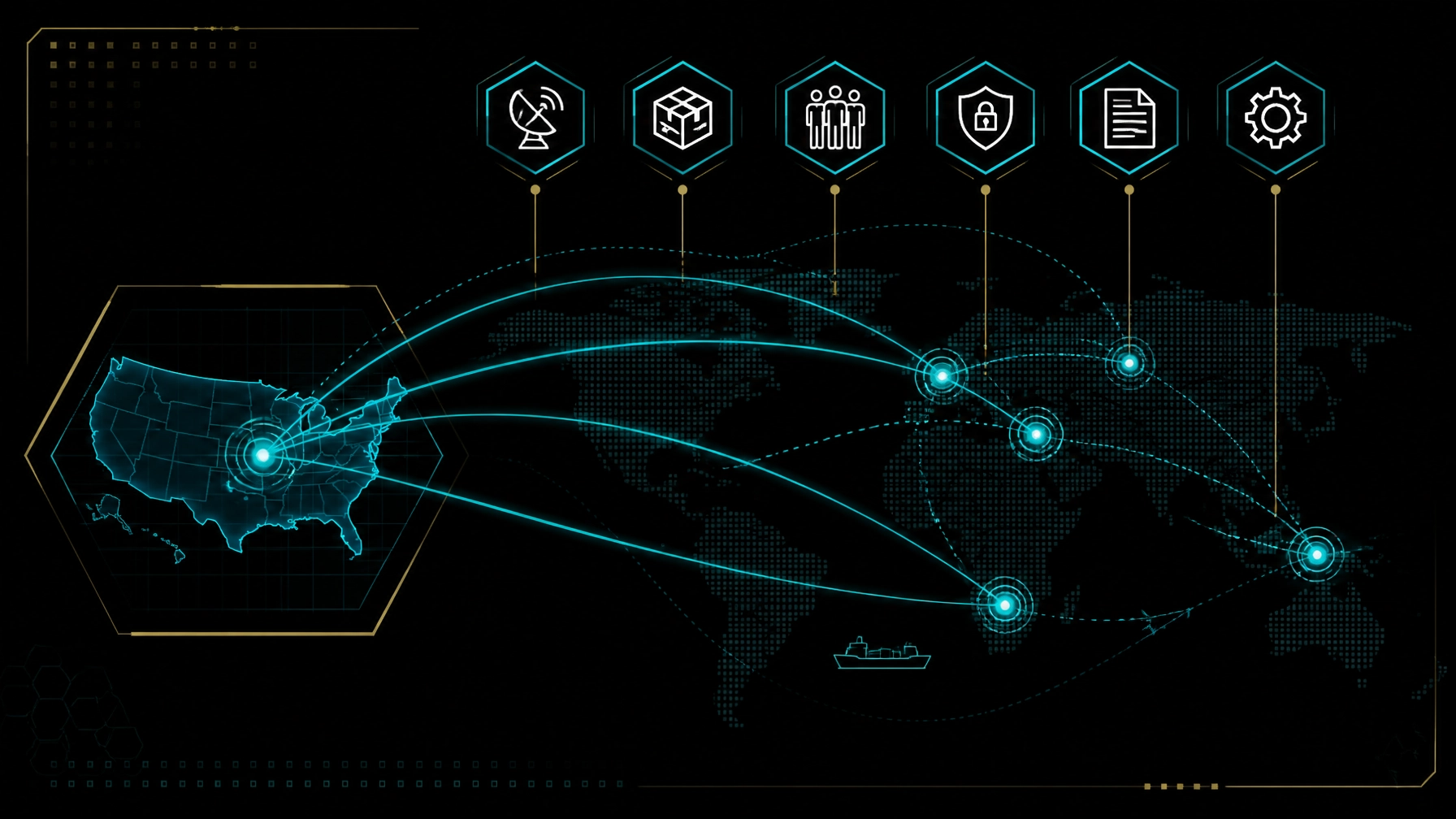
Throughout history, successful missions have depended on more than objectives. They have depended on planning, supply lines, communications, disciplined personnel, and the ability to sustain operations after the first deployment. Overseas business and government support follows the same rule.
A company may have a strong product, capable technical staff, or an attractive government-facing service. That is not enough. To perform effectively outside the continental United States, the company must build the business infrastructure behind the mission.
This is the difference between being interested in OCONUS work and being ready to support OCONUS work.
For planning purposes, CONUS refers to operations within the continental United States. OCONUS refers to performance outside that domestic operating environment. OCONUS work may involve different transportation requirements, regulatory considerations, communications limitations, staffing models, partner relationships, documentation, and sustainment responsibilities.
At The Infinity Group, we approach this challenge as Business Development Architects. We connect strategy, execution, capital planning, government contracting, and strategic partnerships so that your capability can move from concept to dependable performance.

Readiness Begins With the Mission Requirement
A successful overseas support effort starts with a clear definition of the mission.
Companies need to identify the customer, the operating environment, the desired outcome, the performance period, the users, the equipment, the communications requirements, the support boundaries, and the expected reporting structure. We help organize those needs into a practical operating concept.
The first questions should include:
- What capability must be delivered?
- Who will use it?
- What must be available on day one?
- What can be delivered in phases?
- Which resources are customer-provided?
- Which responsibilities remain with the contractor?
- What technical, financial, staffing, and schedule assumptions affect performance?
- What information must be controlled through approved channels?
The answers shape the technical solution, the staffing model, the logistics plan, the pricing structure, the partner strategy, and the capital required to execute.
A vague requirement creates downstream friction. A defined requirement creates a roadmap.
Deployment Planning Is a Business Function
Deployment planning is not merely a travel exercise. It is a business function connecting personnel, equipment, documents, transportation, funding, communications, security procedures, and customer coordination.
A deployment plan should address:
- Personnel readiness: roles, qualifications, rotations, training, travel documents, and points of contact.
- Equipment readiness: bill of materials, staging, configuration, inspection, spares, packaging, and replacement planning.
- Movement planning: shipping routes, receiving procedures, customs coordination, delivery schedules, and local support.
- Communications: primary and alternate connectivity, support escalation, user access, and outage procedures.
- Financial readiness: mobilization costs, working capital, insurance considerations, subcontractor payments, and contingency reserves.
- Documentation: statements of work, acceptance criteria, inventory records, test results, incident procedures, and sustainment records.
This is where many otherwise capable companies encounter difficulty. They can perform the technical work, but they have not planned for the cost and coordination required to deliver it overseas.
We help companies build a plan that is operationally realistic and financially supportable.
Communications Must Be Designed for the Environment
Communications infrastructure is the connective tissue of an overseas mission. It may include wired networks, wireless systems, broadband, satellite connectivity, radio systems, remote access, cloud services, or a combination of approved technologies.
The correct solution depends on the mission and location. No single platform is automatically appropriate for every environment.
A practical communications plan should consider:
- Bandwidth and latency;
- Redundancy and failover;
- Power and environmental conditions;
- Equipment maintenance;
- User authentication and access control;
- Cybersecurity responsibilities;
- Remote technical support;
- Configuration management;
- Local infrastructure limitations; and
- Training and operational handoff.
Connectivity alone is not readiness. A system must be configured, tested, documented, secured, supported, and maintainable.
The JPI Worldwide Insights article on civilian contractors in Latin America provides useful context on how communications, technology, logistics, staffing, and sustainment combine to support overseas government missions.
Logistics Determines Whether Capability Arrives on Time
Equipment that cannot reach the customer is not an operational capability.
OCONUS logistics may involve procurement, inventory control, packaging, shipping, customs documentation, freight coordination, local delivery, staging, installation, replacement parts, and return movement. Each step should have an owner.
Companies should also evaluate whether their proposed movement involves export controls, sanctions screening, host-country requirements, or contract-specific documentation. General assumptions are not enough. The item, destination, end user, route, transaction, and applicable authorization should be reviewed through the responsible compliance and legal channels.
JPI Worldwide’s related material on OFAC, ITAR, and customs considerations illustrates why technical deployment and movement compliance must be planned together.
The Infinity Group does not replace qualified legal, export-control, insurance, or customs professionals. We do help identify where those functions belong in the overall business plan, budget, schedule, and partner structure.

Technical Staffing Must Match the Operating Model
Overseas work requires more than finding technically qualified personnel. It requires matching people to the environment, schedule, support model, and responsibility structure.
Your staffing plan may require:
- Network and communications technicians;
- Systems engineers;
- Cybersecurity personnel;
- Field service specialists;
- Logistics coordinators;
- Project and program managers;
- Trainers and documentation specialists;
- Local coordination resources;
- Help desk or remote support personnel; and
- Replacement or surge personnel.
Staffing must also account for rotations, travel time, rest periods, knowledge transfer, backup coverage, and the possibility that a person may become unavailable. A plan that depends on one individual is not a sustainment plan.
JPI Worldwide is a relevant resource and potential strategic partner for companies and prime contractors seeking communications, network infrastructure, cybersecurity, technical staffing, logistics, field deployment, and sustainment capabilities. Its material should be reviewed directly to confirm current capabilities, availability, and scope.
See JPI’s material on what primes expect from subcontractors and technical infrastructure in OCONUS environments.
Documentation and Sustainment Protect the Investment
A mission is not complete when the equipment is installed or the first invoice is submitted.
The customer, prime contractor, and support team need records that show what was delivered, how it was tested, who accepted it, what remains open, and how the capability will be maintained.
A useful documentation package may include:
- Approved requirements;
- Equipment and asset inventories;
- Configuration baselines;
- Test and acceptance records;
- Training records;
- Maintenance schedules;
- Spare-parts plans;
- Contact and escalation procedures;
- Change-control records;
- Incident and corrective-action records;
- Invoices and supporting cost documentation; and
- Closeout and handoff materials.
Documentation also supports business development. A company that can demonstrate disciplined performance is better positioned for follow-on work, prime-contractor relationships, investment discussions, and expansion into additional markets.
Sustainment should be priced and planned from the beginning. It may require recurring technical labor, replacement equipment, software or service renewals, transportation, local coordination, cybersecurity reviews, and periodic training.
Deployment is an event. Sustainment is the business model.

Partner Coordination Creates the Full Capability
Most companies cannot provide every required function alone. That is not a weakness. It is the reason strategic partnerships matter.
A strong partner structure may include:
- A prime contractor;
- Technical and engineering specialists;
- Logistics providers;
- Local commercial resources;
- Security and compliance professionals;
- Insurance advisors;
- Financial partners;
- Training organizations; and
- Government-facing business development support.
The key is to define responsibilities before performance begins. Partners should understand who owns customer communication, pricing, staffing, equipment, documentation, risk escalation, and sustainment.
The Infinity Group helps build that structure. We identify capability gaps, evaluate strategic partners, shape subcontracting approaches, organize capital needs, strengthen proposal positioning, and connect execution requirements to broader business development goals.
Our services support federal agency consulting, Congressional consultation, business-to-government guidance, contract proposal strategy, startup funding development, and strategic execution. Our industry experience spans public-sector, government-facing, startup, technology, investment, and specialized commercial environments.
How The Infinity Group Supports OCONUS Readiness
OCONUS readiness requires a complete business architecture:
requirement → strategy → partners → capital → deployment → performance → sustainment.
We can help you:
- Define and clarify the mission requirement;
- Assess CONUS and OCONUS execution differences;
- Build a deployment and sustainment roadmap;
- Identify technical, logistics, staffing, and documentation needs;
- Develop a realistic capital and working-capital plan;
- Prepare for prime-contractor discussions;
- Strengthen proposal and subcontract positioning;
- Identify qualified resources and strategic partners;
- Coordinate government-facing communications; and
- Move the organization from planning into disciplined execution.
We will not represent that a company has a contract, clearance, authorization, or capability that it does not possess. We will not substitute general business consulting for legal, insurance, export-control, security, or contracting advice. We will help place the right professional functions into the right part of the plan.
Build the Infrastructure Before the Opportunity Arrives
Overseas mission support is won before deployment. It is won through preparation, credible partners, documented processes, adequate capital, disciplined staffing, and clear responsibility.
If your company is pursuing government or commercial work outside the United States, The Infinity Group can help you assess the opportunity and build the infrastructure behind it.
Contact us at connect@infinity-us.com or through our contact page to discuss your mission, timeline, partners, capital needs, and next steps.
This article is provided for general informational purposes. It does not provide legal advice, export-control advice, insurance advice, security authorization, or contract-specific guidance. Do not send classified information, Controlled Unclassified Information, export-controlled technical data, credentials, or other sensitive information through ordinary email or public contact forms.
Partner Reading and Sources
- JPI Worldwide: Civilian Contractors in Latin America: The Infrastructure Behind U.S. Mission Support
- JPI Worldwide: 5 Steps to Deploy Secure Network Infrastructure in an OCONUS War Zone
- JPI Worldwide: OFAC, ITAR, and Customs
- JPI Worldwide: What Primes Really Expect From a Subcontractor
- JPI Worldwide: FAR 52.225-19 and Civilian Contractor Personnel
- Federal Acquisition Regulation 52.225-19
- The Infinity Group Services
- The Infinity Group Industries
- The Infinity Group About
Comments and replies: Disabled
