Author: Social Media

  • Subpoena Season: What Committee Oversight Does to a Federal Contractor

    Subpoena Season: What Committee Oversight Does to a Federal Contractor

    Article 2 of 7 in The Infinity Group Insights post-election series

    Imagine you are a CEO, and a document request arrives from a congressional committee. It asks for contracts, internal communications, change orders, and names of people who made key decisions. Your agency contact may know about the request. But the committee is not your customer, and it is not asking the same questions as your contracting officer.

    That distinction will matter in the 120th Congress. Democrats won at least 257 House seats and 56 Senate seats in the November 3 midterms. The new Congress convenes January 3, 2027. President Trump retains the veto through January 2029, and overriding it would require roughly 290 House votes and 67 Senate votes.

    The majority’s fastest lever is not legislation. It is the hearing room. A committee can investigate, compel records and testimony, and make a contractor’s work part of a public debate. Most contractors are structurally unprepared for that kind of scrutiny.

    Staffers and an executive seated at a congressional hearing table in a Washington committee room

    Who is expected to lead oversight

    Leadership assignments remain tentatively, subject to change. Robert Garcia (D-CA), tentatively, subject to change, is expected to chair House Oversight and Accountability; he has named corporate corruption and government contracting as leading targets. Richard Blumenthal (D-CT), tentatively, subject to change, is expected to chair the Senate Permanent Subcommittee on Investigations. Ron Wyden (D-OR), tentatively, subject to change, is expected to chair Senate Finance; his one-word response to the result was “Subpoenas.”

    Elizabeth Warren (D-MA), tentatively, subject to change, is expected to lead Senate Banking; Bernie Sanders (I-VT), tentatively, subject to change, Senate HELP; Richard Neal (D-MA), tentatively, subject to change, House Ways and Means; and Rick Larsen (D-WA), tentatively, subject to change, House Transportation and Infrastructure. Hakeem Jeffries (D-NY), tentatively, subject to change, is likely to become Speaker.

    This is not a list of guaranteed investigations. It is a map of where oversight authority and stated priorities may converge. Your contract can come under scrutiny even when your company is not accused of wrongdoing. A project’s performance, a funding decision, or an agency’s explanation can put the vendor in the frame.

    What a committee can actually compel

    Congressional committees have subpoena power. They can compel documents and testimony within the scope of an inquiry. A request may reach beyond the final contract: bids, requirement development, communications with agency staff, subcontractor records, invoices, performance reports, change orders, and internal decisions can all become relevant.

    The practical point is simple: the award becomes a public record of how a requirement was shaped, how money was spent, and whether delivery matched the promise. A committee may ask what the agency bought. It may also ask why the requirement took that form, how the contractor described its capability, what changed during delivery, and who knew what, when.

    A committee investigation is not ordinary contract administration. The agency manages its relationship with you through procurement terms, program oversight, and its contracting officials. A committee examines public accountability, agency performance, and the use of federal money. It can seek answers from both the agency and the contractor, often on its own timeline and in a public setting.

    Privilege is not a complete shield

    Executives sometimes assume that if an exchange involved counsel, it is protected from congressional inquiry in the same way they expect in litigation. Do not build your response plan on that assumption.

    Congressional investigations do not follow the same discovery process as a lawsuit, and attorney-client privilege may not provide the same practical protection executives expect. A committee can demand records or testimony, and privilege claims can become an issue to resolve with counsel. That does not mean every privileged communication is automatically available. It means the question is fact-specific, and the company should not decide on its own what to withhold or produce.

    An inquiry can also have a long tail. Records or testimony produced to a committee may become relevant later in enforcement, litigation, or another government review. A statement that seems like a quick answer today can be compared with contract records, agency statements, or later testimony. Consistency matters. So does accuracy.

    This is not legal advice. If you receive a committee inquiry, involve qualified counsel promptly. Counsel should assess the request, preservation duties, privilege questions, response obligations, and the process for communicating with the committee.

    Four days from service failure to a vendor question

    Consider the FAA’s November 13 nationwide ground stop. The FAA reported that instability affected its telecommunications network and that the initial investigation focused on possible locations including a site in El Dorado, Arkansas, where contractor L3Harris had been working and deploying a new router. The FAA said it was investigating the root cause.

    On November 17, Senate Commerce Committee Democrats publicly demanded answers from the DOT and FAA and urged a pause in further Juniper router deployment. Their November 16 letter cited information from L3Harris: of 3,648 routers planned for conversion, 400 had been installed and 69 were operational.

    Chart 1. Router deployment status

    Counts cited in the Senate Commerce Committee letter. Bars show the share of 3,648 planned routers.

    Stage Routers Share of planned
    Planned 3,648 ██████████████████████████████ 100%
    Installed 400 ███ 11.0%
    Operational 69 ▌ 1.9%

    Source: Senate Commerce Committee letter, released November 17, 2026. Operational routers are a subset of installed routers.

    The FAA reported approximately 12,462 cancellations that day, including 9,082 by major airlines. It also cautioned that not all cancellations were directly caused by the ground stop. In four days, a service disruption had become a vendor question in a congressional inquiry.

    Chart 2. Flight cancellations reported for November 13

    The major-airline count is part of the total, not an additional category.

    Cancellations Flights Share of total
    Total reported 12,462 ██████████████████████████████ 100%
    Major airlines 9,082 ██████████████████████ 72.9%

    Source: FAA, Nationwide Ground Stop: Questions and Answers. The FAA noted that not all cancellations were directly caused by the ground stop.

    That sequence is the point. The committee letter did not establish the final technical cause. It put the questions, the installation numbers, and the demand for a pause into public view while the investigation continued. For a contractor, the immediate exposure is not only the underlying performance issue. It is also how quickly the issue becomes a public test of oversight, readiness, and candor.

    The first explanation usually becomes the story

    In Washington, the first explanation that is clear, credible, and supported by records often sets the frame for everything that follows. If your company waits until a hearing notice or press coverage to organize its facts, someone else may define what happened first.

    Your agency relationship and your committee relationship are different. The agency may be focused on restoring service, meeting contract requirements, or deciding what corrective action is needed. A committee may ask whether the requirements were sound, whether oversight worked, whether warnings were raised, and whether public statements match the record. You need to be prepared to answer both sets of questions without treating one as a substitute for the other.

    That means knowing what your contract says, what you delivered, what changed, what you told the agency, and what the records show. It also means being careful not to speculate about technical or legal conclusions before they are established.

    What a credible response posture looks like

    A credible response is orderly, prompt, and grounded in documents. The company identifies one accountable executive, brings counsel in early, preserves relevant records, and develops a factual timeline before making broad claims. It distinguishes what is known from what remains under review. It answers accurately and does not overpromise.

    The board and senior leadership should understand who is responsible for the response, what decisions are reserved for counsel, and how employees should route inquiries. Front-line staff should not improvise answers to congressional offices or reporters. A sound process lets the company respond without confusing an agency operational update with a committee’s oversight inquiry.

    This preparation matters beyond a single incident. SBA’s proposed size standards, with comments due November 20, affect eligibility and the contracting landscape. As of September 21, roughly 2,100 unique comments had been submitted, most opposed. SBA estimates 37,002 newly qualifying contractors; the SBA Office of Advocacy estimate is 4,000 to 6,000. That difference alone shows why assumptions about a federal market can become a public policy question.

    Three things to do now

    1. Map the records for your top three federal awards. Identify where contracts, communications, change orders, invoices, performance reports, and subcontractor records are kept. Have counsel review legal-hold readiness and preservation procedures.

    2. Name one accountable owner for congressional inquiries. Set up a 72-hour response protocol with counsel that identifies who receives an inquiry, who gathers facts, who approves communications, and how leadership is kept informed.

    3. Pre-write a plain-language explanation for each major contract. State what was bought, what it cost, what was delivered, and what went wrong, if anything did. Check the explanation against the underlying records before you need it.

    Each action can be assigned by a CEO on Monday. Together, they give your leadership team a starting position before a request arrives.

    Forecast

    Prediction: Congressional scrutiny of federal contracting will rise early in the 120th Congress, particularly where a visible service failure, contested procurement, or public funding decision creates a clear oversight question. The FY2027 continuing resolution, P.L. 119-103, expires December 11, 2026. Funding pressure may add urgency to questions about priorities and execution, but it does not guarantee a specific investigation.

    The Infinity Group helps organizations understand federal stakeholders, contracting environments, and government-facing business development. We can help you assess your posture and develop a practical plan. To discuss your situation, contact connect@infinity-us.com or visit our government expertise page.

    Sources

    General-information disclaimer: This article is for general informational purposes only and is not legal advice. Consult qualified counsel about legal obligations, privilege, document preservation, and responses to congressional inquiries. Committee chair and Speaker assignments are tentatively, subject to change.

    Comments: Disabled

    The Infinity Group official horizontal navy-and-gold logo with tagline

  • The Gavel Changes Hands January 3: What the Democratic Sweep Actually Means for Federal Business

    The Gavel Changes Hands January 3: What the Democratic Sweep Actually Means for Federal Business

    By John Marsh, The Infinity Group | Comments disabled

    The morning after an election, the first calls in Washington are not about speeches. They are about access, committee assignments, and who now controls the hearing calendar. After the November 3 midterms, the gavels are changing hands. For companies selling to the federal government, the old relationship map is already out of date.

    Here is the hard truth: with President Trump still holding the veto, major Democratic legislation faces a steep barrier. Oversight, however, does not need the president’s signature. In this divided government, hearings, document demands, subpoenas, and pressure on agency decisions are likely to become the majority’s most immediate tools.

    That changes what “government relationships” means. It is no longer enough to know the agency buyer or program office. You need to understand the committees that fund, authorize, and investigate your work, and be ready to explain how your contracts, claims, and decisions look in a public record.

    The arithmetic of the sweep: power, with a limit

    As of November 18, Democrats held at least 257 House seats and a 56-seat Senate majority, after flipping nine Republican-held Senate seats. Their national House popular-vote lead reached 14 points, the largest for either party since 1974, according to The Washington Post. The 120th Congress convenes January 3, 2027.

    Those are formidable numbers. They are not veto-proof numbers. Democrats would need roughly 290 House votes and 67 Senate votes to override a veto. President Trump remains in office, with veto power, through January 2029. Democrats cannot simply enact their full agenda over his objection.

    Bar chart comparing Democratic seats held against the two-thirds vote needed to override a presidential veto, showing 257 of 290 in the House and 56 of 67 in the Senate

    Chart: Democratic seats held against the two-thirds threshold needed to override a veto. The majority is 33 House seats and 11 Senate seats short. Seat counts as of November 18, 2026; override thresholds are approximate. Sources: AP News; The Washington Post.

    Chamber Democratic seats Approx. override threshold Seats short
    House 257 290 33
    Senate 56 67 11

    The Senate flips included Texas, South Carolina, Kansas, Mississippi, and Alaska, where the final Senate call came. The result gives Democrats control of both chambers, but not the votes to override a determined president. That arithmetic points toward investigations and public pressure rather than a fast run of landmark statutes.

    The new gatekeepers

    Committee chairs control more than a room and a gavel. They shape hearings, direct investigative attention, and can seek records and testimony. The chairs below are tentatively, subject to change, the expected occupants of those seats. They are projections based on post-election analysis, not final assignments.

    • Senate Banking, Housing and Urban Affairs: Elizabeth Warren (D-MA), tentatively, subject to change. Expect scrutiny of banks, housing, consumer finance, and corporate conduct.
    • Senate Finance: Ron Wyden (D-OR), tentatively, subject to change. Wyden’s one-word response to the election was “Subpoenas.” Tax, trade, healthcare, and corporate practices are all within the committee’s reach.
    • Senate Health, Education, Labor and Pensions: Bernie Sanders (I-VT), tentatively, subject to change. Drug pricing, healthcare costs, labor, and workplace issues are likely areas of attention.
    • House Ways and Means: Richard Neal (D-MA), tentatively, subject to change. Tax policy, health-related tax credits, and trade will be central to the tax-writing panel’s work.
    • House Transportation and Infrastructure: Rick Larsen (D-WA), tentatively, subject to change. A federal-aid highway reauthorization is an early priority. Transportation contractors should also watch aviation and infrastructure oversight.
    • House Oversight and Accountability: Robert Garcia (D-CA), tentatively, subject to change. Garcia has named corporate corruption and government contracting as leading targets.
    • Senate Permanent Subcommittee on Investigations: Richard Blumenthal (D-CT), tentatively, subject to change. Expect investigations where business conduct and public-interest questions intersect.
    • Speaker: Hakeem Jeffries (D-NY), tentatively, subject to change, is the likely next Speaker. His priorities will help set the House agenda.

    This is not a list of guaranteed investigations. It is a map of jurisdiction and likely attention. Quartz and ICLG’s post-election analysis likewise points to oversight as an immediate source of pressure for companies, especially those tied to federal contracts.

    A CEO and government-relations advisor review a budget calendar in a Washington office at dusk

    Photo: A leadership team reviewing its federal priorities. The point is practical: agency relationships matter, but committee jurisdiction belongs on the same map.

    Why contractors should pay attention

    A contract award can draw a company into a public discussion about how federal money was spent, how the requirement was shaped, and whether delivery matched the promise. A committee inquiry can bring requests for documents, testimony, and explanations about decisions that may have seemed routine when made.

    Do not assume that courtroom rules translate neatly to a committee room. Congressional investigations operate differently from litigation, and privilege disputes require careful, specialized legal advice. Records or testimony provided during an inquiry can also become relevant to later enforcement or litigation. The right response is not panic. It is preparation.

    A recent example shows how quickly oversight can focus on a particular vendor relationship. After the November 13 nationwide ground stop, Senate Commerce Committee Democrats urged the FAA to pause Juniper router installations and requested more information about the failure. Of 3,648 planned routers, 400 had been installed and 69 were operational; roughly 12,462 flights were canceled that day. The senators’ November 17 letter illustrates the pathway from a service disruption to questions about testing, contractor management, redundancy, and public funding.

    For contractors, the lesson is direct: performance, documentation, and communications can become inseparable when an issue attracts congressional attention.

    What may move in 2027

    Democrats describe their legislative agenda in pocketbook terms: healthcare, housing, energy, and food costs, pursued through legislation and aggressive oversight. Jeffries has made restoring expanded Affordable Care Act premium tax credits a priority. The Congressional Budget Office previously estimated that extending the expanded credits would cost $350 billion over a decade. A proposal can define the debate even when the veto makes enactment unlikely.

    The same is true of tax proposals. The corporate tax rate is 21 percent, and Democrats have proposals to raise it. Senator Chris Van Hollen has proposed a 12 percent surtax on taxpayers earning more than $1 million. Some Democrats have also proposed disallowing data center bonus depreciation, taxing bits, or applying an excise tax to data center electricity use. Our prediction: these proposals will be important signals and negotiation positions, but many will be messaging rather than law unless they attract bipartisan support.

    Households and employers should also track the difference between current benefits and proposed expansions. The 2026 Child Tax Credit is $2,200 per child; the 2021 expansion was $3,000. The maximum childless-worker Earned Income Tax Credit is $664 in 2026, compared with $1,502 under the 2021 expansion. Tax Foundation estimates that restoring the expanded CTC could cost more than $500 billion, while restoring the expanded childless EITC could cost $60 billion to $120 billion.

    Bar chart comparing 2021 expansion amounts with 2026 current law for the Child Tax Credit at 3,000 versus 2,200 dollars and the childless worker Earned Income Tax Credit at 1,502 versus 664 dollars

    Chart: The gap Democrats want to close. Base and maximum credit amounts under current law compared with the 2021 expansion. Source: Tax Foundation, “What a Democratic Congress Means for Tax Policy in 2027.”

    Credit 2021 expansion 2026 amount
    Child Tax Credit, per child $3,000 $2,200
    Childless-worker EITC, maximum $1,502 $664

    The debt limit could become leverage in negotiations, but it will not erase the veto math. Nor will the spending environment make new programs easy to finance: federal debt exceeds $32 trillion and has surpassed 100 percent of GDP; the most recent fiscal-year deficit was roughly $2 trillion. The 10-year Treasury yield has hovered around 5 percent, while Social Security trustees project trust-fund depletion in 2032.

    The first immediate test is closer. The FY2027 continuing resolution, P.L. 119-103, expires December 11, 2026. The lame-duck session must choose among an omnibus, smaller “minibus” bills, or another continuing resolution into early 2027. Contractors should plan for uncertainty around timing and funding, not assume a new majority can rewrite every program on day one.

    Where money and risk may shift

    • Healthcare and health IT: Expect continued focus on affordability, premium tax credits, drug prices, insurers, and healthcare delivery. Businesses with federal health programs should connect their cost and performance evidence to the public need their work serves.
    • Energy and permitting: Energy costs make this a pocketbook issue as well as an infrastructure issue. Projects should be ready to explain timelines, community impacts, reliability, and the federal approvals they need.
    • Data centers and AI: The tax proposals are a warning that power use, investment incentives, and local impacts may draw scrutiny. A Bank of America November survey of 169 fund managers overseeing $461 billion found a record net 38 percent said companies were overinvesting in AI; 52 percent expected an AI hyperscaler to announce a capital-spending cut within six months. Those are investor expectations, not confirmed cuts. Source: Bloomberg.
    • Transportation and infrastructure: A highway reauthorization under Larsen, tentatively, subject to change, creates an opening for firms that can demonstrate readiness, delivery capacity, and alignment with public needs. FAA events also show how quickly safety and systems integration can become oversight issues.
    • Defense: Do not mistake a change in committee control for an automatic end to defense work. Position around mission requirements, credible performance, and funding vehicles that can attract support across the aisle.

    Small-business rules also deserve immediate attention. SBA’s proposed size-standard changes could alter eligibility and competition in federal contracting. The agency estimated that 37,002 contractors would newly qualify as small across roughly 105,655 FY2025 contracts worth about $71 billion; SBA’s Office of Advocacy estimated only 4,000 to 6,000. The comment deadline is November 20, 2026. The estimates differ substantially, which is exactly why affected companies should review the proposal and their own contract exposure. See the Federal Register notice.

    A congressional staffer walks through a Capitol corridor carrying a folder

    Photo: Committee influence often starts in the staff process. Build your stakeholder map around jurisdiction, not just agency contacts.

    Three things to do now

    1. Rebuild your stakeholder map around committee jurisdiction. By Monday, assign one executive or government-relations lead to map every relevant House and Senate committee, expected chair, ranking member, subcommittee, and agency connection for your top three federal opportunities. Identify where each opportunity touches appropriations, authorization, oversight, and regulation.

    2. Audit the documentary record before anyone asks. Ask legal, contracts, compliance, and program teams to identify the records supporting your top federal awards: bid assumptions, communications, performance reports, change orders, testing, subcontractor oversight, and issue escalation. Flag gaps and inconsistent explanations. Have specialized counsel guide privilege, retention, and response decisions.

    3. Re-underwrite your pipeline against the appropriations calendar and veto math. For each active pursuit, list its funding source, next decision date, agency owner, relevant committee, and whether it depends on a new law or a must-pass funding vehicle. Treat a proposed messaging bill as a signal, not booked revenue. Give finance and business development a revised risk rating before the December 11 funding deadline.

    Forecast: the next eighteen months

    My forecast is that the first year will be defined less by sweeping legislation than by hearings, funding negotiations, investigations, and attempts to shape the 2028 policy debate. Expect some bipartisan movement on practical issues, but do not build a company plan around a major bill surviving the veto process. The firms best positioned will be those that can demonstrate public value, document performance, and explain their government relationships clearly.

    The Infinity Group has more than three decades of experience navigating federal opportunities and congressional engagement. We help organizations connect strategy, stakeholders, funding, and execution. To discuss your federal priorities and next steps, write to us at connect@infinity-us.com.

    Sources: AP News; The Washington Post; Quartz/ICLG; Tax Foundation; Bloomberg; Federal Register/SBA; Senate Commerce Committee.

    This article is general information, not legal or tax advice. Consult specialized legal, tax, and contracting counsel for advice on your circumstances. Committee chair assignments named here are tentatively, subject to change, based on post-election analysis as of the sources cited.

    Comments: Disabled

    The Infinity Group - Strategies + Execution = Funding and Growth

  • Small Business Size Standards Are Being Rewritten: What Contractors Need to Know Before November 20

    Small Business Size Standards Are Being Rewritten: What Contractors Need to Know Before November 20

    By John Marsh, The Infinity Group | November 16, 2026 | Comments: Disabled

    From military campaigns to major public works, success depends on understanding the rules of the field before committing resources. In federal contracting, one definition can shape who may compete, how agencies set aside work, and whether a growing company retains access to small-business opportunities: the SBA size standard.

    The SBA has proposed a substantial rewrite. The proposals are not final, and current standards remain in effect. But the public comment deadline is November 20, 2026. If your company competes for federal contracts, you should understand the proposed changes now.

    Two proposals, one major shift

    On August 20, 2026, the SBA published two companion proposals. The Revised Size Standards Methodology (91 Fed. Reg. 54096, Docket No. SBA-2026-0265) would replace the existing seven-factor methodology with one formula. It uses national industry size, the number of geographic markets, and a net imports adjustment to derive an “average market size.” For receipts-based standards, it would add a productivity adjustment based on nominal GDP per employee to the existing inflation adjustment.

    The Proposed Rule on Small Business Size Standards (91 Fed. Reg. 53741, RIN 3245-AI67, Docket No. SBA-2026-0199) applies that methodology. It would consolidate roughly 1,000 existing six-digit NAICS standards into 338 broader industry groupings, generally at the four- and five-digit levels.

    Vector graphic showing many individual classification boxes converging into fewer, broader industry groupings

    Of the 338 proposed standards, 208 would be based on employee count, 129 on receipts, and one on assets. The proposal sets minimums of 500 employees or $30.6 million in receipts, eliminates explicit caps, and preserves existing standards from reduction. It would also eliminate all 18 federal contracting exceptions, including the ITVAR exception under NAICS 541519.

    A proposed three-part test would help determine whether an industry is treated as non-service when SBA selects a size measure. It asks whether physical objects are transferred, whether those objects are the focus of the business, and whether ownership or long-term practical control is transferred. Only if all three conditions are met would an industry be treated as non-service. Otherwise, it generally remains service-based and may receive a receipts-based standard.

    What the proposed thresholds could mean

    The examples below illustrate the scale of the changes. Every proposed threshold is a proposal, not an effective rule. Current standards remain in force unless and until SBA issues a final rule with an effective date.

    Industry and current NAICS Current standard Proposed standard and NAICS grouping
    Computer programming, systems design and other computer services (541511/541512/541513/541519) $34 million to $37 million $531 million under 5415
    Management and other consulting (541611/541618/541690) $19 million to $24.5 million $295 million under 5416
    Engineering services (541330) $25.5 million $252 million under 54133
    R&D in social sciences and humanities (541720) $28 million $246 million under 54172
    R&D in physical, engineering and life sciences (541715) 1,000 employees 2,800 employees under 54171
    Facilities support services (561210) $47 million $156 million under 5612
    Temporary help services (561320) $34 million $150 million under 5613
    Computer and professional training (611420/611430) $15 million to $16 million $157 million under 6114
    Software publishers (513210) $47 million 3,600 employees under 5132
    Other professional, scientific and technical services (541990) $19.5 million $61 million under 5419

    Some proposed changes are especially large. For example, the threshold for management consulting under NAICS 541611 is proposed to rise from $24.5 million to $295 million within the broader 5416 grouping. For firms moving from receipts-based to employee-based standards, the measure itself could change, making workforce records as important as financial reporting.

    Comparison graphic showing receipts measured as a revenue bar and employee count represented by a workforce grid

    The estimate gap deserves close attention

    The size of the potential impact is disputed, including within the SBA. The proposed rule’s headline estimate says 37,002 current contractors would newly qualify as small, across approximately 105,655 FY2025 contracts worth about $71 billion.

    The SBA Office of Advocacy’s September 17 analysis generally supported modernization, but estimated that only 4,000 to 6,000 current small contractors would gain small-business status. It described the proposal as a “narrow, targeted adjustment to eligibility, rather than a broad expansion of the small-business marketplace.”

    That gap is material. The headline estimate is roughly six to nine times the Office of Advocacy’s estimate. The difference affects how contractors assess possible competitors, set-aside opportunities, pipeline value, and the scale of the transition. It also makes it harder to treat either estimate as a dependable forecast.

    For your company, the practical conclusion is straightforward: do your own analysis. Map your NAICS codes, current size measures, affiliate-inclusive employment and receipts, and the proposed groupings. Then assess your contracts and pipeline under both regimes. Do not assume that a broad estimate describes your market.

    Competition, affiliations and program certifications

    A larger pool of eligible small businesses could create more potential set-aside opportunities. Under the Rule of Two, agencies consider a set-aside when at least two responsible small businesses can compete at fair market prices and meet delivery requirements. At the same time, firms that currently qualify as small may face larger competitors in procurements that remain set aside. Growing firms near the current thresholds may feel that pressure most directly.

    The proposal does not change SBA affiliation rules. SBA continues to count affiliates together when calculating employees, receipts, or another applicable measure. Higher thresholds do not remove the need to assess ownership, control, management, and contractual relationships.

    Nor does size eligibility alone confer 8(a), HUBZone, WOSB/EDWOSB, or VOSB/SDVOSB status. Each program has its own ownership, control, management, certification, and location requirements.

    SBA has reported that annual size protests declined from roughly 500 to 600 per year in 2011 to 2016 to roughly 300 per year in 2020 to 2024. The transition to new groupings could nevertheless bring new challenges as contracting officers assign NAICS codes and contractors contest competitors’ size status.

    What to do before November 20

    The extended comment deadline is November 20, 2026. SBA had received approximately 2,100 unique submissions on the size-standards proposal as of September 21, most opposing the proposals as drafted. Participants raised concerns about the speed and scale of threshold increases, competitive imbalance in set-asides, and the need for phased implementation. Representative Nydia Velázquez urged SBA to withdraw the proposals and requested a committee briefing. A letter from 13 senators, including Senator Edward J. Markey, also opposed the changes.

    Given the volume and tenor of feedback, the final rules may be modified, delayed, or withdrawn. We recommend that contractors take these steps:

    1. Map your NAICS codes. Review primary and secondary codes against the proposed four- and five-digit groupings, including any eliminated exception you rely on.
    2. Model both regimes. Compare current and proposed size status using affiliate-inclusive receipts and employee data.
    3. Review your business development strategy. Assess effects on your pipeline, pricing, teaming, subcontracting plans, and contract vehicles.
    4. Check certifications separately. Reassess 8(a), HUBZone, WOSB/EDWOSB, and VOSB/SDVOSB requirements independently of size eligibility.
    5. Revisit business relationships. Consider how potential M&A, joint ventures, and mentor-protégé arrangements may interact with affiliation and size calculations.
    6. Preserve supporting records. Keep documentation that supports current size representations and decisions.
    7. Comment if warranted. Submit evidence-based comments before the deadline. Reference Docket No. SBA-2026-0265 for the methodology proposal, and RIN 3245-AI67 or Docket No. SBA-2026-0199 for the size-standards proposal.

    Decision-flow illustration showing a company assessing current and proposed standards in parallel, with measures and affiliates included

    Current standards govern today. Do not change SAM representations based on a proposal. Wait for a final rule and its effective date before changing your company’s size status.

    Prepare with a clear view of the rules

    These proposals could reshape eligibility and competition across federal contracting. The right response is neither to assume the changes are certain nor to ignore them. It is to understand how the proposed groupings, measures, and affiliate rules could affect your company and prepare accordingly.

    The Infinity Group supports companies with government contracting consulting, business development strategy, and strategic business growth planning. We can help you assess the proposal’s relevance to your market and organize next steps. Contact us to discuss your plan: connect@infinity-us.com

    Sources

    This article is general information, not legal advice. Comments are disabled.

    Official Infinity Group horizontal corporate navy-and-gold logo with tagline

  • The Lame-Duck Playbook: How Government-Facing Companies Should Position for Washington’s Five-Week Sprint

    The Lame-Duck Playbook: How Government-Facing Companies Should Position for Washington’s Five-Week Sprint

    Draft for review

    From military campaigns to major public works, the outcome depends on more than the stated objective. Leaders must understand the calendar, identify the decisions that matter, and commit resources where execution is possible. Washington’s compressed lame-duck session calls for the same discipline.

    Congress returns November 9 facing two major year-end tasks: the December 11 expiration of the current continuing resolution, P.L. 119-103, and action on the FY2027 National Defense Authorization Act (NDAA). If negotiations stall, full-year defense appropriations and NDAA action could slip into early 2027. POLITICO, Breaking Defense, and Bloomberg Government have each reported on the political and timing pressure surrounding the session. POLITICO describes shutdown concerns rising sooner than expected; Breaking Defense reports that defense funding vehicles remain unresolved; and Bloomberg Government identifies significant hurdles to a year-end NDAA agreement.

    For CEOs, founders, and business development leaders, this is not a reason to freeze. It is a reason to distinguish near-term opportunities from uncertain policy outcomes, engage with purpose, and prepare for more than one result.

    Why the lame-duck session concentrates decision power

    A compressed legislative calendar narrows the space for debate and increases the importance of must-pass legislation. Funding legislation and the NDAA are central to the year-end agenda. Standalone policy proposals have less room to move, making must-pass vehicles the likeliest places for policy provisions to be negotiated.

    That changes the business development question. Instead of asking, “What policy would benefit us?” ask: “Which decision-makers are working on a vehicle that can realistically carry this provision, and what is the practical value of our ask?”

    The distinction is important. A proposed policy provision, an authorized program, an appropriation, an obligation, and a contract award are not the same thing. For defense companies in particular, the NDAA can establish policy and authorities, but it does not itself provide appropriated funding. Breaking Defense highlights that distinction in its coverage of the FY2027 defense bills.

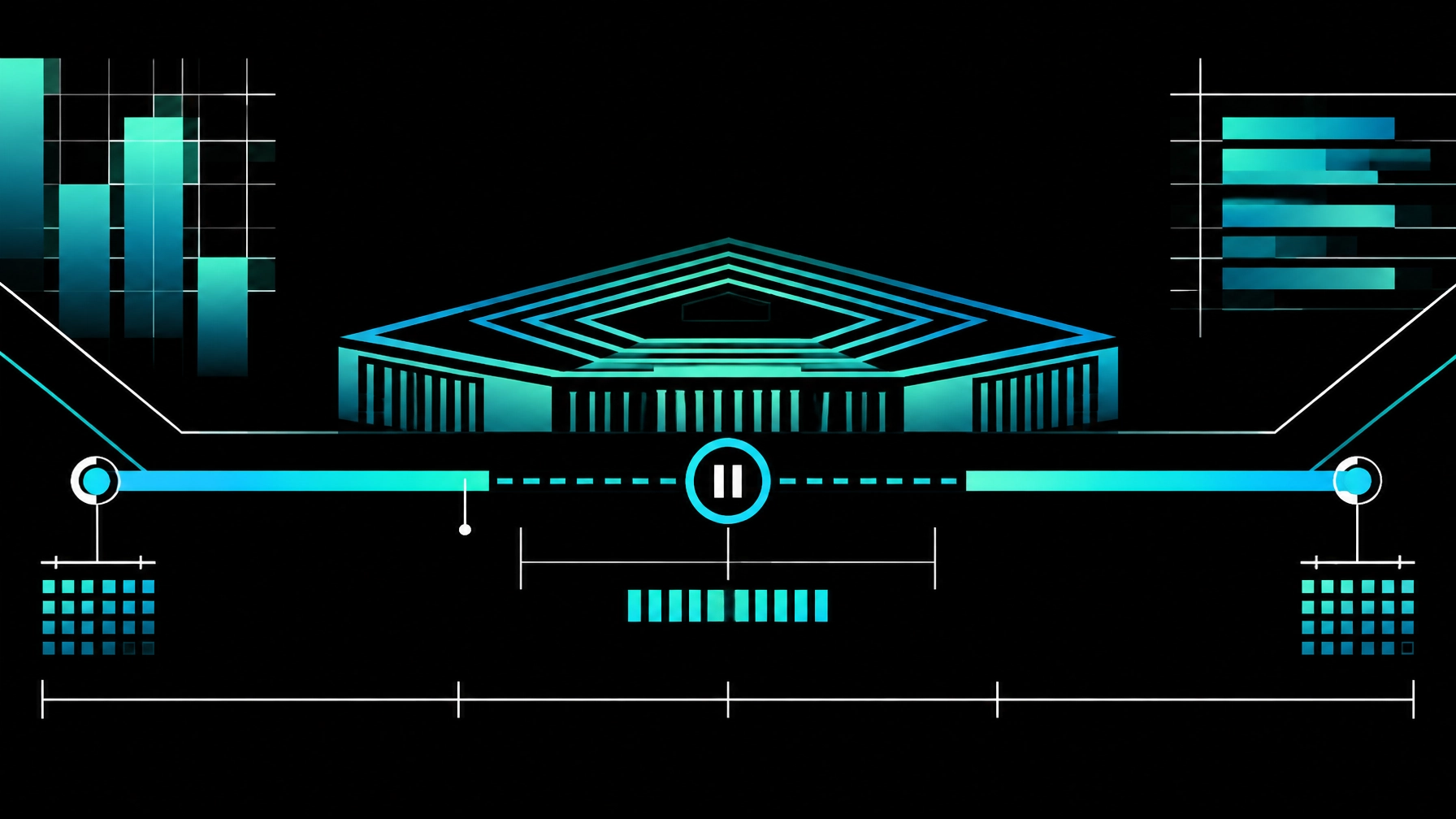
    Timeline graphic showing the lame-duck session opening, the period before Thanksgiving, the December funding deadline, and planning for the next Congress

    The calendar is compressed. Match each engagement to a real decision window and a clear outcome.

    Sort priorities into must-pass and nice-to-have

    Companies need a short, ranked list of legislative priorities. We have the experience to help government-facing businesses assess where a priority fits, what decision it depends on, and whether a request is positioned for action.

    Must-pass priorities connect directly to the funding deadline, the NDAA, or a specific agency implementation decision. They should be concrete, relevant to the mission, and supported by a clear business case. Examples of useful preparation include identifying the precise provision or account at issue, explaining the operational effect, and documenting the capability or capacity your company can deliver.

    Nice-to-have priorities may be worthwhile but have no clear path through the limited year-end agenda. Keep them in your broader 2027 strategy. Do not spend scarce executive time, advocacy resources, or capture funding as though every proposal will receive floor attention.

    For each priority, record the legislative vehicle, the relevant committee or agency, the decision-maker, the evidence supporting your position, and the next decision date. If no credible vehicle or decision point exists, treat the item as monitoring rather than an active year-end ask.

    Time engagement to the legislative calendar

    The key windows are clear, even if the outcome is not.

    Beginning November 9: Congress returns. Reconfirm the status of your priority issues, refresh stakeholder maps, verify which proposals are still under consideration, and request meetings with a defined purpose. Prepare concise, factual materials that connect your company’s capability to a public need.

    Before Thanksgiving: Use the early session to establish context and communicate your highest-priority asks. Keep the message nonpartisan and focused on delivery, readiness, cost control, public value, or a documented mission requirement. If a policy proposal depends on a broader negotiation, state that dependency plainly.

    The December 11 run-up: Treat the final days before the CR expires as a decision window, not a guarantee of resolution. Be ready to explain how a continuing resolution, a shutdown, or delayed appropriations could affect your programs, customers, and delivery schedule. Keep internal and customer-facing messages consistent.

    Geometric priority funnel separating must-pass legislative priorities from lower-priority policy proposals

    Put resources behind priorities with a credible vehicle and decision point. Keep other proposals under review without overcommitting.

    A strong Washington plan is not a sequence of last-minute calls. It is a disciplined set of conversations supported by accurate information, clear requests, and practical alternatives.

    Prepare for oversight as well as legislation

    The next Congress is expected to bring more oversight and investigations into administration actions. Breaking Defense reports that Democratic lawmakers have highlighted oversight as a priority. Companies that work with government should treat this as a prompt to strengthen records discipline, not as a reason to speculate about individual investigations.

    Make sure your organization can locate and explain relevant contract files, invoices, timekeeping, procurement decisions, subcontractor records, communications, compliance reviews, and performance documentation. Confirm that document-retention practices are followed and that staff know how to escalate requests appropriately. Maintain accurate records, observe applicable legal and contractual requirements, and involve qualified counsel when needed.

    These practices are sound business controls in any political environment. They help you answer customer questions, support audits, preserve institutional knowledge, and demonstrate that your company manages public resources responsibly.

    Compliance-readiness graphic with a document archive, audit trail, and shield icon in a black, teal, and cyan vector style

    Records discipline supports customer confidence and operational readiness, regardless of the legislative outcome.

    Track priorities across sectors without chasing every headline

    Post-midterm dynamics will shape the policy environment. Companies are watching healthcare affordability, energy permitting reform, defense modernization, artificial intelligence, and tax provisions. Each area may present opportunities, but not every issue will move during the lame-duck session.

    Healthcare businesses should track proposals that could affect affordability, access, procurement, or program delivery. Energy companies should monitor permitting developments while separating potential policy changes from projects that already have a defined path. Defense suppliers should distinguish NDAA authorization language from the appropriations and agency actions needed for actual work.

    AI companies should identify relevant policy questions and government use cases, while avoiding assumptions that a provision or announcement will become a funded procurement. Businesses following tax provisions should assess the implications for their own planning and keep legislative monitoring distinct from tax advice.

    The practical response is to maintain a sector-specific watch list with three categories: confirmed actions, live proposals, and emerging discussion. Update it as Congress moves. Do not turn an early proposal into a revenue forecast.

    Keep the business plan ready for multiple outcomes

    The lame-duck session may produce a funding agreement and NDAA action, or those decisions may move into early 2027. Your plan should work in either case.

    Re-rank the pipeline by funding certainty and execution readiness. Separate funded, executable work from options and recompetes, new starts dependent on full-year appropriations, and opportunities exposed to policy or timing risk. Review hiring, inventory, supplier commitments, and capital spending against actual funding signals, not optimistic headlines.

    Prepare bridge-funding scenarios for delays. Review working capital, receivables, contract timing, staffing flexibility, and the conditions under which you would slow or accelerate spending. Keep financing options warm, including appropriate debt, equity, and other capital strategies. A prepared company has more control over timing and fewer forced decisions.

    This is the next strategic step after tactical pre-deadline preparation. In our November 6 article, “FY2027 Funding Freeze: 10 Things Government Contractors Should Do Before December 11”, we addressed pipeline triage, options timing, funding scenarios, working capital, and readiness. Now the focus is how the legislative session itself should inform your Washington strategy.

    Position now, execute with discipline

    Companies need a clear view of what Congress can decide, what agencies can implement, and what your organization can perform. We have more than three decades of experience navigating federal opportunities, Congressional stakeholders, and business development. The Infinity Group helps companies position, engage, and execute, from strategic planning and government relationships to pipeline development and capital strategy.

    The question for your leadership team is practical: Which opportunities can you support under a continuing resolution, which depend on a full-year appropriation, and what capital will you need if decisions shift into 2027? We can help you assess those needs, prepare a focused engagement plan, and keep your options open at reasonable cost.

    Contact us to discuss your plan and next steps: connect@infinity-us.com

    Comments are disabled.

    The Infinity Group official horizontal corporate logo with the tagline “Strategies + Execution = Funding and Growth.”

  • FY2027 Funding Freeze: 10 Things Government Contractors Should Do Before December 11

    FY2027 Funding Freeze: 10 Things Government Contractors Should Do Before December 11

    By John Marsh, The Infinity Group | Draft for review | Target publish time: 9:00 AM ET | Comments: Disabled

    The first rule of a tight funding window is the oldest rule of strategy: plan for the deadline before it dictates your choices.

    The current FY2027 continuing resolution funds covered federal agencies through December 11, 2026, generally at FY2026 rates. Congress returns November 9 to a compressed post-election session. Lawmakers may pursue an omnibus, several smaller appropriations packages known as minibuses, or another continuing resolution that carries funding into early 2027. None of those outcomes is certain.

    For contractors, suppliers, and founders, the immediate task is not to guess which deal Congress will make. It is to make sound pipeline, award-timing, and capital decisions while the funding picture remains unsettled.

    This is not a blanket shutdown of federal contracting. Existing work may continue when supported by prior-year funding and agency authority. But the CR generally limits new starts and directs agencies to take only limited actions needed to continue existing activities. Department of Defense activities also face specific restrictions on new starts and certain production increases. The exact effect depends on the appropriation, program, contract, and agency action.

    The Congressional Research Service overview explains the CR’s provisions. Here are ten actions your leadership team should take now.

    Diagram showing active contract continuation, FY2026-funded work, restricted new starts, and later award timing

    1. Separate funded work from forecasted work

    Build a single view of your federal-facing revenue and classify each opportunity: currently funded contract work, expected options or task orders, recompetes, new program starts, production increases, grants, and proposals awaiting award.

    Do not treat all pipeline entries as equally executable. A contract or opportunity associated with an existing program may have a different path from an initiative that requires a new FY2027 start. Identify the funding source, period of performance, obligated amount, and key decision dates for each material pursuit.

    2. Recheck contract and option timing

    Review option periods, ordering periods, funding clauses, notice requirements, and any customer-provided schedule. An option is not cash in the bank, and a forecasted award is not an obligation. Confirm assumptions through the contracting officer or authorized customer contact, and document what is known versus what is estimated.

    For each major action, ask: What must happen before December 11? What could move under another CR? What requires full-year appropriations or a new start? Keep your delivery plan within the funding and authority actually available.

    3. Re-sequence your pipeline by decision date

    Rank opportunities by customer need, funding status, award readiness, and the consequences of delay. Put near-term, well-supported pursuits first. Keep strategically important longer-term work active, but assign it a later decision gate if appropriations or program authorization remain unresolved.

    Congress is scheduled to return November 9. That leaves a short window before the current CR expires. Use this period to clarify milestones and keep proposals, pricing, teaming arrangements, and compliance materials ready. Do not assume that a bill being debated means an agency can immediately make an award.

    4. Model three funding outcomes

    Build operating plans around three practical scenarios: full-year appropriations in time, another CR into early 2027, and a funding gap beginning December 12 for affected activities. These are planning cases, not predictions.

    For each case, model the consequences for award dates, option exercise, hiring, inventory, subcontractor commitments, and cash. Identify the trigger for changing course. The current CR’s expiration is a deadline for Congress to act, not a guarantee that all FY2027 funding will be resolved by that date.

    5. Confirm what the $1.5 trillion request does, and does not, mean

    The Trump administration’s FY2027 budget request places a proposed $1.5 trillion national-defense topline into the appropriations debate. The request combines about $1.15 trillion in discretionary national-defense funding with $350 billion sought through reconciliation. It is a proposal, not enacted funding, and the reconciliation component depends on separate congressional action. Review the White House topline fact sheet.

    Use the request to track policy priorities and prepare for customer questions. Do not convert a budget request, headline figure, or policy announcement into a booked contract assumption.

    6. Protect supplier and working-capital continuity

    Map your critical suppliers, long-lead items, payroll exposure, and customer payment timing. Identify which purchases are supported by funded work and which depend on an anticipated award. Discuss timing and capacity with suppliers early, and set practical limits on inventory and hiring until the funding path is clearer.

    Where a prime or agency customer controls the next step, ask for a realistic schedule and the information needed to maintain readiness. This is disciplined execution, not retreat from the market.

    7. Build a capital plan that does not rely on an unawarded contract

    Prepare cash-flow forecasts for the three funding scenarios. Review available liquidity, receivables, lender covenants, investor milestones, and the cost of carrying capacity through a delay. Consider which forms of capital suit each need, and assess timing, eligibility, repayment obligations, and dilution before making a commitment.

    Ask the practical question: if an award moves one quarter, can your business still meet payroll, supplier terms, and delivery obligations without taking capital on unfavorable terms? A credible plan gives you choices before pressure narrows them.

    Diagram of distinct contract pipeline, working-capital, and private investment lanes converging on company capability

    8. Prepare for relevant SWPC channels

    For eligible small manufacturers and defense suppliers, the Smaller War Plants Commission (SWPC) provides a route to information on capital and government-market readiness. Its Get Started page points businesses toward SBA-backed lending resources, SAM.gov, APEX Accelerators, supplier and subcontracting resources, and defense industrial-base opportunities.

    Prepare accurate registration and capability information, current financial statements, a clear use of proceeds, and a documented production or supplier need. SWPC is a readiness and access channel, not a promise of a loan, contract, or grant. Confirm the requirements of each actual program or opportunity.

    9. Get investor-ready for SBIC-E if your technology fits

    The Small Business Investment Company-Energy Initiative (SBIC-E) connects eligible small businesses with participating investment funds focused on specified technology priorities. It is an investment route through funds, not a direct government grant or an automatic award. Review the Department of Energy’s SBIC-E overview.

    If your company’s technology aligns, prepare a concise investment case: ownership and capitalization, intellectual property, commercial progress, financing needs, and a realistic plan for deploying capital. Keep this work distinct from contract capture. Private investment can support growth, but it does not replace the need to validate contract timing and terms.

    10. Put a decision cadence in place now

    Assign an executive owner for the funding watch. Review congressional developments, customer communications, pipeline stages, cash exposure, and supplier risk on a regular schedule. Set clear go, hold, and defer criteria for hiring, inventory, proposal spending, and capital decisions.

    The deadline is close, but a disciplined plan still gives your organization room to act. We have more than three decades of experience navigating federal opportunities, congressional stakeholders, and business development. At The Infinity Group, we help companies assess market position, sharpen pursuit strategy, and connect funding plans to execution. We can support your team from opportunity review through practical next steps.

    Plan for the deadline. Protect your position. Be ready to move.

    Sources and planning resources

    Executive readiness dashboard graphic showing contract timing, pipeline priorities, supplier continuity, and cash planning

    The Infinity Group horizontal corporate logo and tagline, unaltered

    For a discussion of your plan and next steps, contact connect@infinity-us.com

  • The Pentagon and SBA Just Opened a New Capital Channel for Small Manufacturers: How the Smaller War Plants Commission Works

    The Pentagon and SBA Just Opened a New Capital Channel for Small Manufacturers: How the Smaller War Plants Commission Works

    Draft for review, not published or scheduled.

    The history of American industrial mobilization shows that production capacity is built before a crisis, not improvised during one. On October 12, 2026, the U.S. Small Business Administration (SBA) and Department of War (DoW) took a practical step toward strengthening that capacity: they signed a memorandum of agreement (MOA) that operationalizes a capital pathway under the Smaller War Plants Commission (SWPC).

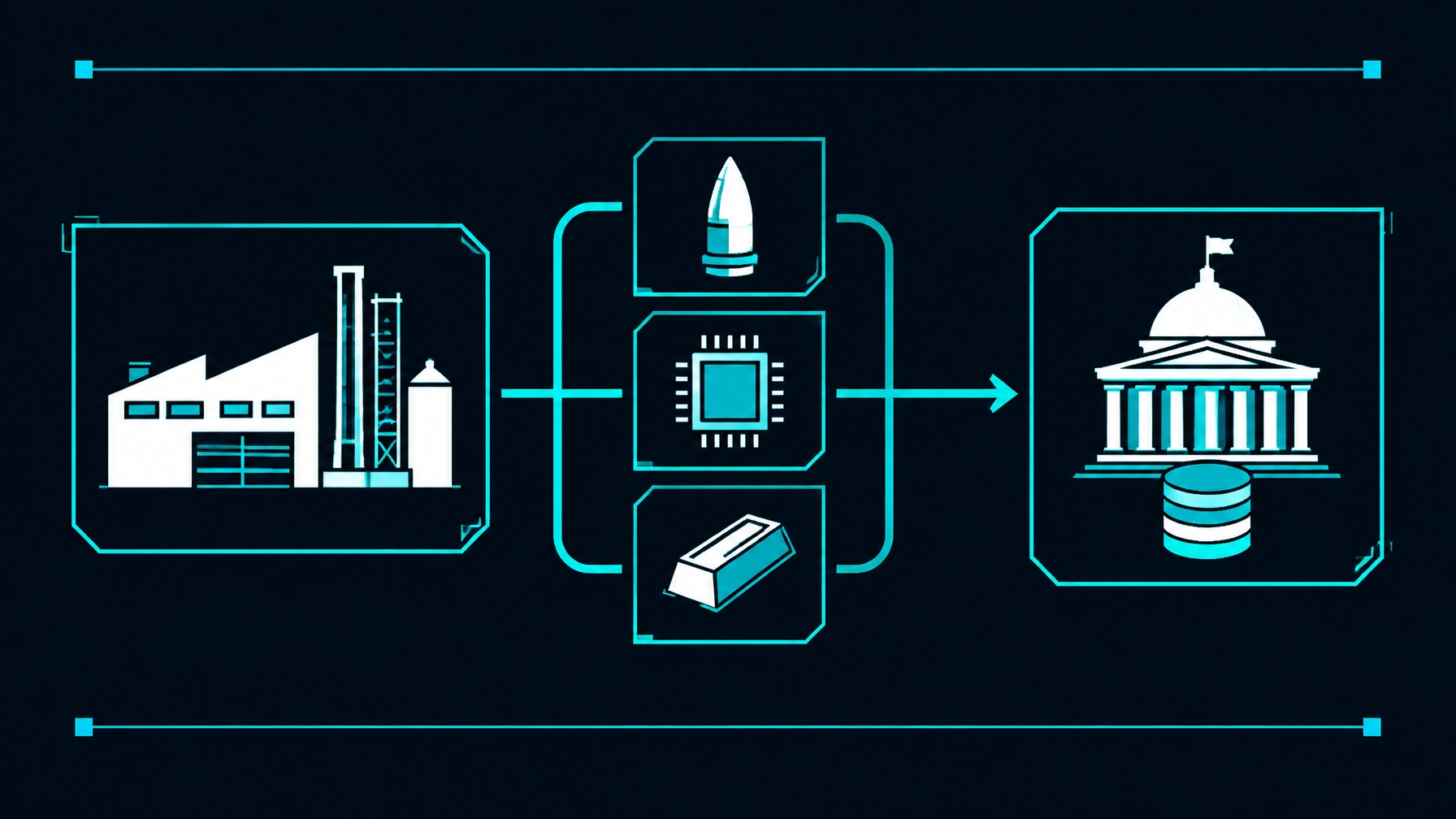
    For founders and executives in munitions, microelectronics, essential materials, and other national-security-critical businesses, this is worth attention. The agreement connects DoW’s Economic Defense Unit (EDU) with SBA lending channels and SBA’s investment-support expertise. It creates a potential route to loans and Department of War-funded redeemable preferred equity, but it does not promise financing, establish automatic eligibility, or replace sound financial preparation.

    What the new pathway does

    The Commission was established in August to coordinate federal support for small suppliers and expand the defense industrial base. The October MOA adds a more specific capital process. According to the SBA announcement, EDU will identify companies with financing needs through its Business Operators for National Defense (BOND) efforts and refer potential loan candidates to the SBA.

    SBA will then use its existing 7(a) and 504 lender networks to connect eligible firms with SBA-backed capital. In other words, this is a referral and coordination mechanism, not a new, direct SBA loan handed to a manufacturer by the Commission.

    The agreement also establishes a separate equity track. EDU may source Department of War-funded redeemable preferred-equity investments for small and medium-sized businesses that create, expand, or restore industrial capacity important to national security. SBA can support the work with due diligence, underwriting, transaction structuring and documentation, monitoring, and portfolio-management assistance. EDU retains final investment decision authority.

    Flowchart showing a defense supplier referred through the Economic Defense Unit toward a lender pathway or preferred-equity evaluation

    Two kinds of capital, two different roles

    The debt and equity paths should not be confused. An SBA-backed loan is still a loan: the company must meet program and lender requirements, support repayment, and use proceeds for an eligible purpose. SBA’s 7(a) program can support uses that include working capital, equipment, and certain real estate or business needs. The 504 program is designed for major fixed assets, such as facilities and long-term machinery; it is not a general working-capital substitute.

    Preferred equity is different. It is an investment, not a conventional bank loan. The MOA identifies it as redeemable preferred equity, but the public announcement does not spell out a universal term sheet, pricing formula, redemption schedule, transaction size, or application process. Those details matter. A founder should not assume that “preferred” means inexpensive capital, that redemption terms will fit the company’s cash plan, or that every referred firm will receive an investment.

    There is also an important division of responsibility: SBA’s expertise is part of the evaluation and execution support, but the MOA leaves the final equity call with EDU. On the loan side, SBA-backed financing still runs through lender channels and remains subject to program eligibility and underwriting. A referral is a point of access, not approval.

    Who should pay attention

    The initiative is aimed at businesses whose output strengthens essential domestic defense capacity. The August SWPC announcement highlights areas including munitions and components, microelectronics, strategic and critical minerals, shipbuilding and repair components, sensors, batteries, castings and forgings, and textiles. The October agreement further references platforms, technological processes, essential materials, and minerals.

    That scope can include more than a prime contractor or a company with a large federal contract. A specialized component maker, materials processor, production technology company, or supplier with a credible role in a critical supply chain may have a relevant story to tell. The key is to explain the connection: what the business produces, where it fits in the supply chain, what capacity is constrained, and how financing would expand or restore capacity of national-security value.

    Side-by-side icons illustrating equipment and working-capital loans versus redeemable preferred-equity investment

    How founders can prepare now

    1. Position your company in operational terms.
    Describe your product, process, production capacity, customers, bottlenecks, and lead times in plain language. Identify the national-security relevance and the specific supply-chain gap you help address. Quantify the impact of the proposed investment: additional units, shorter lead times, domestic sourcing, new tooling, or restored production capability.

    2. Make the financing request precise.
    Separate the uses of capital. Facility improvements and long-lived equipment may point toward one type of financing; working capital, inventory, or fulfilling a large contract may require another. Identify the amount, timing, and milestones. Connect each dollar to a production result and a credible repayment or investment case.

    3. Get financial records and forecasts in order.
    Prepare current financial statements, debt schedules, cash-flow forecasts, customer and contract information, accounts receivable and payable details, inventory records, and a documented use-of-funds plan. Be ready to explain assumptions and how the company will manage ramp-up costs, supplier delays, and payment timing. Lenders and investment reviewers need evidence, not only a compelling mission.

    4. Understand the referral pathway.
    The MOA describes EDU identification through BOND efforts and referrals of potential loan candidates to SBA. It does not describe a single universal application form or guarantee that a business can self-refer directly to an investment decision. Review the official SWPC “Get Started” resource and confirm the current route for your situation. For a loan, the SBA explains that borrowers work through lenders; 7(a) applicants apply through a participating lender, while 504 financing is arranged through a Certified Development Company.

    5. Prepare for scrutiny and follow-through.
    Government-facing business development requires disciplined records and reliable execution. Be ready to discuss ownership, company size, contracts, production readiness, quality systems, security or compliance requirements relevant to your work, and potential risks. Keep your forecasts aligned with realistic customer demand and operating capacity.

    Three-part readiness illustration: financial records, defense supply-chain positioning, and organized referral documentation

    The budget backdrop, and the caveats

    The MOA arrives during a stopgap funding period. As of October 16, federal funding is extended through December 11, 2026, unless regular appropriations are enacted earlier. The continuing resolution also includes provisions addressing increased demand for SBA loan programs, as summarized by the National Association of Counties.

    For companies, that deadline is a planning factor, not a reason to assume the capital pathway shuts off on December 12, nor evidence that a financing decision will arrive before then. The appropriations debate adds uncertainty around timing and government operations. The MOA itself does not announce a single overall funding allocation, guarantee a loan or equity investment, or waive ordinary lender and eligibility requirements. Businesses should track official updates and build plans that remain viable under more than one funding timeline.

    The strategic opportunity is meaningful: government coordination may help connect qualifying manufacturers to capital, while SBA brings established lending networks and investment experience to the process. But opportunity is not the same as a commitment. The strongest candidates will be those that can show a clear national-security contribution, a defined financing need, credible operating plans, and the discipline to execute.

    The Infinity Group works with businesses on strategy, execution, funding, and growth, from positioning and capital planning to government-facing business development. Explore our government capabilities, business growth services, and services. To discuss your company’s plan and next steps, contact connect@infinity-us.com.

    This article is for general informational purposes only and is not legal, tax, or investment advice. Comments are disabled.

    The Infinity Group corporate logo with the tagline “Strategies + Execution = Funding and Growth”

  • FY2027 Opens Under a Continuing Resolution: What a 10-Week Funding Freeze Means for Your Pipeline

    FY2027 Opens Under a Continuing Resolution: What a 10-Week Funding Freeze Means for Your Pipeline

    Published October 2, 2026

    Throughout history, military campaigns have been won by commanders who understood timing, supply, and positioning, not simply by those with the strongest forces. Federal business development follows the same rule. Under a continuing resolution, the companies that manage timing and working capital will be positioned to win when funding authority opens.

    FY2027 began on October 1 under the Continuing Appropriations Act, 2027, enacted as Public Law 119-103. The law funds federal operations generally at FY2026 rates through December 11, 2026. For approximately ten weeks, agencies must continue existing activities while operating under restrictions that limit new starts, unusually high initial operating rates, and funding actions that could interfere with Congress’s final FY2027 decisions.

    For the Department of Defense, the restrictions are direct. The law generally bars:

    • New production of items not funded for production in FY2026 or prior years;
    • Increases in production rates above those sustained with FY2026 funds;
    • New projects, activities, organizations, budget activities, program elements, and subprograms without FY2026 funding or authority;
    • New multiyear procurements using advance procurement funding for economic order quantity purchases.

    Breaking Defense reports that more than 150 new military programs face delay under the CR. This is a serious constraint. It is not a reason to abandon your federal pipeline.

    It is a reason to manage the pipeline with discipline.

    What the Continuing Resolution Actually Changes

    A continuing resolution is not a complete shutdown of federal buying. It is a temporary operating framework. Existing programs can continue, but agencies are limited in how they begin, expand, or accelerate activities that were not funded in the prior fiscal year.

    That distinction matters.

    Companies with active contracts, funded options, established program relationships, recurring requirements, and existing agency demand may still have meaningful work to pursue. Existing contracts can continue. Previously funded production and services can move forward. Some option-year exercises may proceed when funding and authority are already available.

    However, options that require new FY2027 funding may be delayed. Production-rate increases may wait. New program launches may remain frozen. Awards tied to new starts may move from an anticipated October or November action into a later period, or into the FY2027 full-year appropriations process.

    The CR also directs agencies to take only the most limited funding action permitted to continue projects and activities. That language creates a slower, more cautious environment. Government customers will be careful about making commitments that appear to establish a new program before Congress has completed the full-year appropriation.

    Your strategy must reflect that reality.

    Vector infographic showing existing funded work continuing while new starts pause and FY2027 preparation advances

    The Three-Way Pipeline Decision: Pursue, Hold, Prepare

    During a funding freeze, every opportunity should be placed into one of three categories.

    1. Pursue: Existing and Funded Requirements

    Pursue opportunities connected to activities already funded in FY2026. This includes:

    • Existing prime contracts and subcontracts;
    • Funded task orders and delivery orders;
    • Previously authorized production;
    • Sustainment, maintenance, logistics, cybersecurity, and technical support;
    • Contract modifications that remain within existing authority;
    • Simplified acquisitions tied to established requirements;
    • Existing option years where the agency has available funding;
    • Mission-critical work that supports continuity of operations.

    This is not the time to treat every federal opportunity as frozen. It is the time to identify which opportunities have a valid funding path today.

    Your capture team should review each target against the contract vehicle, program element, appropriation account, period of performance, option structure, and customer funding position. A strong requirement with no current funding path belongs in a different category than an active need supported by an existing program.

    2. Hold: New Starts and Unfunded Expansions

    Hold pursuits that depend entirely on new FY2027 authority or a significant increase above FY2026 operating levels.

    This includes:

    • New military programs;
    • New production lines;
    • New multiyear procurements;
    • New program elements;
    • Major production-rate increases;
    • New agency initiatives that were not funded in FY2026;
    • Awards that require Congress to establish a new account or funding line.

    Holding does not mean abandoning. It means controlling cost and timing.

    Do not spend as though a solicitation is imminent when the program cannot legally or practically move forward under the current CR. Do not build inventory, add staff, or commit subcontractor capacity against a speculative award without a clear financing plan. Do not allow an anticipated October award to become a November working-capital crisis.

    3. Prepare: FY2027 Full-Year Positioning

    The third category is preparation. This is where companies will create the advantage that becomes visible after a full-year appropriation is enacted.

    Prepare your:

    • Capture strategy;
    • Price-to-win analysis;
    • Technical solution;
    • Past performance package;
    • Partner and subcontractor structure;
    • Small-business and socioeconomic participation plan;
    • Congressional and stakeholder briefing materials;
    • Agency engagement plan;
    • Proposal production schedule;
    • Capital and working-capital requirements.

    The company that waits for appropriations before preparing will enter the market late. The company that prepares now will be able to move when the government can move.

    Protect Your Working-Capital Position

    A delayed award is not merely a sales problem. It is a financial management problem.

    When federal awards slip, companies may still carry proposal costs, recruiting expenses, engineering work, travel, inventory, facility commitments, and subcontractor obligations. A ten-week delay can become longer if Congress extends the CR or if a full-year bill changes program priorities.

    We recommend a formal pipeline cash review covering:

    1. Expected award date: What is the earliest realistic obligation date under the CR?
    2. Funding dependency: Is the opportunity supported by FY2026 funding, an anomaly, or a future FY2027 appropriation?
    3. Internal spend: How much has already been committed to capture and proposal activity?
    4. Forward commitments: Which hires, purchases, facilities, and subcontractor agreements can be delayed?
    5. Liquidity threshold: How much cash must remain available if the award moves by 30, 60, or 90 days?
    6. Alternative revenue: Which commercial, state, local, or existing federal opportunities can offset the delay?

    The proper objective is not to cut activity blindly. The objective is to preserve the ability to execute when the opportunity opens.

    That requires sequencing. Maintain the customer relationship. Maintain the technical work that improves your position. Delay avoidable costs that do not improve your probability of award.

    Executive pipeline triage diagram showing pursue, hold, and prepare decisions during a federal funding freeze

    Continue Government Relationship Engagement, With the Right Message

    Government relationship strategy remains active during a CR, but the conversation must be aligned with the appropriations cycle.

    Your government customers need practical information, not pressure. Ask:

    • Is the requirement tied to an existing FY2026 program?
    • Does the agency expect an option exercise, modification, task order, or new-start action?
    • What funding account supports the requirement?
    • Is the activity dependent on a specific FY2027 line item?
    • Are there operational consequences if the award slips?
    • What information will help the customer move quickly once authority is available?

    Your Congressional engagement must also be disciplined. Congressional offices and committee staff need a clear explanation of mission impact, industrial-base consequences, schedule risk, cost growth, and the consequences of delay. A briefing that simply says “we need the contract” is weak. A briefing that explains what the capability does, why timing matters, how the requirement aligns with national priorities, and what happens if funding is delayed is useful.

    Infinity Group provides government relationship strategy and federal business development support for companies that need to align agency, Congressional, industry, and capital conversations. We have the experience and contacts to help you communicate with precision during a period when timing matters.

    Build the FY2027 Win Before the Bill Arrives

    The full-year appropriation may restore funding for some new starts. It may modify others. It may delay or remove certain activities. Your company must be prepared for all three outcomes.

    Build an appropriations-to-pipeline matrix that connects:

    • Your target program;
    • The FY2027 budget request;
    • The relevant House and Senate appropriations positions;
    • Committee and subcommittee activity;
    • Agency budget materials;
    • Program executive office priorities;
    • Existing contract vehicles;
    • Likely acquisition strategy;
    • Your required capital and delivery capacity.

    Then assign each opportunity a confidence rating and a next action. This turns government uncertainty into a managed business-development process.

    Companies need access to the right government relationships. We have that capability.

    Companies need capture planning, proposal development, teaming, pricing, and execution support. We have that expertise.

    Companies need capital to sustain the pursuit and fulfill the contract when awarded. We can help develop a capital strategy that supports growth without creating unnecessary pressure on the balance sheet.

    Our business development services are designed to support companies from A to Z: market identification, government positioning, relationship strategy, capture, proposal development, partner coordination, investment strategy, and execution planning.

    Geometric staircase diagram showing progression from contract execution to stakeholder alignment and FY2027 capture readiness

    A Pipeline Stall Does Not Have to Become a Growth Stall

    The current CR creates delay. It does not eliminate demand. It does not eliminate mission requirements. It does not eliminate the need for capable companies, qualified technologies, reliable services, or well-positioned partners.

    The companies that will perform best are the companies that distinguish between:

    • What can be awarded now;
    • What must wait;
    • What must be prepared;
    • What must be financed;
    • What must be communicated to customers and Congressional stakeholders.

    That is business development architecture.

    At The Infinity Group, we support businesses and investors with strategy, execution, government relationships, Congressional engagement, capture and proposal development, and capital planning. We will help you protect your position during the funding freeze and prepare for the opportunities that follow.

    The practical question is simple: if a disciplined investment in positioning today creates a materially larger contract opportunity after FY2027 funding is enacted, what is the cost of waiting?

    Contact us at connect@infinity-us.com to discuss your pipeline, your funding exposure, and the next phase of your government relationship strategy. We will review the opportunities to pursue, the commitments to hold, and the actions required to be ready when funding opens.

    THE FREEZE IS TEMPORARY.
    THE POSITIONING WINDOW IS NOW.
    STRATEGIES + EXECUTION = FUNDING AND GROWTH.

    Comments are disabled for this article.

    Official The Infinity Group corporate logo with the tagline Strategies + Execution = Funding and Growth

  • From Risk to Resilience: The CEO’s Playbook for Security, Privacy, Continuity, and Recovery

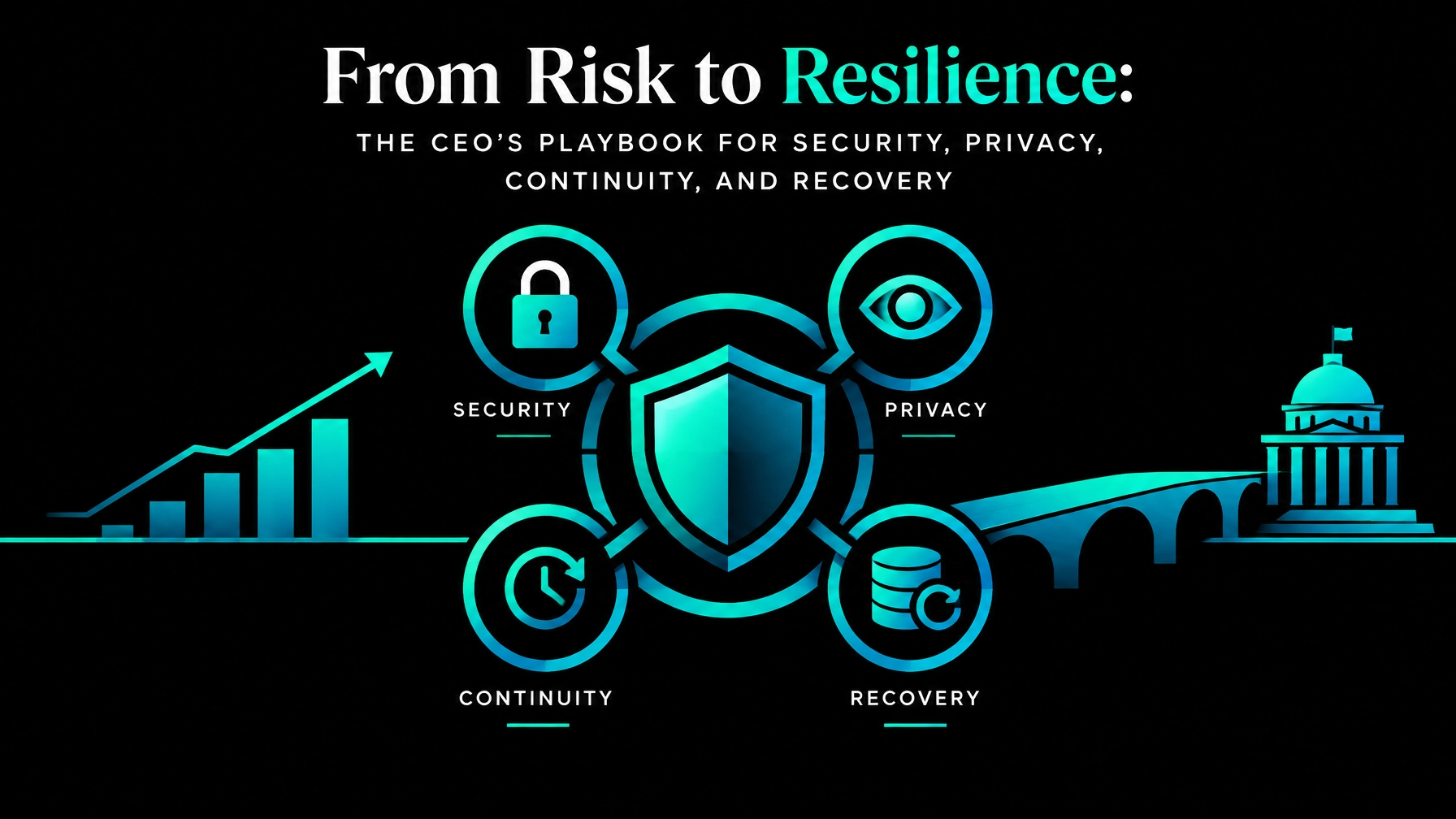
    From Risk to Resilience: The CEO’s Playbook for Security, Privacy, Continuity, and Recovery

    In military planning, commanders do not protect every road, facility, and supply line in the same manner. They identify the mission, establish priorities, control access, prepare for disruption, and preserve the ability to continue operating.

    CEOs must manage business resilience with the same discipline.

    Security, privacy, continuity, and recovery are not separate technology projects. They are executive responsibilities tied directly to revenue, customer confidence, government-market readiness, capital diligence, and long-term growth.

    The Infinity Group is a team of Business Development Architects. We coordinate the strategic, operational, financial, and institutional requirements that help organizations move from risk to resilience: from beginning to end and from A to Z.

    Resilience Is a Business Operating Model

    Companies need to know which services must continue, which data requires protection, which systems create the greatest exposure, and which decisions must be made during a crisis. We have the expertise to organize these questions into an integrated resilience program.

    The structure is straightforward:

    • Govern: Establish executive ownership, risk appetite, policies, reporting, and decision rights.
    • Identify: Map critical services, systems, data, dependencies, vendors, and business impact.
    • Protect: Apply access controls, network segmentation, data protection, training, and secure operating procedures.
    • Detect: Monitor systems, accounts, vendors, and unusual activity.
    • Respond: Activate incident response, communications, legal coordination, and executive decisions.
    • Recover: Restore operations, validate data, execute continuity plans, and improve the program.

    This model reflects the organization of the NIST Cybersecurity Framework 2.0, which is designed to help organizations manage cybersecurity risk across industry and government environments. It is not a substitute for contract-specific, legal, regulatory, or technical advice. It is a practical management structure.

    Six-stage resilience operating model from Govern through Recover

    Companies need a risk assessment that speaks in business terms. We can coordinate an assessment that identifies revenue exposure, operational dependencies, sensitive data, customer obligations, regulatory considerations, critical vendors, and recovery priorities.

    A technical severity rating is not enough. A moderate technical weakness in a system supporting payroll, production, logistics, government deliverables, or customer records may be more urgent than a high-severity issue in an isolated environment.

    Your risk register should show:

    • The business service affected;
    • The data and systems involved;
    • The likely operational consequence;
    • The responsible executive or manager;
    • The current control;
    • The remaining exposure;
    • The cost and timing of remediation; and
    • The decision required from leadership.

    Privacy and Data Protection Must Follow the Mission

    Companies need to know what information they hold, where it resides, who can access it, how it moves, and what happens if it is stolen, corrupted, unavailable, or improperly disclosed. We can coordinate data mapping, classification, access review, retention planning, backup validation, and protection requirements across your operating environment.

    Your minimum data protection baseline should address:

    • Multifactor authentication for critical systems and privileged users;
    • Least-privilege and role-based access;
    • Encryption in transit and at rest where appropriate;
    • Tested, protected, and preferably immutable backups;
    • Endpoint and cloud security controls;
    • Logging and monitoring for critical services;
    • Secure data transfer procedures;
    • Employee security and privacy training; and
    • Documented incident escalation.

    Network segmentation is equally important. Companies need to limit the blast radius of a compromise. We can help coordinate the right technical and operational expertise to separate critical systems, administrative access, production environments, sensitive data, and ordinary commercial activity.

    A segmented environment is not merely a separate folder or a different label. It is a documented, technically enforced boundary with controlled access and defined transfer points.

    This is especially important for organizations pursuing federal opportunities. Your CMMC and government-contracting strategy must reflect actual contract requirements, information flows, and system scope. Resilience supports government-market readiness; it does not replace a qualified assessment, cybersecurity provider, or government contracts attorney.

    Continuity and Recovery Must Be Demonstrated

    Companies need a business-impact analysis before they spend heavily on recovery technology. We can coordinate the analysis that determines what happens if a service is unavailable for one hour, one day, or one week.

    For every critical service, document:

    • Maximum tolerable downtime;
    • Recovery time objective, or RTO;
    • Recovery point objective, or RPO;
    • Internal and external dependencies;
    • Manual workarounds;
    • Required personnel;
    • Required data and applications;
    • Customer and contractual consequences; and
    • The executive who can authorize recovery decisions.

    Disaster recovery plans must connect to business continuity plans. A system may be technically restored while the business remains unable to deliver because a vendor, facility, employee group, integration, or physical process is unavailable.

    Companies need to test their plans under pressure. We can coordinate tabletop exercises, technical recovery tests, communications drills, and after-action reviews. A test is not a failure because it reveals weaknesses. The failure is allowing those weaknesses to remain unknown.

    The CISA guidance on cyber threats and response emphasizes the importance of identifying, managing, and limiting the spread of attacks. Your organization should also know who declares an incident, who can isolate systems, who contacts customers, who coordinates with counsel, who speaks to the public, and who authorizes extraordinary spending.

    Third-Party Risk Is Executive Risk

    Companies need to understand that a vendor can create the same operational impact as an internal failure. We can establish a tiered third-party risk program covering cloud providers, software vendors, managed service providers, logistics partners, manufacturers, subcontractors, and critical suppliers.

    Begin with the top ten vendors by business impact. For each, confirm:

    • What services the vendor provides;
    • What data the vendor handles;
    • What systems connect to the vendor;
    • How quickly the vendor must notify you of an incident;
    • How the vendor supports continuity and recovery;
    • What security evidence is available;
    • What happens if the vendor becomes unavailable; and
    • Whether the contract provides meaningful protection.

    Your procurement, legal, finance, operations, and security teams should use one coordinated process. We have that breadth. We can help connect contract review, operational dependency analysis, security requirements, and executive reporting.

    Partner confidence is strengthened when you can explain your critical dependencies, recovery priorities, security controls, and improvement plan. No resilience program guarantees that an incident will not occur. A disciplined program demonstrates that your organization is prepared to manage disruption responsibly.

    The CEO’s Practical 90-Day Roadmap

    A 90-day program should create a reliable baseline, produce visible improvements, and establish the next investment decisions.

    CEO 90-day roadmap showing Assess, Build, Validate, and the Stop or Scale decision gates

    Days 1–30: Assess and Stabilize

    Companies need clarity first. We can coordinate:

    • A business-impact analysis for five to ten critical services;
    • A rapid risk assessment;
    • A one-page “Top Five Risks” register;
    • A crown-jewels and sensitive-data inventory;
    • A review of incident response and disaster recovery plans;
    • A critical-vendor inventory and initial risk tiers;
    • Backup integrity checks;
    • Multifactor authentication priorities; and
    • Executive decision rights and escalation thresholds.

    STOP decision point: Stop expansion or new high-risk initiatives if critical services are unmapped, backups are unverified, privileged access is uncontrolled, or no executive can clearly declare and manage an incident.

    SCALE decision point: Scale into the next phase when leadership has accepted the risk baseline, named owners, and approved immediate protective actions.

    Days 31–60: Build and Integrate

    Companies need controls that work together. We can coordinate:

    • Network segmentation for critical systems;
    • Access reviews and privileged-account controls;
    • Data protection standards;
    • Role-specific incident playbooks;
    • Communications procedures;
    • Recovery objectives aligned to business impact;
    • A tabletop exercise design;
    • Deeper reviews for Tier 1 vendors; and
    • Board or executive reporting metrics.

    Your metrics should remain practical: critical assets mapped, privileged accounts reviewed, backups tested, recovery plans validated, high-risk vendors addressed, and open remediation actions by business impact.

    STOP decision point: Stop scaling the resilience program when controls exist only on paper, recovery dependencies remain unknown, or executives have not participated in a decision exercise.

    SCALE decision point: Scale when critical controls are implemented, owners are accountable, and the organization can explain how it would respond to a material outage or cyber incident.

    Days 61–90: Validate and Institutionalize

    Companies need evidence, not assumptions. We can coordinate:

    • An executive tabletop exercise;
    • A recovery test for at least one crown-jewel service;
    • After-action findings and remediation deadlines;
    • A resilience scorecard;
    • A 12- to 36-month investment roadmap;
    • A formal governance cadence;
    • Capital and staffing priorities; and
    • A clear statement of remaining risk.

    Executive resilience scorecard linking tested capability to growth, capital, and trust

    STOP decision point: Stop major growth commitments that depend on unproven systems, undocumented vendors, or recovery assumptions that have not been tested.

    SCALE decision point: Scale when the organization has demonstrated recovery capability, established governance, and a prioritized plan for remaining exposure.

    Resilience Supports Growth and Capital Diligence

    Security and resilience are not obstacles to growth. They are part of the infrastructure that makes growth credible.

    Companies pursuing investment need to answer diligence questions about customer data, intellectual property, operational continuity, vendor exposure, insurance, compliance obligations, and incident history. We can help organize these matters so that investors receive a clear view of risk, controls, priorities, and required capital.

    Companies entering government markets need to demonstrate operational discipline, contract awareness, protection of sensitive information, and the ability to perform reliably. We can coordinate the broader strategy through our government-market resources, technical operations support, and business growth services.

    Companies preparing for strategic partnerships, acquisitions, or expansion need a resilience position that supports confidence. We can help you present the program, the remaining gaps, the financial requirements, and the execution schedule.

    The practical question is direct:

    If a disciplined resilience investment protects a critical customer, preserves a government opportunity, improves capital diligence, and strengthens partner confidence, what is the cost of delaying it?

    The answer belongs in the CEO’s operating plan.

    The Infinity Group: From Risk to Resilience

    The Infinity Group is a Business Development Architecture firm. We assist businesses with comprehensive strategies from A to Z, including resources, investment capital, government relationships, operational planning, and execution.

    We can help coordinate risk assessments, incident response, disaster recovery, business-impact analysis, network segmentation, data protection, security training, third-party risk, executive governance, and measurable resilience. We bring private-sector expertise together with a deep understanding of federal and state agencies and Congress.

    We do not promise that risk disappears. We build the structure, contacts, priorities, and execution plan that allow you to manage risk with greater discipline and pursue growth with stronger preparation.

    Contact us at connect@infinity-us.com to discuss your 90-day roadmap, resilience priorities, government-market readiness, capital diligence, or next steps.

    ASSESS THE RISK. PROTECT THE MISSION. PROVE THE RECOVERY.

    RESILIENCE SUPPORTS GROWTH.
    EXECUTION BUILDS CONFIDENCE.
    THE INFINITY GROUP SUPPORTS BOTH.

    Sources

    General-information disclaimer: This article provides general business and risk-management information for educational purposes. It is not legal, cybersecurity, privacy, insurance, accounting, investment, regulatory, or government-contracting advice. Requirements depend on your organization, contracts, systems, data, industry, and jurisdiction. Obtain advice from qualified legal, technical, financial, and compliance professionals before making operational, certification, disclosure, or investment decisions.

    Publishing setting: Comments and replies are disabled.

    The Infinity Group official full horizontal corporate logo with the tagline “Strategies + Execution = Funding and Growth”

  • The Managed Security Model: Extending Your Team Without Building Every Function In-House

    The Managed Security Model: Extending Your Team Without Building Every Function In-House

    Infinity Group Insights : Article 6 of 7

    Throughout history, successful commanders have understood a basic rule: an objective is not secured by assembling every capability from scratch. It is secured by defining the mission, assigning responsibility, controlling access, establishing communications, and bringing the right specialists into the operating plan at the right time.

    Growing companies need the same discipline.

    You may be expanding into government markets, preparing for investment, adding employees, moving systems to the cloud, or supporting sensitive customer information. Your business needs dependable IT and security operations, but building every function in-house can create cost, hiring, management, and execution challenges.

    The managed security model extends your team without requiring you to build a complete security department, governance office, vulnerability practice, documentation function, or 24-hour response operation on your own.

    The Infinity Group can coordinate these capabilities as part of a broader business development and execution strategy : from A to Z.

    Managed Services Are a Strategic Operating Decision

    Managed services are not simply a technology purchase. They are an operating model.

    The decision affects how your company manages risk, responds to incidents, supports customers, documents procedures, prepares for government-facing opportunities, and allocates capital. Investors and senior decision-makers want to see that critical functions have owners, controls, reporting, and continuity.

    Companies need security coverage. We can coordinate managed IT and security support.

    Companies need governance, risk, and compliance structure. We can help organize the requirements, documentation, control responsibilities, and evidence pathways that qualified professionals must scope for your business.

    Companies need vulnerability management. We can coordinate scanning, prioritization, remediation tracking, exception handling, and reporting.

    Companies need email and web protections, vendor reviews, policies, procedures, security documentation, and additional personnel during periods of growth. We can help bring those functions into one practical plan.

    The question is not whether you should outsource everything. The question is which capabilities should be made internally, which should be purchased or managed externally, and which should operate through a hybrid structure.

    Make, buy, or hybrid decision matrix comparing coverage, control, specialist depth, scaling, and leadership load

    Make, Buy, or Hybrid: Choose With Discipline

    A pure in-house model can provide direct control and close alignment with your internal systems. It also requires recruiting, training, retaining, and managing the personnel and tools needed to cover a wide range of responsibilities.

    A managed model can provide broader access to specialized functions and operating coverage without requiring your company to hire every role immediately. It still requires internal ownership, oversight, and decision-making.

    For many growing and mid-sized companies, a hybrid model is the practical path:

    • Internal leaders retain ownership of business priorities, risk tolerance, policies, identity decisions, and material response decisions.
    • Managed personnel support monitoring, triage, vulnerability operations, endpoint controls, email and web protections, documentation, and defined response activities.
    • Internal IT and business teams remain responsible for approved remediation, operational continuity, and decisions affecting customers, contracts, and revenue.
    • Executive leadership receives reporting that connects technical activity to business exposure and strategic priorities.

    The appropriate model depends on your industry, systems, data, customers, contractual requirements, government obligations, risk profile, and available internal resources. We will help you evaluate the structure instead of allowing a vendor catalog to dictate your operating plan.

    Define the Service Boundary Before the Work Begins

    A managed services relationship performs best when the scope is written clearly. Broad promises create confusion. Specific responsibilities create execution.

    Your service description should address:

    • Managed IT and security operations
    • Monitoring, alert review, triage, and defined response activities
    • Vulnerability scanning and risk-based prioritization
    • Endpoint, email, web, firewall, and related protective controls
    • Governance-risk-compliance coordination and evidence support
    • Vendor due diligence and third-party risk review
    • Policy and procedure development
    • Security documentation, runbooks, inventories, and system records
    • Staff augmentation for technical, security, compliance, documentation, or project needs
    • Reporting cadence, meeting structure, and executive review
    • Out-of-scope work, change requests, travel, on-site response, and specialized assessments

    Service-level expectations must also be practical. Define business hours and after-hours coverage. Define severity levels. Define the target for acknowledgment, triage, notification, escalation, and response initiation. Define which actions may be automated, which require approval, and which are outside the engagement.

    A service-level agreement should support your actual risk priorities. A critical system supporting a government contract should not be governed by the same response expectation as a low-impact internal application.

    Ownership, Access Controls, and Escalation

    Managed does not mean ownerless.

    Your company should retain ownership of business risk, policy approval, risk acceptance, identity governance, privileged access decisions, vendor relationships, business continuity, and executive communications. A managed team may perform important operational work, but your leadership remains accountable for the business.

    Access must be controlled accordingly.

    Require least-privilege access, role-based permissions, strong authentication, documented approvals, and timely removal of access when personnel change. Record who can isolate an endpoint, block an address, alter a firewall rule, reset an account, or modify a security policy.

    A written escalation ladder should identify both organizations:

    1. Analyst or technician
    2. Operations or shift lead
    3. Incident manager
    4. Account or service owner
    5. Your internal IT or security lead
    6. Executive leadership for material business decisions

    The escalation plan should state who is contacted, through which channel, and within what target time. It should also state who has authority to approve containment, customer communications, system shutdowns, legal review, or government notifications when applicable.

    Managed security operating model showing ownership across company leadership, internal IT and security, and managed operations

    Governance and Documentation Make the Model Usable

    Security operations without governance become a collection of alerts. Governance without operational support becomes a binder that no one uses.

    The two must work together.

    The Infinity Group can coordinate policy and procedure development covering acceptable use, access control, incident response, vulnerability management, vendor management, security awareness, change management, business continuity, and data handling. We can also support the documentation required to explain how your company operates, who approves decisions, and what evidence is maintained.

    Governance-risk-compliance support may include:

    • Control and responsibility mapping
    • Policy and procedure registers
    • Risk registers and treatment plans
    • Vendor due diligence workflows
    • Evidence collection schedules
    • Exception and remediation tracking
    • Management reporting
    • Preparation support for qualified assessors, auditors, customers, and government-facing stakeholders

    These services do not automatically make a company compliant, and documentation does not eliminate risk. They create a structured basis for qualified professionals and company leadership to evaluate requirements and make informed decisions.

    Vulnerability Management Must Lead to Action

    A vulnerability report is not a remediation program.

    A disciplined model connects discovery to business context. The process should identify affected assets, determine whether the asset is critical, consider exploitability and exposure, assign an owner, establish a remediation target, record exceptions, and report aging over time.

    Managed support can coordinate:

    • Network, endpoint, server, cloud, and applicable web application scanning
    • Asset coverage validation
    • Risk-based prioritization
    • Patch and configuration recommendations
    • Remediation ticket coordination
    • Compensating controls and documented exceptions
    • Retesting and closure evidence
    • Executive reporting on trends and unresolved exposure

    Your internal team may execute the changes. Managed personnel may identify, prioritize, and track them. Leadership decides how much operational disruption is acceptable and where investment should be directed.

    That is responsible ownership.

    Reporting Should Support Growth and Investment

    Reports should not bury leadership in technical volume. They should show whether the operating model is aligned with the company’s objectives.

    Operational reporting may include alert volume, confirmed incidents, response activity, vulnerability aging, asset coverage, control status, open actions, and service-level performance.

    Executive reporting should connect those facts to:

    • Critical business systems
    • Customer and contract requirements
    • Government-facing readiness
    • Investment priorities
    • Expansion plans
    • Material business risks
    • Progress against the security roadmap

    For investors, this demonstrates that the company is not treating security as an afterthought. For CEOs and founders, it creates a basis for making decisions. For mid-sized firms, it supports repeatable execution as the organization grows.

    Transition In and Transition Out

    A managed service should be designed for continuity, not dependency.

    The transition-in plan should begin with an asset inventory, system map, identification of crown-jewel assets, current policies, existing incidents, open vulnerabilities, key contacts, and business priorities. Integration then proceeds through approved tools, accounts, log sources, endpoint agents, ticketing systems, communication channels, and reporting requirements.

    A pilot period allows the teams to validate coverage, tune alerts, test playbooks, and correct ownership gaps before steady-state operations.

    Transition-out requirements should be documented at the beginning. They should cover data export, incident records, configurations, procedures, detection logic where applicable, credentials, access revocation, documentation return, and reasonable handover support.

    Five-stage transition roadmap from assessment and scope through integration, pilot, review, and exit planning

    Cost Discipline Without False Promises

    Managed services can provide access to expertise and capacity without requiring every function to be staffed internally. That does not mean every managed engagement costs less, and it does not mean savings, compliance, or protection are guaranteed.

    The financial discipline comes from matching the service model to the mission:

    • Pay for coverage your business actually requires.
    • Separate recurring operations from one-time projects.
    • Establish approval controls for out-of-scope work.
    • Review tool overlap and unused licenses.
    • Scale staff augmentation according to workload.
    • Measure service performance against agreed objectives.
    • Reassess the model as your company, contracts, systems, and risk profile change.

    What is the cost of building and managing every function yourself? What is the cost of delaying a government opportunity because documentation is incomplete? What is the value of having experienced support available while your leadership concentrates on customers, capital, hiring, and execution?

    The right answer is found through a scoped business analysis : not a slogan.

    The Infinity Group Brings the Pieces Together

    Companies need security operations. We can coordinate them.

    Companies need governance and documentation. We can organize the work.

    Companies need vulnerability management, email and web protections, vendor due diligence, procedures, reporting, and staff augmentation. We can support the full operating structure.

    Companies need strategic growth aligned with disciplined execution. That is where our broader experience matters. We understand business development, government-facing organizations, investors, capital strategy, and the practical demands of moving from plans to action.

    We will help you define the model, assign responsibility, establish service expectations, manage access, plan escalation, review reporting, and protect continuity : at reasonable costs and with clear next steps.

    Managed capability. Clear ownership. Disciplined execution.

    Extend the team. Strengthen the plan. Advance the business.

    Contact The Infinity Group

    To discuss your requirements, operating model, or next steps, contact connect@infinity-us.com or visit The Infinity Group contact page.

    Comments and replies: disabled. Verified before scheduling.

    At least three topic-specific charts and graphics are present in this article, including the make-buy-hybrid decision matrix, the managed security operating model, and the five-stage transition roadmap.

    Sources

    Disclaimer

    Managed IT, security, governance, risk, compliance, vulnerability management, documentation, and staff augmentation services must be scoped to your systems, industry, contracts, data, and applicable legal or regulatory requirements with qualified professionals. No service model guarantees compliance, savings, prevention, detection, response, or protection from every threat. The Infinity Group provides strategic coordination and business development support; final technical, legal, regulatory, and risk decisions should be made with appropriately qualified professionals.

    The Infinity Group official horizontal corporate logo with navy and gold monogram and the tagline Strategies + Execution = Funding and Growth

  • Penetration Testing and Risk Assessments: Finding Business-Critical Weaknesses Before Someone Else Does

    Penetration Testing and Risk Assessments: Finding Business-Critical Weaknesses Before Someone Else Does

    Infinity Group Insights : Article 5 of 7

    From the battlefield to the boardroom, successful leaders have always understood one principle: victory belongs to the organization that identifies its weak points before an adversary does. Generals study terrain, supply lines, communications, and readiness before committing forces. Business leaders must apply the same discipline to technology, people, facilities, vendors, and critical operations.

    A security assessment is not simply a technical exercise. It is a structured way to determine what could fail, how an attacker or disruptive event could take advantage of that weakness, and what your organization should do first.

    The Infinity Group coordinates the right assessment scope, qualified testers, remediation priorities, executive reporting, and follow-through. We support CEOs, CISOs, government contractors, regulated businesses, and investors conducting diligence. We bring strategic perspective to the technical details so you can make informed decisions about security, continuity, growth, and capital.

    The Purpose: Evidence Before Assumptions

    Companies need more than a general statement that “security is important.” They need evidence.

    A vulnerability assessment identifies weaknesses across systems, applications, networks, endpoints, and cloud services. It emphasizes breadth. Automated tools and analyst review may identify missing patches, insecure configurations, exposed services, weak authentication, outdated software, or excessive permissions.

    A penetration test goes further. Qualified testers use authorized, controlled methods to determine whether vulnerabilities can be exploited and what an attacker could reach by chaining multiple weaknesses together. Penetration testing emphasizes depth. It may uncover broken access controls, business-logic flaws, privilege-escalation paths, insecure APIs, or weaknesses that automated tools do not understand.

    The difference is practical:

    • Vulnerability assessments help identify where weaknesses exist.
    • Penetration testing helps demonstrate how weaknesses could affect the business.
    • Enterprise risk assessments determine which weaknesses deserve attention first.

    Neither exercise proves that an organization is perfectly secure. Testing is scoped evidence produced during a defined period, against defined assets, using defined methods and assumptions. Systems change. Threats change. New vulnerabilities appear. Assessment results must therefore be maintained and updated over time.

    Infographic showing seven assessment domains from broad discovery to deep adversarial proof

    Seven Assessment Domains You Should Understand

    1. Vulnerability Assessments: Find the Broad Exposure

    A vulnerability assessment is often the correct starting point for an organization that needs visibility across a large environment.

    The scope may include internet-facing assets, internal networks, workstations, servers, applications, databases, APIs, mobile systems, and supporting infrastructure. The purpose is to build a defensible inventory of weaknesses, validate exposures, and establish a remediation queue.

    This is especially valuable for:

    • Growing companies with incomplete asset inventories
    • Government contractors preparing for customer review
    • Regulated businesses managing recurring security obligations
    • Investors reviewing operational risk before an acquisition or capital commitment

    A vulnerability assessment is broad and repeatable. It gives management a baseline and enables comparison over time.

    2. Penetration Testing: Prove Business Impact

    Penetration testing is an authorized adversarial exercise. Testers attempt to demonstrate realistic attack paths without causing unnecessary disruption or unauthorized damage.

    A properly scoped test defines:

    • Assets and applications in scope
    • Testing windows and operational restrictions
    • Permitted techniques
    • Data-handling requirements
    • Emergency contacts
    • Stop conditions
    • Rules of engagement
    • Reporting expectations

    Testing may focus on external infrastructure, internal networks, web applications, mobile applications, APIs, wireless environments, cloud-hosted services, or specific business-critical systems.

    The central question is not merely, “Is this vulnerability present?” The stronger question is, “Can this weakness be used to reach sensitive data, disrupt operations, obtain unauthorized privileges, or affect a mission-critical process?”

    3. Social-Engineering Exercises: Test the Human Process

    Technology does not operate alone. Employees, contractors, vendors, and executives interact with systems every day. A social-engineering exercise evaluates whether established procedures work when someone attempts to manipulate them.

    Authorized exercises may include simulated phishing, vishing, pretexting, impersonation, or requests for sensitive information. The purpose is not to embarrass employees. The purpose is to test verification procedures, reporting behavior, training effectiveness, access approvals, and executive decision-making.

    Companies need to know whether a caller can persuade an employee to bypass identity verification, whether a suspicious email is reported, and whether a request for sensitive information receives proper scrutiny. We coordinate exercises with clear rules, appropriate safeguards, and useful management reporting.

    4. Physical-Security Testing: Examine the Facility as an Attack Surface

    Physical security remains part of information security. An unsecured office, wiring closet, server room, backup area, or reception process can provide an attacker with a path around digital controls.

    Physical-security testing may examine:

    • Badge and visitor controls
    • Tailgating resistance
    • Door and cabinet access
    • Reception and escort procedures
    • Protection of network equipment
    • Disposal of documents and devices
    • Access to backup media
    • Surveillance and access-log practices

    For government contractors and regulated businesses, the physical environment may be directly connected to contractual and compliance expectations. A digital perimeter cannot compensate for uncontrolled physical access.

    5. Cloud Assessments: Review Configuration, Identity, and Dependency

    Cloud environments introduce speed and flexibility, but they also create shared-responsibility challenges. A cloud assessment examines how identity, access, configurations, logging, storage, networking, workload protection, and third-party integrations are managed.

    Common areas of concern include:

    • Publicly exposed storage
    • Excessive identity permissions
    • Weak administrative authentication
    • Unprotected management interfaces
    • Missing or incomplete audit logging
    • Poor separation between environments
    • Insecure integrations between cloud and on-premises systems
    • Insufficient monitoring of privileged activity

    Cloud testing must be carefully authorized. The scope should distinguish between configuration review, attack-surface analysis, and targeted penetration of approved assets.

    6. Information-Security Reviews: Evaluate the Control Environment

    An information-security review addresses the policies, architecture, governance, procedures, and control design supporting the technical environment.

    It may examine:

    • Security policies and standards
    • Asset and data classification
    • Identity and access management
    • Remote-access controls
    • Incident response
    • Business continuity and recovery
    • Vendor and supply-chain risk
    • Security awareness
    • Network and application architecture
    • Control ownership and evidence

    This review helps determine whether controls are documented, implemented, operating as intended, and producing the desired outcome. It also helps identify the gap between what leadership believes is in place and what the organization can demonstrate.

    For federal-facing organizations, the review can be aligned with recognized risk-management and security frameworks, including applicable NIST guidance. It does not replace a formal certification, authorization, audit, or regulatory determination unless specifically designed and conducted for that purpose.

    7. Enterprise Risk Assessments: Put Findings in Business Order

    An enterprise risk assessment places cybersecurity findings into the broader context of operational, financial, regulatory, reputational, and strategic risk.

    NIST describes risk in terms of likelihood and impact. That structure is useful because not every technical weakness deserves the same investment at the same time.

    A risk assessment should identify:

    1. Critical assets and business services
    2. Relevant threat events and sources
    3. Vulnerabilities and predisposing conditions
    4. Likelihood of occurrence and successful impact
    5. Potential harm to operations, assets, people, customers, and partners
    6. Risk treatment options and residual risk

    The result should be a risk register that executives can use. A high-severity technical finding on an isolated, noncritical system may not outrank a moderate weakness affecting revenue, customer data, controlled information, or a mission-essential service.

    Executive risk matrix showing business assets, likelihood, impact, and prioritized warning areas

    From Findings to Remediation Priorities

    Companies need a remediation plan, not a folder full of findings.

    We help organize results by business impact, exploitability, exposure, control effectiveness, contractual significance, regulatory relevance, and dependencies. We identify immediate actions, near-term improvements, and longer-term architectural or governance work.

    A practical executive report should include:

    • A plain-language summary of the most important risks
    • A description of the assessment purpose and scope
    • Critical assets and affected business functions
    • Evidence supporting each material finding
    • Likelihood and impact considerations
    • Recommended owners and timelines
    • Dependencies and resource requirements
    • Residual-risk decisions
    • A roadmap for validation and retesting

    The correct response may be mitigation, transfer, avoidance, acceptance, or a combination of these options. We help leadership understand those choices and document the reasoning.

    Four-stage cybersecurity assessment lifecycle showing scope, testing, executive reporting, remediation, and monitoring

    The Infinity Group Approach: Scope, Coordinate, Report, Follow Through

    The Infinity Group is a business development architecture firm with experience across commercial organizations, government-facing businesses, technology, capital strategy, and regulated operating environments. Founded in 1994, we understand that security decisions affect contracts, financing, growth, reputation, and enterprise value.

    We can coordinate the full assessment process:

    • Define the business purpose and assessment questions
    • Identify critical systems, data, facilities, people, and dependencies
    • Select the appropriate combination of assessments
    • Coordinate qualified testers and subject-matter resources
    • Establish rules of engagement and evidence requirements
    • Translate technical results into business risk
    • Prioritize remediation by consequence and urgency
    • Prepare executive and investor-ready reporting
    • Support management reviews and stakeholder briefings
    • Track remediation and arrange validation testing
    • Connect security findings to broader business strategy and capital needs

    We will help you avoid the common mistake of purchasing a test without deciding how the results will be used. The assessment must support a decision: whether to invest, authorize, acquire, bid, expand, insure, disclose, remediate, or accept a defined level of risk.

    Important Limitations

    Testing is scoped evidence. It is not proof of perfect security, and it does not guarantee that previously unknown vulnerabilities, future changes, insider actions, supply-chain issues, or undiscovered attack paths do not exist.

    Assessment results are also not legal or regulatory advice. They do not replace advice from qualified counsel, a regulator, an auditor, an authorizing official, or another required professional. Your organization should determine which laws, regulations, contracts, standards, and reporting obligations apply to your circumstances.

    Still, disciplined testing is far superior to assumption. You can either identify weaknesses under controlled conditions, or allow someone else to discover them during an incident, failed diligence review, lost contract, or disrupted operation.

    What is the value of finding one business-critical weakness before it becomes a breach, shutdown, claim, investigation, or lost investment opportunity? What is the reasonable cost of knowing where your enterprise stands?

    We can help you find the weakness. We can help you prioritize the response. We can help you move forward.

    Contact The Infinity Group to discuss your objectives, assessment scope, qualified resources, reporting needs, fees, and next steps:

    connect@infinity-us.com

    Comments and replies: Disabled.

    Sources

    ASSESS THE RISK. PRIORITIZE THE RESPONSE. EXECUTE WITH CONFIDENCE.

    Official The Infinity Group full horizontal corporate logo with navy-and-gold monogram and tagline