
Infinity Group Insights : Article 6 of 7
Throughout history, successful commanders have understood a basic rule: an objective is not secured by assembling every capability from scratch. It is secured by defining the mission, assigning responsibility, controlling access, establishing communications, and bringing the right specialists into the operating plan at the right time.
Growing companies need the same discipline.
You may be expanding into government markets, preparing for investment, adding employees, moving systems to the cloud, or supporting sensitive customer information. Your business needs dependable IT and security operations, but building every function in-house can create cost, hiring, management, and execution challenges.
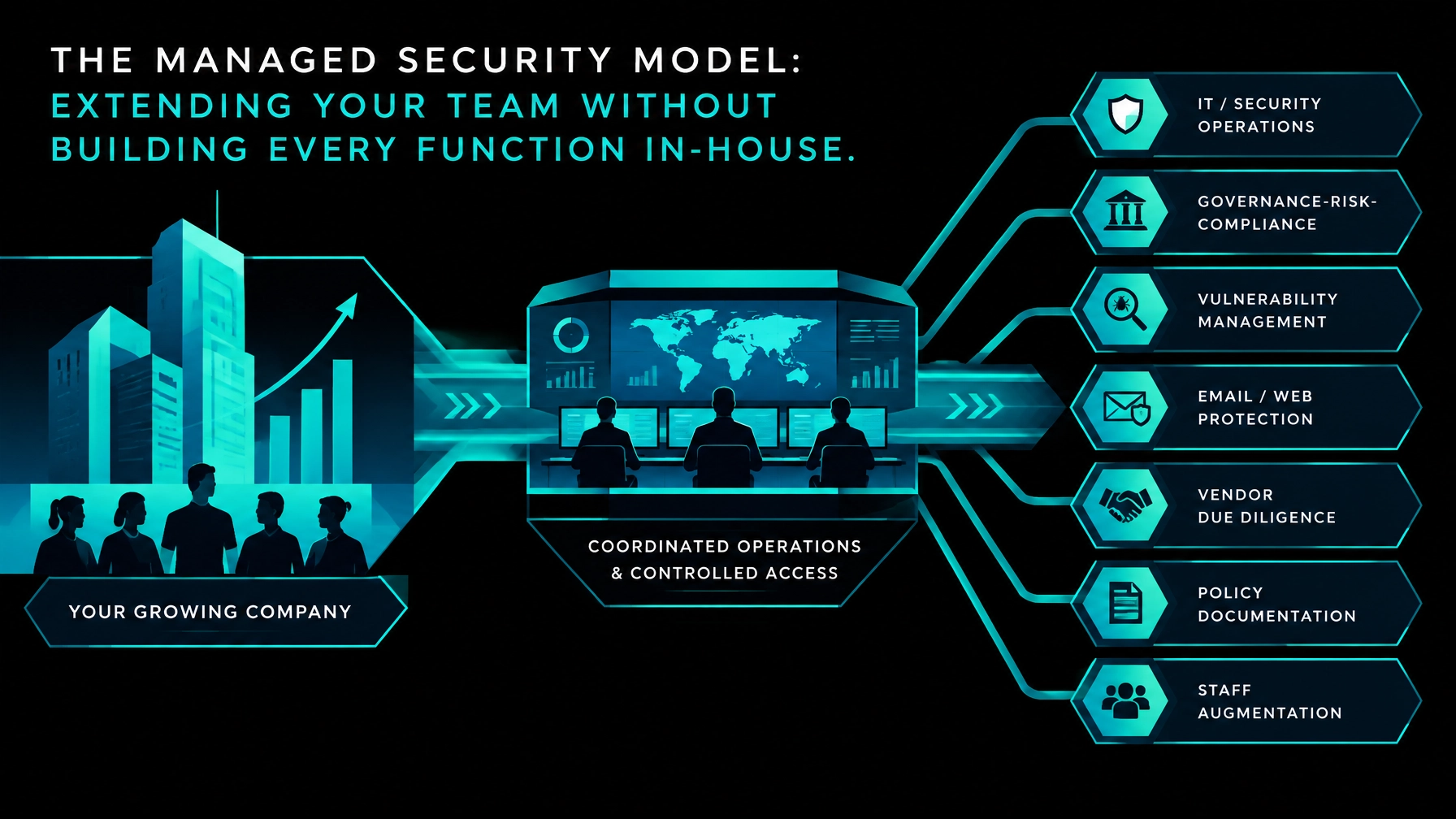
The managed security model extends your team without requiring you to build a complete security department, governance office, vulnerability practice, documentation function, or 24-hour response operation on your own.
The Infinity Group can coordinate these capabilities as part of a broader business development and execution strategy : from A to Z.
Managed Services Are a Strategic Operating Decision
Managed services are not simply a technology purchase. They are an operating model.
The decision affects how your company manages risk, responds to incidents, supports customers, documents procedures, prepares for government-facing opportunities, and allocates capital. Investors and senior decision-makers want to see that critical functions have owners, controls, reporting, and continuity.
Companies need security coverage. We can coordinate managed IT and security support.
Companies need governance, risk, and compliance structure. We can help organize the requirements, documentation, control responsibilities, and evidence pathways that qualified professionals must scope for your business.
Companies need vulnerability management. We can coordinate scanning, prioritization, remediation tracking, exception handling, and reporting.
Companies need email and web protections, vendor reviews, policies, procedures, security documentation, and additional personnel during periods of growth. We can help bring those functions into one practical plan.
The question is not whether you should outsource everything. The question is which capabilities should be made internally, which should be purchased or managed externally, and which should operate through a hybrid structure.

Make, Buy, or Hybrid: Choose With Discipline
A pure in-house model can provide direct control and close alignment with your internal systems. It also requires recruiting, training, retaining, and managing the personnel and tools needed to cover a wide range of responsibilities.
A managed model can provide broader access to specialized functions and operating coverage without requiring your company to hire every role immediately. It still requires internal ownership, oversight, and decision-making.
For many growing and mid-sized companies, a hybrid model is the practical path:
- Internal leaders retain ownership of business priorities, risk tolerance, policies, identity decisions, and material response decisions.
- Managed personnel support monitoring, triage, vulnerability operations, endpoint controls, email and web protections, documentation, and defined response activities.
- Internal IT and business teams remain responsible for approved remediation, operational continuity, and decisions affecting customers, contracts, and revenue.
- Executive leadership receives reporting that connects technical activity to business exposure and strategic priorities.
The appropriate model depends on your industry, systems, data, customers, contractual requirements, government obligations, risk profile, and available internal resources. We will help you evaluate the structure instead of allowing a vendor catalog to dictate your operating plan.
Define the Service Boundary Before the Work Begins
A managed services relationship performs best when the scope is written clearly. Broad promises create confusion. Specific responsibilities create execution.
Your service description should address:
- Managed IT and security operations
- Monitoring, alert review, triage, and defined response activities
- Vulnerability scanning and risk-based prioritization
- Endpoint, email, web, firewall, and related protective controls
- Governance-risk-compliance coordination and evidence support
- Vendor due diligence and third-party risk review
- Policy and procedure development
- Security documentation, runbooks, inventories, and system records
- Staff augmentation for technical, security, compliance, documentation, or project needs
- Reporting cadence, meeting structure, and executive review
- Out-of-scope work, change requests, travel, on-site response, and specialized assessments
Service-level expectations must also be practical. Define business hours and after-hours coverage. Define severity levels. Define the target for acknowledgment, triage, notification, escalation, and response initiation. Define which actions may be automated, which require approval, and which are outside the engagement.
A service-level agreement should support your actual risk priorities. A critical system supporting a government contract should not be governed by the same response expectation as a low-impact internal application.
Ownership, Access Controls, and Escalation
Managed does not mean ownerless.
Your company should retain ownership of business risk, policy approval, risk acceptance, identity governance, privileged access decisions, vendor relationships, business continuity, and executive communications. A managed team may perform important operational work, but your leadership remains accountable for the business.
Access must be controlled accordingly.
Require least-privilege access, role-based permissions, strong authentication, documented approvals, and timely removal of access when personnel change. Record who can isolate an endpoint, block an address, alter a firewall rule, reset an account, or modify a security policy.
A written escalation ladder should identify both organizations:
- Analyst or technician
- Operations or shift lead
- Incident manager
- Account or service owner
- Your internal IT or security lead
- Executive leadership for material business decisions
The escalation plan should state who is contacted, through which channel, and within what target time. It should also state who has authority to approve containment, customer communications, system shutdowns, legal review, or government notifications when applicable.

Governance and Documentation Make the Model Usable
Security operations without governance become a collection of alerts. Governance without operational support becomes a binder that no one uses.
The two must work together.
The Infinity Group can coordinate policy and procedure development covering acceptable use, access control, incident response, vulnerability management, vendor management, security awareness, change management, business continuity, and data handling. We can also support the documentation required to explain how your company operates, who approves decisions, and what evidence is maintained.
Governance-risk-compliance support may include:
- Control and responsibility mapping
- Policy and procedure registers
- Risk registers and treatment plans
- Vendor due diligence workflows
- Evidence collection schedules
- Exception and remediation tracking
- Management reporting
- Preparation support for qualified assessors, auditors, customers, and government-facing stakeholders
These services do not automatically make a company compliant, and documentation does not eliminate risk. They create a structured basis for qualified professionals and company leadership to evaluate requirements and make informed decisions.
Vulnerability Management Must Lead to Action
A vulnerability report is not a remediation program.
A disciplined model connects discovery to business context. The process should identify affected assets, determine whether the asset is critical, consider exploitability and exposure, assign an owner, establish a remediation target, record exceptions, and report aging over time.
Managed support can coordinate:
- Network, endpoint, server, cloud, and applicable web application scanning
- Asset coverage validation
- Risk-based prioritization
- Patch and configuration recommendations
- Remediation ticket coordination
- Compensating controls and documented exceptions
- Retesting and closure evidence
- Executive reporting on trends and unresolved exposure
Your internal team may execute the changes. Managed personnel may identify, prioritize, and track them. Leadership decides how much operational disruption is acceptable and where investment should be directed.
That is responsible ownership.
Reporting Should Support Growth and Investment
Reports should not bury leadership in technical volume. They should show whether the operating model is aligned with the company’s objectives.
Operational reporting may include alert volume, confirmed incidents, response activity, vulnerability aging, asset coverage, control status, open actions, and service-level performance.
Executive reporting should connect those facts to:
- Critical business systems
- Customer and contract requirements
- Government-facing readiness
- Investment priorities
- Expansion plans
- Material business risks
- Progress against the security roadmap
For investors, this demonstrates that the company is not treating security as an afterthought. For CEOs and founders, it creates a basis for making decisions. For mid-sized firms, it supports repeatable execution as the organization grows.
Transition In and Transition Out
A managed service should be designed for continuity, not dependency.
The transition-in plan should begin with an asset inventory, system map, identification of crown-jewel assets, current policies, existing incidents, open vulnerabilities, key contacts, and business priorities. Integration then proceeds through approved tools, accounts, log sources, endpoint agents, ticketing systems, communication channels, and reporting requirements.
A pilot period allows the teams to validate coverage, tune alerts, test playbooks, and correct ownership gaps before steady-state operations.
Transition-out requirements should be documented at the beginning. They should cover data export, incident records, configurations, procedures, detection logic where applicable, credentials, access revocation, documentation return, and reasonable handover support.

Cost Discipline Without False Promises
Managed services can provide access to expertise and capacity without requiring every function to be staffed internally. That does not mean every managed engagement costs less, and it does not mean savings, compliance, or protection are guaranteed.
The financial discipline comes from matching the service model to the mission:
- Pay for coverage your business actually requires.
- Separate recurring operations from one-time projects.
- Establish approval controls for out-of-scope work.
- Review tool overlap and unused licenses.
- Scale staff augmentation according to workload.
- Measure service performance against agreed objectives.
- Reassess the model as your company, contracts, systems, and risk profile change.
What is the cost of building and managing every function yourself? What is the cost of delaying a government opportunity because documentation is incomplete? What is the value of having experienced support available while your leadership concentrates on customers, capital, hiring, and execution?
The right answer is found through a scoped business analysis : not a slogan.
The Infinity Group Brings the Pieces Together
Companies need security operations. We can coordinate them.
Companies need governance and documentation. We can organize the work.
Companies need vulnerability management, email and web protections, vendor due diligence, procedures, reporting, and staff augmentation. We can support the full operating structure.
Companies need strategic growth aligned with disciplined execution. That is where our broader experience matters. We understand business development, government-facing organizations, investors, capital strategy, and the practical demands of moving from plans to action.
We will help you define the model, assign responsibility, establish service expectations, manage access, plan escalation, review reporting, and protect continuity : at reasonable costs and with clear next steps.
Managed capability. Clear ownership. Disciplined execution.
Extend the team. Strengthen the plan. Advance the business.
Contact The Infinity Group
To discuss your requirements, operating model, or next steps, contact connect@infinity-us.com or visit The Infinity Group contact page.
Comments and replies: disabled. Verified before scheduling.
At least three topic-specific charts and graphics are present in this article, including the make-buy-hybrid decision matrix, the managed security operating model, and the five-stage transition roadmap.
Sources
- National Institute of Standards and Technology : Cybersecurity Framework
- CISA : Cybersecurity Performance Goals
- Proficio : The SOC Dilemma: Build, Buy, or In Between
- ESET : How to Build or Buy a SOC: SOCaaS, MSSP, and MDR Compared
- NinjaOne : Choosing Between an In-House SOC and an MSSP
- The Infinity Group : Technical Operations
- The Infinity Group : Consulting Services
- The Infinity Group : Business Growth
Disclaimer
Managed IT, security, governance, risk, compliance, vulnerability management, documentation, and staff augmentation services must be scoped to your systems, industry, contracts, data, and applicable legal or regulatory requirements with qualified professionals. No service model guarantees compliance, savings, prevention, detection, response, or protection from every threat. The Infinity Group provides strategic coordination and business development support; final technical, legal, regulatory, and risk decisions should be made with appropriately qualified professionals.
