
In military planning, commanders do not protect every road, facility, and supply line in the same manner. They identify the mission, establish priorities, control access, prepare for disruption, and preserve the ability to continue operating.
CEOs must manage business resilience with the same discipline.
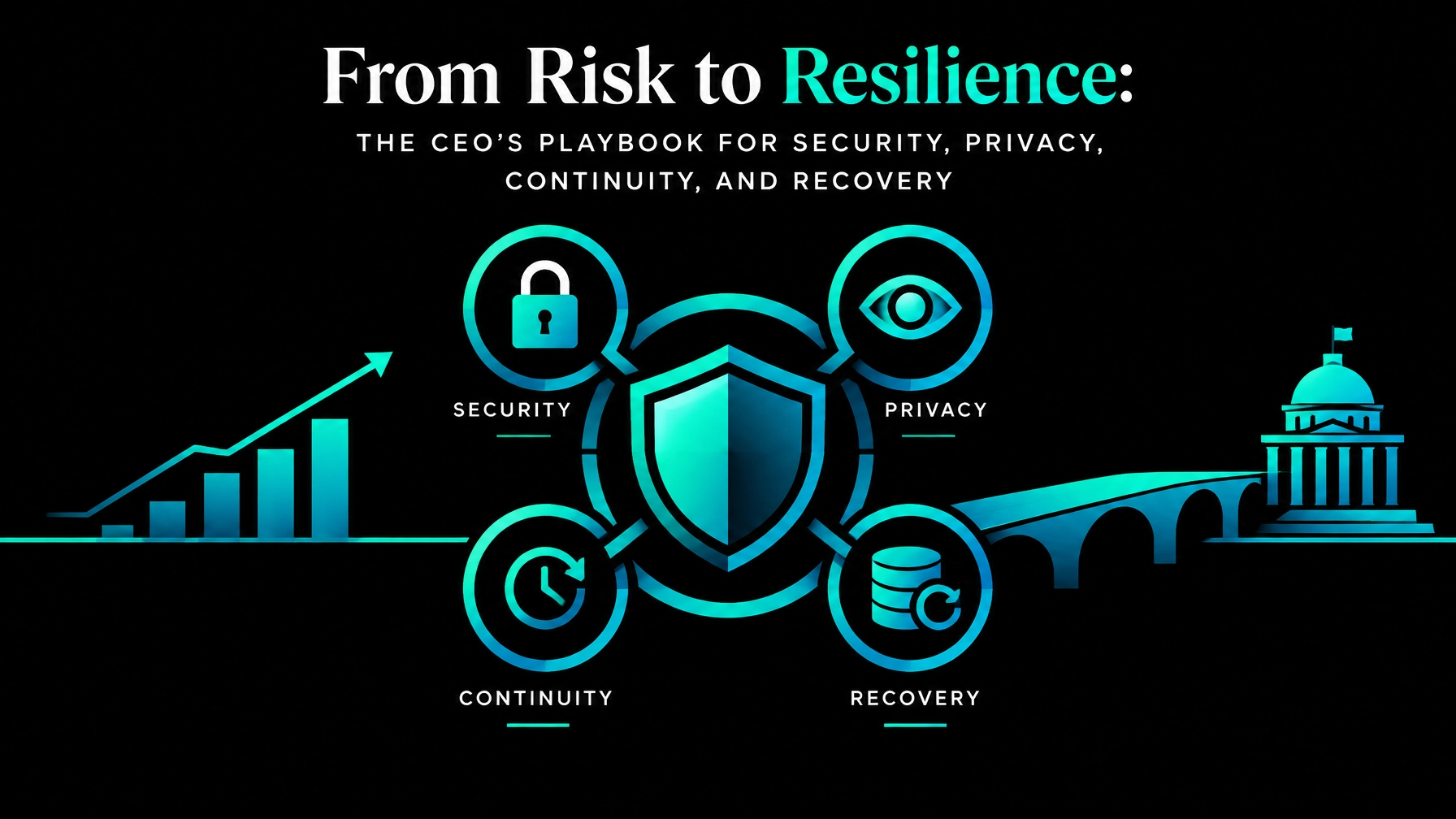
Security, privacy, continuity, and recovery are not separate technology projects. They are executive responsibilities tied directly to revenue, customer confidence, government-market readiness, capital diligence, and long-term growth.
The Infinity Group is a team of Business Development Architects. We coordinate the strategic, operational, financial, and institutional requirements that help organizations move from risk to resilience: from beginning to end and from A to Z.
Resilience Is a Business Operating Model
Companies need to know which services must continue, which data requires protection, which systems create the greatest exposure, and which decisions must be made during a crisis. We have the expertise to organize these questions into an integrated resilience program.
The structure is straightforward:
- Govern: Establish executive ownership, risk appetite, policies, reporting, and decision rights.
- Identify: Map critical services, systems, data, dependencies, vendors, and business impact.
- Protect: Apply access controls, network segmentation, data protection, training, and secure operating procedures.
- Detect: Monitor systems, accounts, vendors, and unusual activity.
- Respond: Activate incident response, communications, legal coordination, and executive decisions.
- Recover: Restore operations, validate data, execute continuity plans, and improve the program.
This model reflects the organization of the NIST Cybersecurity Framework 2.0, which is designed to help organizations manage cybersecurity risk across industry and government environments. It is not a substitute for contract-specific, legal, regulatory, or technical advice. It is a practical management structure.

Companies need a risk assessment that speaks in business terms. We can coordinate an assessment that identifies revenue exposure, operational dependencies, sensitive data, customer obligations, regulatory considerations, critical vendors, and recovery priorities.
A technical severity rating is not enough. A moderate technical weakness in a system supporting payroll, production, logistics, government deliverables, or customer records may be more urgent than a high-severity issue in an isolated environment.
Your risk register should show:
- The business service affected;
- The data and systems involved;
- The likely operational consequence;
- The responsible executive or manager;
- The current control;
- The remaining exposure;
- The cost and timing of remediation; and
- The decision required from leadership.
Privacy and Data Protection Must Follow the Mission
Companies need to know what information they hold, where it resides, who can access it, how it moves, and what happens if it is stolen, corrupted, unavailable, or improperly disclosed. We can coordinate data mapping, classification, access review, retention planning, backup validation, and protection requirements across your operating environment.
Your minimum data protection baseline should address:
- Multifactor authentication for critical systems and privileged users;
- Least-privilege and role-based access;
- Encryption in transit and at rest where appropriate;
- Tested, protected, and preferably immutable backups;
- Endpoint and cloud security controls;
- Logging and monitoring for critical services;
- Secure data transfer procedures;
- Employee security and privacy training; and
- Documented incident escalation.
Network segmentation is equally important. Companies need to limit the blast radius of a compromise. We can help coordinate the right technical and operational expertise to separate critical systems, administrative access, production environments, sensitive data, and ordinary commercial activity.
A segmented environment is not merely a separate folder or a different label. It is a documented, technically enforced boundary with controlled access and defined transfer points.
This is especially important for organizations pursuing federal opportunities. Your CMMC and government-contracting strategy must reflect actual contract requirements, information flows, and system scope. Resilience supports government-market readiness; it does not replace a qualified assessment, cybersecurity provider, or government contracts attorney.
Continuity and Recovery Must Be Demonstrated
Companies need a business-impact analysis before they spend heavily on recovery technology. We can coordinate the analysis that determines what happens if a service is unavailable for one hour, one day, or one week.
For every critical service, document:
- Maximum tolerable downtime;
- Recovery time objective, or RTO;
- Recovery point objective, or RPO;
- Internal and external dependencies;
- Manual workarounds;
- Required personnel;
- Required data and applications;
- Customer and contractual consequences; and
- The executive who can authorize recovery decisions.
Disaster recovery plans must connect to business continuity plans. A system may be technically restored while the business remains unable to deliver because a vendor, facility, employee group, integration, or physical process is unavailable.
Companies need to test their plans under pressure. We can coordinate tabletop exercises, technical recovery tests, communications drills, and after-action reviews. A test is not a failure because it reveals weaknesses. The failure is allowing those weaknesses to remain unknown.
The CISA guidance on cyber threats and response emphasizes the importance of identifying, managing, and limiting the spread of attacks. Your organization should also know who declares an incident, who can isolate systems, who contacts customers, who coordinates with counsel, who speaks to the public, and who authorizes extraordinary spending.
Third-Party Risk Is Executive Risk
Companies need to understand that a vendor can create the same operational impact as an internal failure. We can establish a tiered third-party risk program covering cloud providers, software vendors, managed service providers, logistics partners, manufacturers, subcontractors, and critical suppliers.
Begin with the top ten vendors by business impact. For each, confirm:
- What services the vendor provides;
- What data the vendor handles;
- What systems connect to the vendor;
- How quickly the vendor must notify you of an incident;
- How the vendor supports continuity and recovery;
- What security evidence is available;
- What happens if the vendor becomes unavailable; and
- Whether the contract provides meaningful protection.
Your procurement, legal, finance, operations, and security teams should use one coordinated process. We have that breadth. We can help connect contract review, operational dependency analysis, security requirements, and executive reporting.
Partner confidence is strengthened when you can explain your critical dependencies, recovery priorities, security controls, and improvement plan. No resilience program guarantees that an incident will not occur. A disciplined program demonstrates that your organization is prepared to manage disruption responsibly.
The CEO’s Practical 90-Day Roadmap
A 90-day program should create a reliable baseline, produce visible improvements, and establish the next investment decisions.

Days 1–30: Assess and Stabilize
Companies need clarity first. We can coordinate:
- A business-impact analysis for five to ten critical services;
- A rapid risk assessment;
- A one-page “Top Five Risks” register;
- A crown-jewels and sensitive-data inventory;
- A review of incident response and disaster recovery plans;
- A critical-vendor inventory and initial risk tiers;
- Backup integrity checks;
- Multifactor authentication priorities; and
- Executive decision rights and escalation thresholds.
STOP decision point: Stop expansion or new high-risk initiatives if critical services are unmapped, backups are unverified, privileged access is uncontrolled, or no executive can clearly declare and manage an incident.
SCALE decision point: Scale into the next phase when leadership has accepted the risk baseline, named owners, and approved immediate protective actions.
Days 31–60: Build and Integrate
Companies need controls that work together. We can coordinate:
- Network segmentation for critical systems;
- Access reviews and privileged-account controls;
- Data protection standards;
- Role-specific incident playbooks;
- Communications procedures;
- Recovery objectives aligned to business impact;
- A tabletop exercise design;
- Deeper reviews for Tier 1 vendors; and
- Board or executive reporting metrics.
Your metrics should remain practical: critical assets mapped, privileged accounts reviewed, backups tested, recovery plans validated, high-risk vendors addressed, and open remediation actions by business impact.
STOP decision point: Stop scaling the resilience program when controls exist only on paper, recovery dependencies remain unknown, or executives have not participated in a decision exercise.
SCALE decision point: Scale when critical controls are implemented, owners are accountable, and the organization can explain how it would respond to a material outage or cyber incident.
Days 61–90: Validate and Institutionalize
Companies need evidence, not assumptions. We can coordinate:
- An executive tabletop exercise;
- A recovery test for at least one crown-jewel service;
- After-action findings and remediation deadlines;
- A resilience scorecard;
- A 12- to 36-month investment roadmap;
- A formal governance cadence;
- Capital and staffing priorities; and
- A clear statement of remaining risk.

STOP decision point: Stop major growth commitments that depend on unproven systems, undocumented vendors, or recovery assumptions that have not been tested.
SCALE decision point: Scale when the organization has demonstrated recovery capability, established governance, and a prioritized plan for remaining exposure.
Resilience Supports Growth and Capital Diligence
Security and resilience are not obstacles to growth. They are part of the infrastructure that makes growth credible.
Companies pursuing investment need to answer diligence questions about customer data, intellectual property, operational continuity, vendor exposure, insurance, compliance obligations, and incident history. We can help organize these matters so that investors receive a clear view of risk, controls, priorities, and required capital.
Companies entering government markets need to demonstrate operational discipline, contract awareness, protection of sensitive information, and the ability to perform reliably. We can coordinate the broader strategy through our government-market resources, technical operations support, and business growth services.
Companies preparing for strategic partnerships, acquisitions, or expansion need a resilience position that supports confidence. We can help you present the program, the remaining gaps, the financial requirements, and the execution schedule.
The practical question is direct:
If a disciplined resilience investment protects a critical customer, preserves a government opportunity, improves capital diligence, and strengthens partner confidence, what is the cost of delaying it?
The answer belongs in the CEO’s operating plan.
The Infinity Group: From Risk to Resilience
The Infinity Group is a Business Development Architecture firm. We assist businesses with comprehensive strategies from A to Z, including resources, investment capital, government relationships, operational planning, and execution.
We can help coordinate risk assessments, incident response, disaster recovery, business-impact analysis, network segmentation, data protection, security training, third-party risk, executive governance, and measurable resilience. We bring private-sector expertise together with a deep understanding of federal and state agencies and Congress.
We do not promise that risk disappears. We build the structure, contacts, priorities, and execution plan that allow you to manage risk with greater discipline and pursue growth with stronger preparation.
Contact us at connect@infinity-us.com to discuss your 90-day roadmap, resilience priorities, government-market readiness, capital diligence, or next steps.
ASSESS THE RISK. PROTECT THE MISSION. PROVE THE RECOVERY.
RESILIENCE SUPPORTS GROWTH.
EXECUTION BUILDS CONFIDENCE.
THE INFINITY GROUP SUPPORTS BOTH.
Sources
- NIST Cybersecurity Framework 2.0
- CISA: Cyber Threats and Response
- CISA: Known Exploited Vulnerabilities Catalog
- CISA: StopRansomware
- The Infinity Group: Technical Operations
- The Infinity Group: Business Growth
- The Infinity Group: CMMC and CUI
- The Infinity Group: Services
General-information disclaimer: This article provides general business and risk-management information for educational purposes. It is not legal, cybersecurity, privacy, insurance, accounting, investment, regulatory, or government-contracting advice. Requirements depend on your organization, contracts, systems, data, industry, and jurisdiction. Obtain advice from qualified legal, technical, financial, and compliance professionals before making operational, certification, disclosure, or investment decisions.
Publishing setting: Comments and replies are disabled.
