Alexander the Great did not move an army across continents by improvising one decision at a time. He relied on preparation, intelligence, logistics, disciplined execution, and a clear objective. Raising capital for business requires the same standard of planning.
Mid-sized companies do not need a funding conversation first. They need a business development strategy that proves where the company stands, where it can grow, how it will execute, and what capital is required to support that plan.
This is why corporate strategy consulting should precede a capital raise. Investors, lenders, strategic partners, and government stakeholders want to see more than ambition. They want to see a company with a practical growth plan, management discipline, reliable financial information, and a defined use for capital.
At The Infinity Group, we are Business Development Architects. We help decision-makers organize the full development picture: from A to Z: using private-sector experience and a deep understanding of Federal and State government agencies, Congressional stakeholders, capital sources, and strategic partnerships.
The A-to-Z Pre-Capital Framework

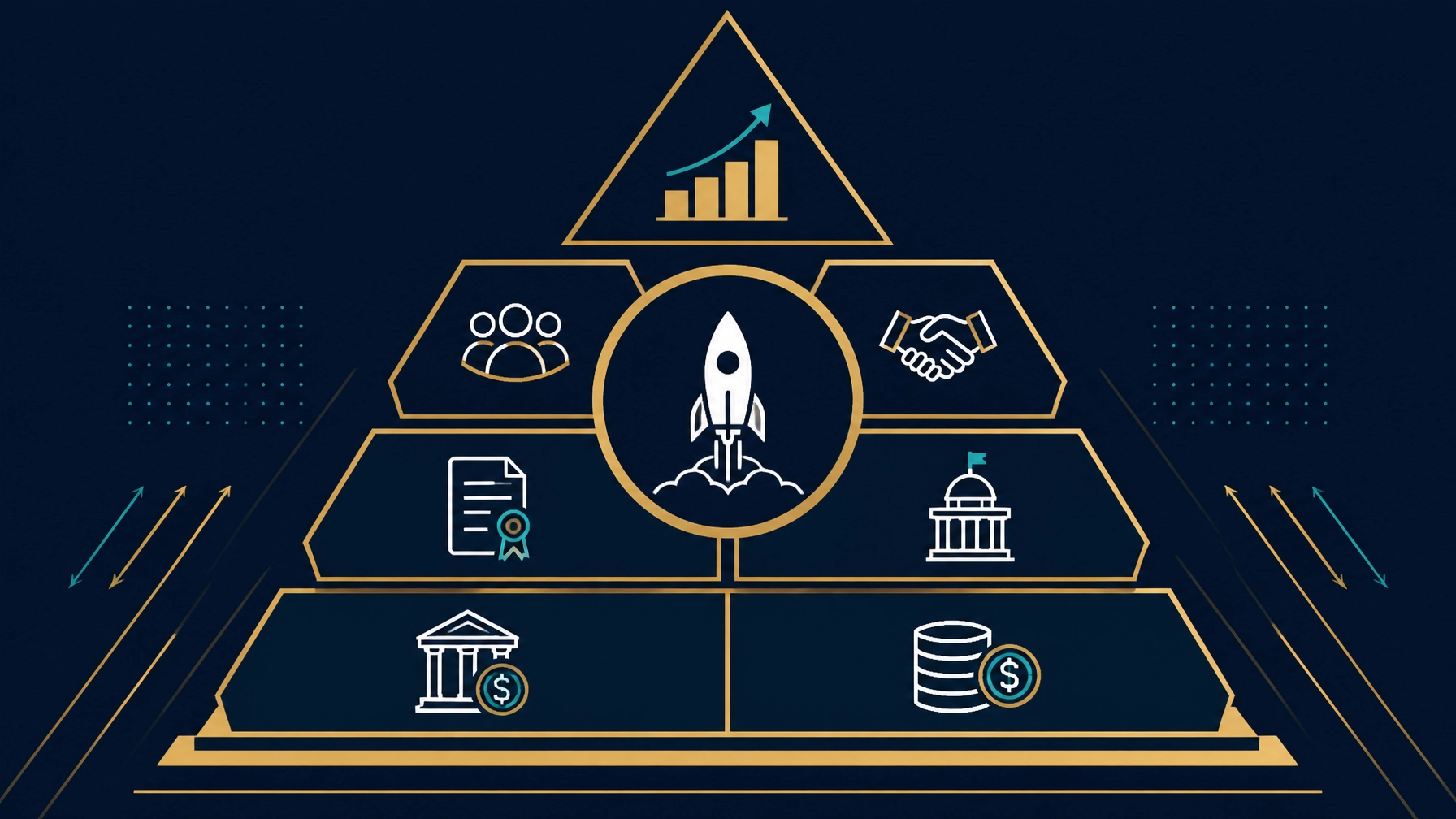
Caption: A disciplined capital strategy connects assessment, positioning, proof, funding, partnerships, resources, and execution.
A capital raise should be the result of a coherent strategy, not a substitute for one. Use the following framework to prepare your company.
1. Assess the Business Honestly
Begin with a structured assessment of the company’s current position. Review revenue, gross margin, customer concentration, retention, operating costs, cash position, delivery capacity, technology, contracts, leadership bandwidth, and internal controls.
You should be able to answer:
- What is working today?
- Which activities produce reliable revenue?
- Where are margins being lost?
- Which processes will fail under increased volume?
- What management roles or capabilities must be strengthened?
- What risks could limit strategic business growth?
Complete a SWOT analysis, but do not stop at general statements. Support each conclusion with operating evidence. A strong assessment identifies three to five major opportunities, three to five material risks, and the specific actions required to address each one.
Pre-capital checklist:
- Historical financial statements organized
- Revenue and margin trends documented
- Customer and contract concentration reviewed
- Operational constraints identified
- Leadership and staffing gaps listed
- Legal, compliance, and governance records assembled
2. Define Your Market Position
Capital providers back companies that understand the market they intend to win. Your company needs a clear ideal customer profile, a defined market position, and a practical explanation of why customers select your organization over alternatives.
Document your priority sectors, customer size, buyer roles, purchase triggers, competitive alternatives, pricing conditions, and market gaps. Then state your value proposition in one sentence.
A useful positioning statement answers four questions:
- Who do you serve?
- What business problem do you solve?
- What measurable value do you provide?
- Why are you better positioned than competing options?
Do not present ten disconnected growth ideas. Select two or three growth paths for the next 12 to 24 months: deeper penetration of current markets, adjacent industries, geographic expansion, new channels, product development, strategic alliances, or government-market entry.
Our business growth services are designed to help companies connect market opportunity to an executable development plan.
3. Prove Revenue and Operating Capability
A forecast is not proof. Investors need evidence that the company can acquire customers, deliver products or services, protect margins, and repeat the process.
Your proof may include:
- Recurring or repeat revenue
- Qualified sales pipeline
- Customer retention data
- Signed contracts or purchase orders
- Case studies and references
- Channel or partner agreements
- Delivery and fulfillment metrics
- Documented sales and operating procedures
- Certifications, intellectual property, or specialized capabilities
Mid-sized companies often have valuable operating history but present it poorly. Organize the evidence so a decision-maker can see the connection between your capabilities and your growth plan.
Revenue quality matters. Explain which revenue is contracted, recurring, repeatable, project-based, concentrated, seasonal, or dependent on one individual. Clear information increases confidence; unsupported claims weaken it.
4. Build the Management Plan
Capital does not execute itself. Management must convert resources into decisions, hires, contracts, customer relationships, and operating results.
Your management plan should identify:
- Executive responsibilities
- Department ownership
- Hiring requirements
- Reporting relationships
- Decision rights
- Advisory or board needs
- Key-person dependencies
- Performance measures
- Succession and continuity considerations
Investors want to know whether the organization can manage growth without losing control. That requires documented processes, financial oversight, customer accountability, and a leadership structure that matches the company’s next stage.
Companies need the right people in the right roles. We have the experience to help evaluate organizational requirements, strengthen strategic positioning, and align management responsibilities with business development objectives.
5. Connect the Strategy to a Financial Model
A financial model should explain how the business works: not simply display optimistic numbers.
Your model should include:
- Three to five years of projections
- Monthly or quarterly cash flow
- Revenue by customer, product, service, or segment
- Gross margin assumptions
- Operating expense requirements
- Hiring and compensation assumptions
- Customer acquisition costs
- Sales-cycle assumptions
- Retention and churn
- Working-capital requirements
- Base, downside, and upside scenarios

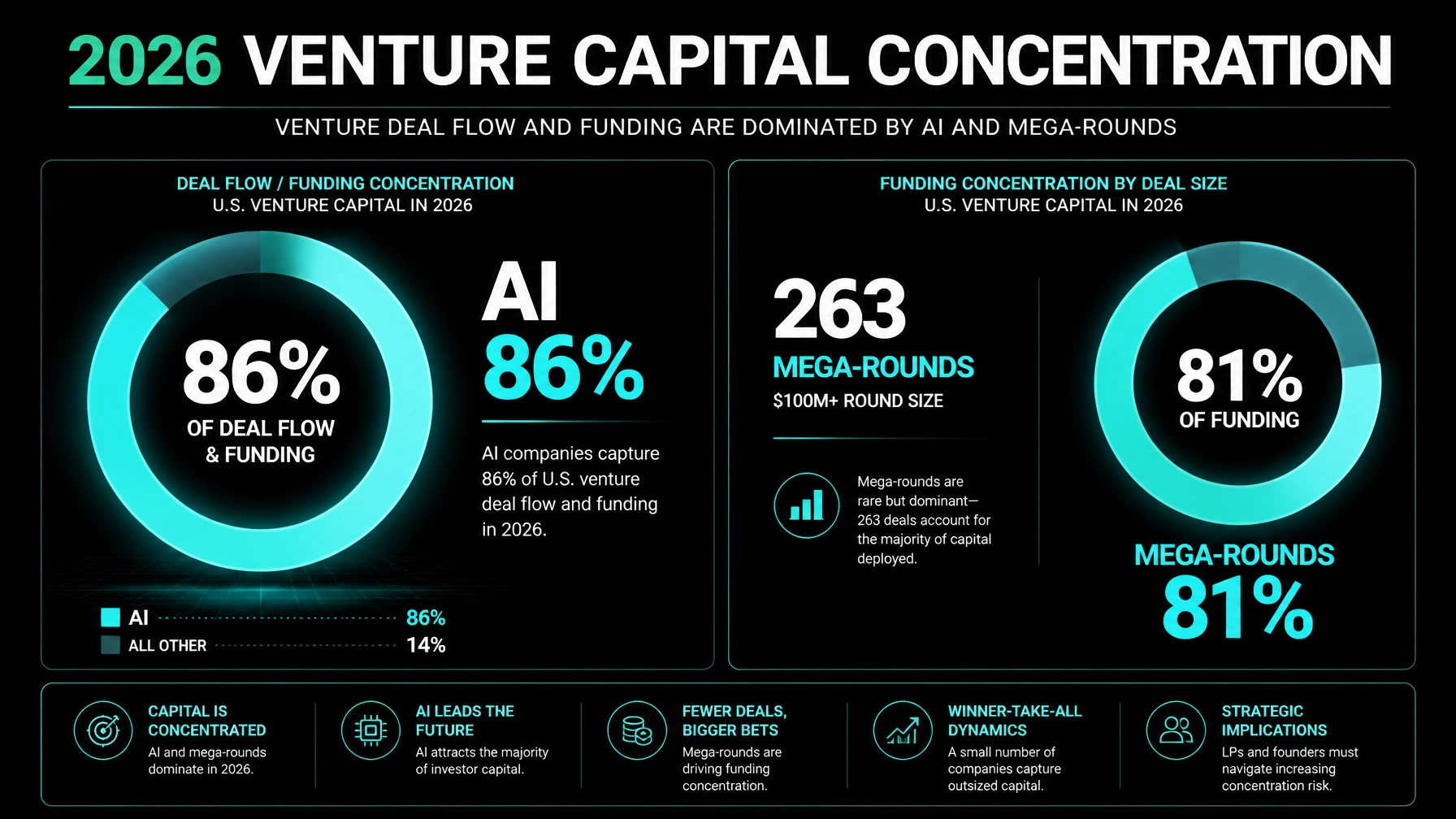
Caption: A useful financial model connects strategic choices to capital requirements, operating milestones, and measurable reporting.
Every major assumption must have a business reason. If revenue grows because you are entering a new market, explain the customer target, sales channel, staffing needs, timing, and expected cost. If margins improve, show which process, price, supplier, or product change produces that improvement.
Your model should also show how capital will be used. Separate funds for hiring, equipment, product development, marketing, expansion, working capital, technology, acquisitions, or government-market preparation. Then connect each allocation to a milestone.
6. Define the Capital Requirement
“ We need capital to grow ” is not a capital strategy.
State how much funding is required, when it is required, what form may be appropriate, and what the company expects to accomplish with the funds. Consider equity, debt, convertible instruments, strategic investment, asset-based financing, government-backed lending, grants, tax credits, and other resources where applicable.
The correct amount is determined by the plan. It is not determined by a round number selected before the strategy is complete.
Ask yourself:
- What does the company need to accomplish before additional capital is necessary?
- What milestones will the proposed funding support?
- How long will the capital extend operating capacity?
- What reporting obligations will follow?
- Which funding structure fits the company’s risk and cash-flow profile?
The SBA funding programs provide official information on programs such as 7(a), 504, and microloans. Eligibility, terms, and lender requirements vary. These resources should be evaluated as part of a broader funding plan: not treated as automatic sources of capital.
7. Target the Right Investors and Partners
Investor targeting is a business development activity. Do not distribute the same materials to every capital source.
Build a target list based on:
- Industry experience
- Investment size
- Geography
- Preferred ownership position
- Debt or equity preference
- Growth stage
- Strategic value
- Portfolio fit
- Government or commercial relationships
- Operating expertise
A strategic investor may provide customers, distribution, technology, manufacturing, or market access. A lender may focus on repayment capacity and collateral. An equity investor may focus on growth, governance, and potential value creation.
Your materials must reflect the decision-maker’s priorities. Prepare a concise presentation, an executive summary, a use-of-proceeds schedule, a financial model, and a secure data room containing financial, legal, operational, customer, contract, and governance documentation.
8. Develop Partnerships and Government Resources
Partnerships can improve growth economics and strengthen the capital story. Evaluate distributors, suppliers, technology providers, prime contractors, channel partners, research institutions, and complementary service providers.
For companies pursuing government-facing opportunities, the strategy must also account for agencies, programs, acquisition pathways, stakeholders, budgets, procurement requirements, and Congressional considerations.
The Infinity Group’s government expertise includes opportunity research, procurement strategy, program analysis, competitive positioning, teaming strategy, proposal planning, and capability alignment. We understand that successful government business development requires more than identifying an opportunity. It requires positioning, relationships, resources, and execution.
Non-dilutive resources may include grants, tax credits, export programs, training support, research programs, or government-backed financing. Grants.gov is the official federal source for organizational grant opportunities. Eligibility and application requirements must be verified for each program.
9. Establish Milestones and Risk Management
A capital plan becomes credible when it includes measurable milestones and a process for managing risk.
Use milestones such as:
- Revenue targets
- Gross-margin targets
- Customer or contract acquisition
- Product or service launch
- Hiring completion
- Geographic or sector expansion
- Partnership activation
- Government opportunity stage
- Operating-cost control
- Cash and liquidity thresholds
For each milestone, assign an owner, deadline, budget, and reporting measure. Then document the risks that could prevent completion.
Your risk register should cover:
- Customer concentration
- Pricing pressure
- Supply-chain disruption
- Hiring and retention
- Regulatory exposure
- Cybersecurity
- Contract dependence
- Cash-flow timing
- Execution capacity
- Key-person reliance
Risk management is not a negative presentation. It demonstrates that management understands the operating environment and has prepared responses.
A Practical 90-Day Pre-Raise Plan

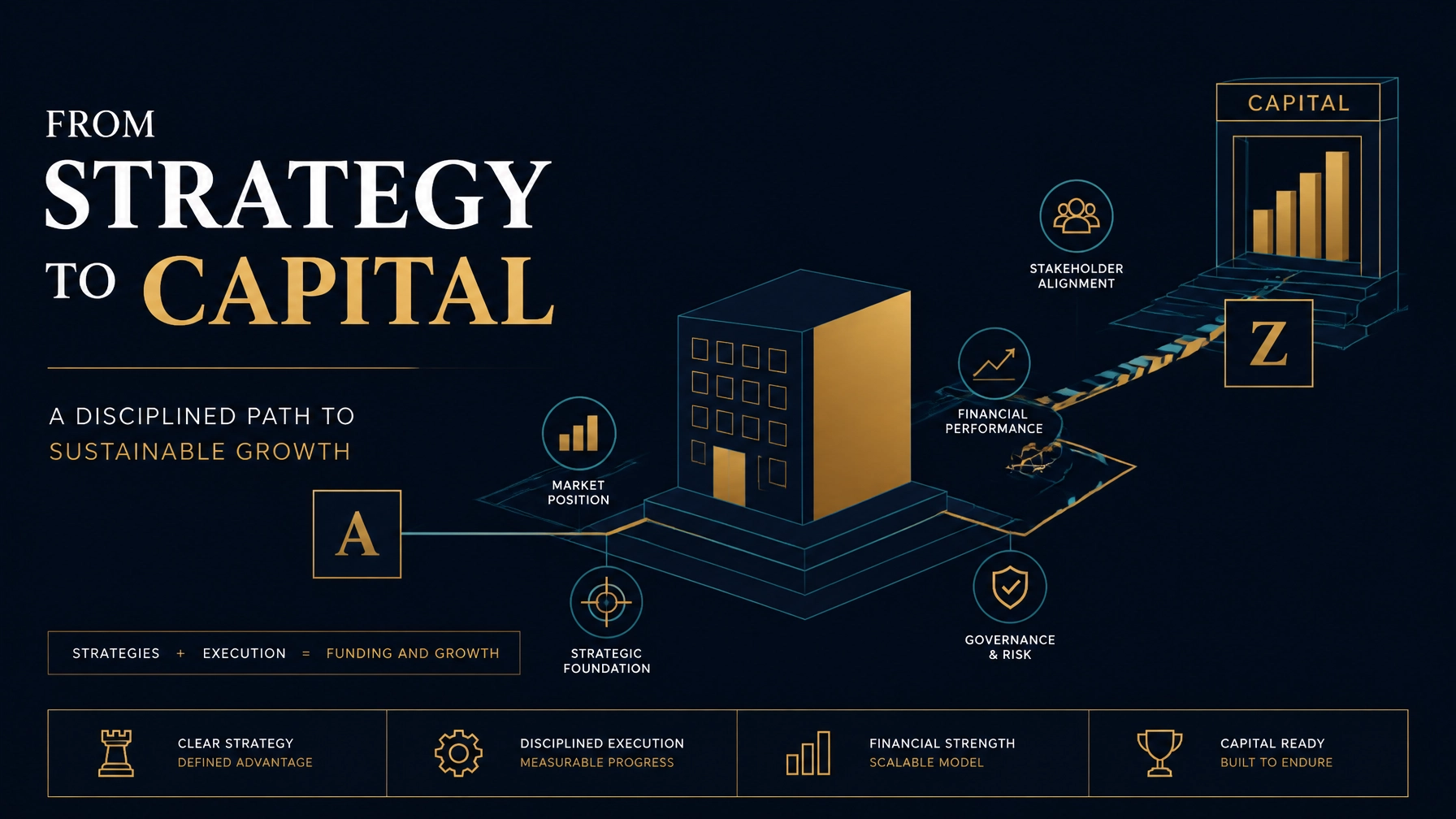
Caption: The first 90 days should convert business information into an organized strategy, financial plan, and capital-readiness package.
Days 1–30: Assessment
Complete the internal business review, market map, customer analysis, SWOT, risk register, and operating-capacity review.
Days 31–60: Strategy and Financial Model
Finalize your positioning, priority growth paths, management plan, financial scenarios, capital requirement, use of proceeds, and KPI structure.
Days 61–90: Readiness and Outreach
Prepare the investor presentation and data room. Prioritize investors and strategic partners. Evaluate government and non-dilutive resources. Begin qualified conversations only after the materials and strategy are aligned.
Why The Infinity Group
Mid-sized companies need more than a presentation deck. They need strategic development that connects market position, operating proof, management, capital, partnerships, government resources, and execution.
The Infinity Group serves companies across industry sectors as Business Development Architects. We combine private-sector expertise with relationships and knowledge involving Federal and State agencies, Congress, government programs, capital development, and strategic growth.
We can help you assess your position, develop your business development strategy, strengthen investor readiness, organize your capital requirements, identify relevant partnerships, evaluate government-facing opportunities, and establish a practical execution plan.
The question is straightforward: if disciplined strategy can improve the quality of your capital conversation, clarify your use of funds, and protect your company from avoidable mistakes, what is that preparation worth compared with the cost of raising capital without it?
We will discuss your objectives, review your present position, and help determine the appropriate next steps at reasonable costs. Begin with our services, review the industries we support, or contact The Infinity Group to discuss your plan.
STRATEGY FIRST. EXECUTION ALWAYS.
CAPITAL WITH PURPOSE. GROWTH WITH DISCIPLINE.