
Almost 2,000 years ago, Hannibal demonstrated that strategy could defeat superior numbers, superior resources, and a larger industrial base. He did not win by meeting Rome on Rome’s terms. He won by selecting the ground, understanding the opposition, and executing a plan.
That is the lesson for founders raising capital in 2026.
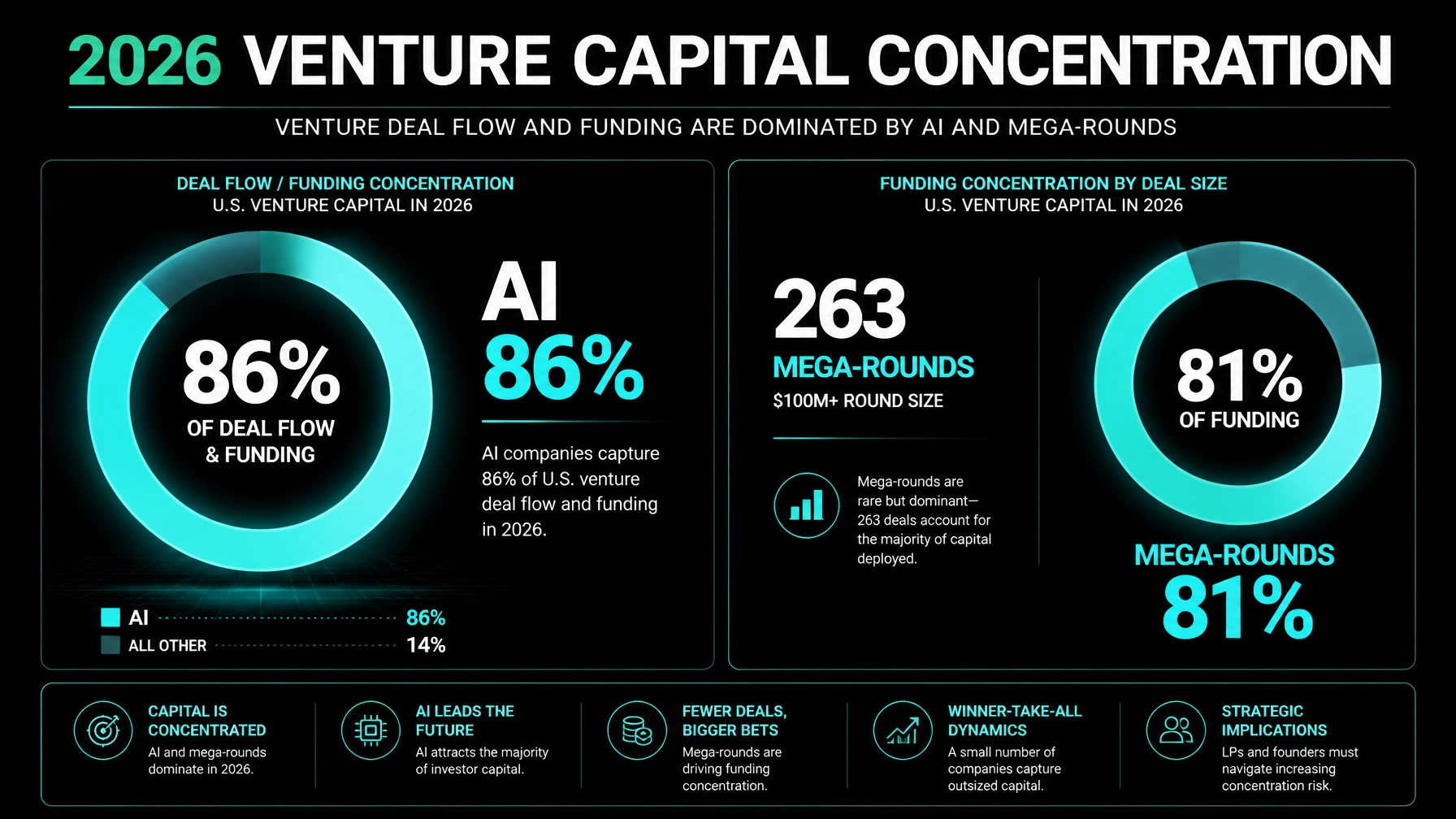
The venture market is producing record headline numbers, but access to that capital is highly concentrated. Global venture funding reached approximately $510 billion in the first half of 2026. AI companies captured approximately 86% of deployed U.S. venture dollars, while 263 mega-rounds represented approximately 81% of total funding in the period reported by market analysts.
The result is a two-level market: a small number of AI companies receiving extraordinary rounds, and a much larger group of startups and mid-sized companies competing for attention, disciplined checks, strategic investors, government resources, contracts, and revenue-based growth.
You can still raise capital. But you must raise it with a complete strategy.
The 2026 Market Is Concentrated : Not Closed
The first mistake is assuming that a record funding year means capital is broadly available. It does not.
Capital is moving toward a limited number of companies with:
- Artificial intelligence infrastructure;
- Proprietary data;
- Large enterprise contracts;
- Rapid revenue growth;
- Strong retention;
- Defensible technology;
- Experienced management teams;
- Large addressable markets;
- Clear paths to substantial financial return.
AI has captured the largest share of attention because investors expect major changes across nearly every industry. But investors are not funding every company that adds an AI feature. They are funding companies that can prove why their technology matters, why customers will pay, and why competitors cannot easily duplicate the result.
If you are not an AI company, you must not pretend to be one. You must show why your business solves an enduring problem, produces measurable value, and can generate attractive returns with disciplined use of capital.
If you are an AI company, you must show more than a demonstration. You must show proprietary data, customer adoption, gross margin, retention, distribution, security, compliance, and a credible operating model.
The market is not rewarding general statements. It is rewarding evidence.
Step One: Define the Capital You Actually Need
Companies often begin fundraising by asking, “Who will invest in us?”
The better question is: What type of capital will move the company to its next measurable milestone?
A venture round may be appropriate. It may also be only one part of the answer.
Your capital plan can include:
- Venture capital;
- Angel investors;
- Strategic corporate investors;
- Family offices;
- Private equity;
- Equipment financing;
- Bank financing;
- Federal grants;
- State and local economic development programs;
- Research and development funding;
- Government contracts;
- Commercial revenue;
- Joint ventures;
- Licensing;
- Acquisitions or strategic partnerships.
Venture capital is generally designed for companies with high growth potential and a path toward a major liquidity event. Federal and State funding may support research, product development, workforce expansion, infrastructure, or commercialization. Government contracts can create revenue, customer validation, and operating scale without requiring the same level of equity dilution.
This is why a founder should not approach fundraising as a single transaction. You need a capital architecture.

Step Two: Build an Investor-Ready Business Case
In a concentrated market, your materials must answer the investor’s questions before the investor asks them.
Your business plan, presentation, financial model, and data room should clearly establish:
- The problem: Who has the problem and what does it cost them?
- The solution: What do you provide and why is it better?
- The market: How large is the opportunity?
- The customer: Who pays, how much, and how often?
- The traction: What revenue, contracts, users, retention, or partnerships exist?
- The economics: What are your gross margins, customer acquisition costs, payback period, and lifetime value?
- The competition: Why will you win?
- The management: Why does your team have the expertise to execute?
- The capital request: How much are you raising?
- The use of funds: What will the money accomplish?
- The milestone plan: What will be true 12 to 18 months after the investment?
- The return: How can the investment become substantially more valuable?
An investor does not want to fund uncertainty without a plan for reducing it.
If you are raising a seed round, explain the milestones that lead to your next round. If you are raising a Series A, demonstrate repeatable sales, customer retention, and a growing commercial engine. If you are a mid-sized company seeking expansion capital, show contracts, operating history, margins, acquisition opportunities, and the exact use of new capital.
A clean data room should include your cap table, financial statements, tax records, customer contracts, intellectual property records, employment agreements, organizational documents, forecasts, and material litigation or regulatory information.
Preparation communicates management quality.
Step Three: Stop Chasing Only the Largest Venture Funds
The largest fund is not automatically the right fund.
In 2026, many brand-name investors are concentrating their attention on frontier AI, infrastructure, and very large later-stage rounds. That does not mean they are the best source of capital for your company.
Develop a target list based on:
- Investment stage;
- Check size;
- Industry focus;
- Geography;
- Partner relationships;
- Portfolio conflicts;
- Follow-on capacity;
- Recent investments;
- Strategic value;
- Government or corporate relationships;
- Experience with your type of commercialization.
Target 50 to 100 potential investors. Separate them into priority groups. Identify 10 to 15 investors who are highly aligned with your business and seek introductions through customers, advisors, board members, attorneys, accountants, industry executives, existing investors, and strategic partners.
A warm introduction is useful, but a strong investment case is decisive.
Run the process in a compressed schedule. Hold meetings within the same one- to two-week period when possible. Follow up within 24 hours. Send requested information promptly. Provide progress updates every two to three weeks. Maintain a written record of each conversation, concern, request, and next action.
Fundraising is a campaign. It requires command, timing, discipline, and follow-through.
Step Four: Use Government Funding and Contracting as a Capital Strategy
Founders frequently overlook Federal and State resources because they believe venture capital is the only serious form of growth capital.
That is a costly mistake.
Federal contracting remains a substantial market for qualified small businesses. The SBA reported that in FY2025, small businesses received approximately $179 billion in prime federal contract awards, representing nearly 28% of eligible prime contracting dollars. Including prime contracts and subcontracts, the total was approximately $273 billion.
Some market reports use figures near $195 billion and cite set-aside access above 48%, depending on whether they are measuring prime awards, subcontracts, solicitations, categories, or a specific agency program. These figures should be defined carefully before they appear in an investor presentation. The opportunity is real, but so are the requirements.
Federal and State contracting can support a broader capital plan through:
- Paid pilot programs;
- Research and development contracts;
- Commercialization opportunities;
- Agency partnerships;
- Small business set-asides;
- State procurement;
- Technology demonstrations;
- Manufacturing and infrastructure programs;
- Subcontracting relationships;
- International government and business opportunities.
Compliance costs are rising. Registration, certifications, cybersecurity, accounting systems, proposal controls, contract terms, labor requirements, and reporting obligations must be managed correctly.
This is where strategy matters. A government opportunity is not valuable merely because it exists. Your company must be qualified, positioned, compliant, capable of performing, and connected to the right acquisition path.
Step Five: Present a Specific, Defensible Investment Thesis
Your pitch must answer one central question:
Why should this investor place capital with your company instead of the hundreds of AI opportunities already in the pipeline?
Your answer should be specific.
You may be:
- A non-AI company with dependable recurring revenue;
- A vertical software company with deep customer relationships;
- A defense or aerospace company aligned with Federal priorities;
- A healthcare company solving a measurable operational problem;
- A manufacturing company with contracts and expansion capacity;
- An infrastructure company supporting data, energy, logistics, or communications;
- An AI company with proprietary data and a clear commercial wedge;
- A mid-sized company ready for acquisition or geographic expansion.
Do not lead with a general vision. Lead with the commercial facts.
Show the customer. Show the contract. Show the margin. Show the repeatability. Show the market. Show the barrier to entry. Show the use of funds. Show the return.

The Infinity Group Approach: Business Development Architecture From A to Z
The Infinity Group was formed in 1994 and has provided business development support for more than 30 years. Our primary focus is the Washington Metropolitan Area, with relationships involving industry, Federal agencies, and Congress. Our partners include industry executives and retired military officers from the Army, Air Force, Navy, and Marines.
Our associates complete coverage across Federal agencies, U.S. Congress, State and local governments, international governments, and international businesses.
That breadth matters when you are raising capital in a concentrated market.
We can help develop the business plan, identify investment capital, organize the management strategy, establish the marketing plan, identify customers, develop government opportunities, support technical requirements, evaluate acquisitions, coordinate international business development, and prepare the company for larger financing, an IPO, or a sale.
We can support private-sector capital and government-sector resources. We can help determine which path should come first, which paths can operate together, and which milestones will create the strongest financial position.
Our specialties include business plans, investment capital, marketing, strategies, government relationships, international business development, mergers and acquisitions, technical support, and IPO preparation. Our government expertise covers major Federal departments, defense organizations, NASA, transportation, justice, commerce, health, homeland security, and Congress.
Companies need a plan. We have that expertise.
Companies need capital. We can identify private, Federal, State, local, and strategic sources.
Companies need customers and revenues. We will support the strategy to identify and win new business.
Companies need technical and operational support. We can provide it directly or through our partners.
Companies need execution from beginning to end. We are Business Development Architects.
Raise Capital With a Complete Plan
The question is not whether your company can compete with the largest AI financings.
The question is whether you have built a strategy that allows the right investor, agency, customer, or strategic partner to recognize your value.
Is a $50,000 investment in strategy, preparation, relationships, and execution worth revenues of $500,000, $1 million, $2 million, and more?
The answer depends on the plan and the execution.
We have the experience, contacts, and capability to help fulfill your business needs at reasonable costs. Contact The Infinity Group to discuss your company, your capital requirements, your target market, and the next steps.
YES. YES. YES.
CAPITAL NEEDS A STRATEGY.
STRATEGY NEEDS EXECUTION.
BUSINESS IS OUR BUSINESS.