Author: Social Media

  • Continuous Compliance: Why an Annual Audit Is Not a Security Strategy

    Continuous Compliance: Why an Annual Audit Is Not a Security Strategy

    Infinity Group Insights : Article 4 of 7

    Great commanders do not inspect their defenses once a year and assume the mission is secure. They establish a daily operating rhythm: assess the perimeter, update the plan, monitor activity, train personnel, rehearse response, and correct weaknesses before the next engagement.

    Your compliance program requires the same discipline.

    An annual audit may provide a useful point-in-time review. It does not, by itself, create secure operations, reliable evidence, prepared employees, or documented corrective action. Continuous compliance is the operating discipline that keeps your business prepared throughout the year: before an audit, government contract review, investor diligence process, customer questionnaire, or major growth event.

    The Infinity Group Insights series examines how companies can build stronger strategies, execution plans, and capital readiness. Article 4 focuses on the compliance systems that support sound growth.

    Annual Audits Show a Moment. Continuous Compliance Shows the Business.

    An annual audit is a scheduled event. Continuous compliance is a management system.

    The difference is important. A point-in-time review may identify whether selected controls and documents are available on the review date. A continuous program helps leadership understand whether those controls operate consistently as systems, vendors, policies, people, and risks change.

    Companies need current visibility into their vulnerabilities; we have the strategic coordination to organize assessments, qualified technical support, reporting, and corrective action.

    Companies need policies that reflect actual operations; we can coordinate policy updates with changes to systems, contracts, personnel, suppliers, and business priorities.

    Companies need evidence that is produced during normal work; we can help establish ownership, schedules, repositories, and reporting processes so evidence is managed throughout the year instead of reconstructed under pressure.

    The annual audit remains one input. It should not be the entire strategy.

    Continuous compliance cadence showing monthly, quarterly, and annual operating activities

    Continuous Compliance Is a Recurring Operating Discipline

    Continuous compliance does not mean that every control must be checked every minute. It means that the organization establishes a documented cadence, assigns responsibility, measures performance, and responds when conditions change.

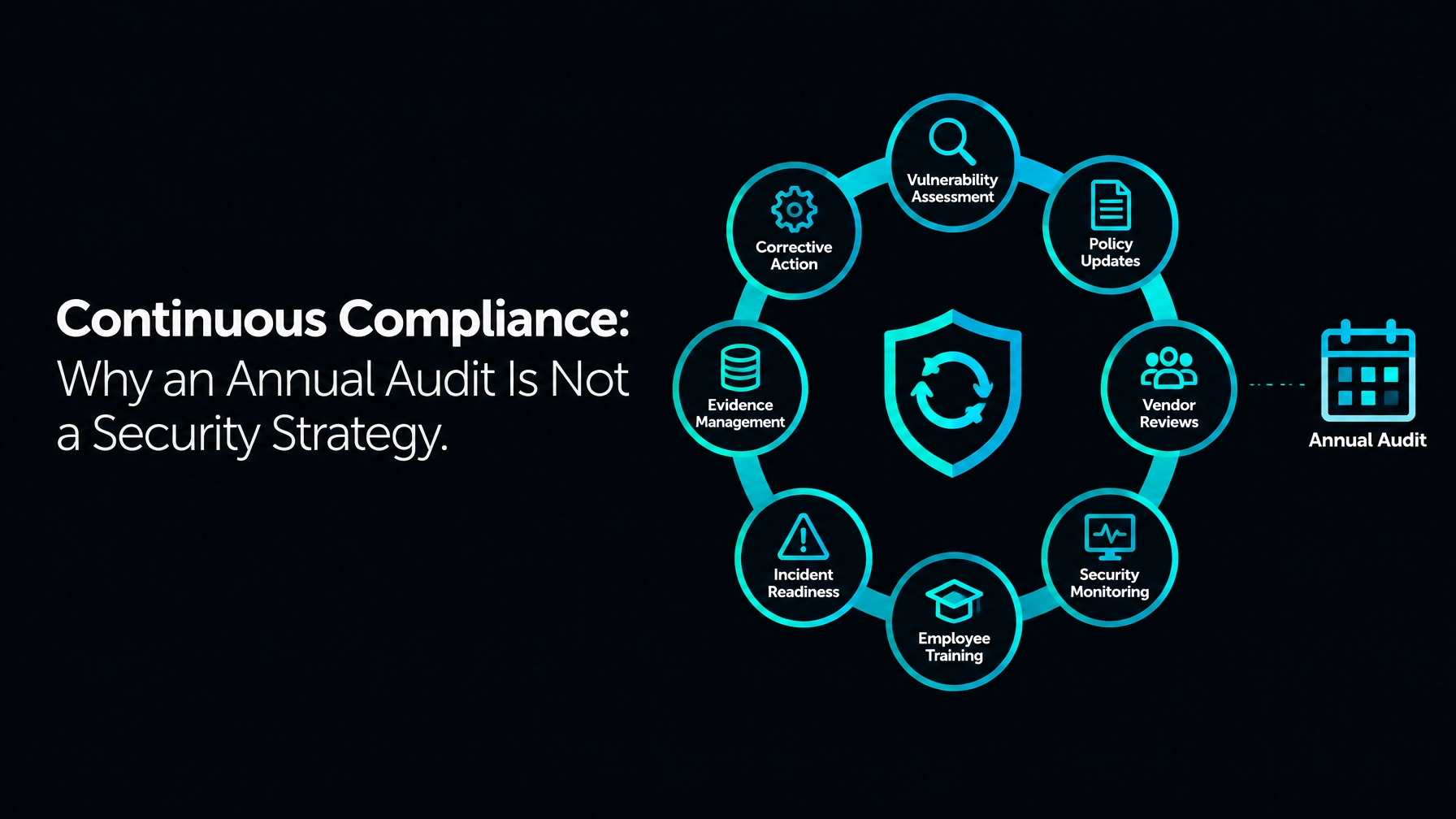
    A practical program includes the following operating areas:

    Vulnerability Assessments

    Vulnerability assessments identify weaknesses in applications, infrastructure, endpoints, cloud services, and other technology environments. The value comes from the complete process: not merely from producing a scan report.

    Your organization should track:

    • Number of open vulnerabilities by severity;
    • Age of critical and high-priority findings;
    • Percentage remediated within internal target periods;
    • Repeated findings and root causes;
    • Systems not covered by assessment activity; and
    • Exceptions that require documented business approval.

    The objective is not to claim that every vulnerability can be eliminated. The objective is to identify exposure, prioritize action, document decisions, and verify that corrective work is completed.

    Policy Updates

    Policies must match how your business actually operates. A policy written two years ago may not reflect remote work, new vendors, artificial intelligence tools, cloud migrations, acquisitions, or government contract requirements.

    Track:

    • Policies reviewed during the quarter;
    • Policies changed because of business or technology developments;
    • Employee acknowledgement rates;
    • Exceptions and approved deviations;
    • Policy owners and review dates; and
    • Gaps between policy language and operating practice.

    Companies need policies that can be followed and demonstrated; we can coordinate policy owners, subject-matter specialists, leadership review, and evidence collection.

    Vendor Reviews

    Your security and compliance posture is affected by the providers that process data, host systems, support operations, or access business information.

    A vendor review process should measure:

    • Critical vendors with current risk records;
    • Vendors with expired assessments or agreements;
    • Services with access to sensitive information;
    • Contractual security requirements;
    • Vendor incidents and response performance;
    • Business continuity and recovery information; and
    • Outstanding vendor corrective actions.

    Review vendors according to risk. A payroll provider, managed technology provider, cloud platform, and low-risk office supplier should not automatically receive the same level of review.

    Security Monitoring

    Monitoring provides operational visibility between formal assessments. Leadership should understand whether logging, alerting, endpoint protection, identity controls, and escalation processes are functioning as expected.

    Monthly reporting may include:

    • Alerts received and investigated;
    • Incidents classified and closed;
    • Monitoring coverage across critical systems;
    • Failed or unusual authentication activity;
    • Privileged access activity;
    • Unresolved alert backlogs; and
    • Mean time to acknowledge and resolve priority events.

    The goal is not to produce impressive numbers. The goal is to identify where the organization sees activity, where it does not, and whether the response process is working.

    Employees and Incident Readiness Are Core Controls

    Technology does not operate independently. Employees create, access, transmit, approve, and protect information every day.

    Training should be scheduled for new hires, role changes, policy updates, and recurring awareness. Measure:

    • Completion rates by department;
    • Overdue training;
    • Completion time for new employees;
    • Training related to privileged or sensitive roles;
    • Repeated user mistakes; and
    • Lessons incorporated into future training.

    Incident readiness also requires practice. A response plan stored in a folder is not the same as a response capability tested by decision-makers.

    Quarterly or semi-annual exercises can examine:

    • Who declares an incident;
    • Who contacts leadership;
    • Who preserves evidence;
    • Who communicates with customers or partners;
    • Who coordinates technology recovery;
    • How vendors participate; and
    • How decisions are documented.

    This is an operating exercise, not a prediction of a specific event. It establishes roles, exposes confusion, and creates corrective actions before an actual disruption.

    Eight-step continuous compliance loop showing assessment, policy, vendors, monitoring, training, readiness, evidence, and correction

    Evidence Management Turns Activity Into Demonstrable Control

    Evidence should be created as part of business operations. Access approvals should live in a traceable workflow. Training records should be retained. Vulnerability reports should connect to remediation tickets. Vendor reviews should show decisions and follow-up. Incident exercises should produce meeting records, findings, and assigned actions.

    A useful evidence structure identifies:

    • The control or requirement;
    • The responsible owner;
    • The evidence required;
    • The source system or repository;
    • The review frequency;
    • The retention period;
    • The reviewer; and
    • The corrective action process.

    Companies need evidence that is organized, current, and connected to responsible people; we can coordinate reporting structures, documentation workflows, management reviews, and qualified specialist support.

    Evidence management also protects leadership from an unreliable “hero system,” where one employee knows where everything is stored and manually prepares every response. That approach creates concentration risk and becomes increasingly difficult as the business grows.

    Documented Corrective Action Is the Measure of Maturity

    Every program will identify weaknesses. Mature organizations do not hide that fact. They record the issue, assign an owner, set a target date, evaluate the risk, and document the result.

    Each corrective action should include:

    1. The identified condition;
    2. The affected system, process, vendor, or department;
    3. The risk or business impact;
    4. The assigned owner;
    5. The planned action;
    6. The target completion date;
    7. Any approved exception;
    8. Evidence of completion; and
    9. Management disposition of remaining risk.

    Measure the number of open actions, overdue actions, aging by priority, recurring findings, and actions closed with verified evidence. These measures show whether the organization is improving or simply recording the same problems repeatedly.

    Executive remediation and budgeting matrix showing how exposure and business impact guide prioritization

    How to Measure Monthly and Quarterly

    A practical cadence keeps the program active without making every activity an emergency.

    Monthly

    Review:

    • Security alerts and incidents;
    • Vulnerability remediation progress;
    • Critical system coverage;
    • Privileged and high-risk access;
    • New and retired vendors;
    • Policy acknowledgements;
    • Training completion;
    • Open corrective actions; and
    • Evidence collection exceptions.

    The monthly review should produce a concise management report. It should identify what changed, what remains open, who owns the work, and which decisions require executive attention.

    Quarterly

    Conduct a deeper review of:

    • Vulnerability assessments and remediation trends;
    • Access rights for critical systems;
    • High-risk vendor reassessments;
    • Selected policy updates;
    • Incident response or business continuity exercises;
    • Evidence completeness;
    • Risk register changes;
    • Scope changes caused by new products, contracts, or acquisitions; and
    • Budget requirements for the next quarter.

    Quarterly reviews should result in documented decisions: not just presentations. Leadership should approve priorities, assign resources, accept or reject exceptions, and confirm the next operating cycle.

    Annually

    An annual review can consolidate the year’s evidence, refresh the enterprise risk assessment, review the full policy set, evaluate the vendor population, and prepare the organization for external scrutiny where applicable.

    The annual event becomes more valuable when it confirms an operating program rather than discovering the program for the first time.

    How to Budget and Prioritize Remediation

    Compliance budgeting should separate three categories:

    • Critical: Work addressing material exposure, essential systems, high-impact vulnerabilities, incident readiness, or contract-driven priorities.
    • Required: Work necessary to maintain defined policies, evidence, training, vendor reviews, monitoring, and recurring assessments.
    • Improvement: Work that strengthens resilience, efficiency, automation, reporting, or long-term maturity.

    Prioritize remediation by considering business impact, exposure, likelihood, contractual importance, customer expectations, operational dependency, and available resources. Do not fund every request equally. Do not postpone every difficult issue indefinitely.

    A documented priority model helps executives explain why one issue is addressed immediately, another is scheduled, and a third is accepted temporarily with ownership and review. It also helps investors and government-facing stakeholders see that spending decisions are connected to business risk.

    The NIST Cybersecurity Framework and CISA Cybersecurity Performance Goals offer useful reference points for organizing cybersecurity activity. They do not replace organization-specific requirements, qualified technical evaluation, contract review, or professional advice.

    This article provides general business information. It is not legal, audit, certification, or cybersecurity advice, and it does not guarantee a particular compliance outcome.

    The Infinity Group Coordinates the Full Strategy

    Companies need to prepare for audits, government contracts, investment diligence, customer requirements, and growth without losing operational focus. We have the experience to coordinate the business strategy around those demands.

    We can help organize:

    • Executive objectives and risk priorities;
    • Compliance roadmaps;
    • Vulnerability and remediation planning;
    • Policy and evidence workflows;
    • Vendor review programs;
    • Monitoring and reporting structures;
    • Employee training schedules;
    • Incident readiness exercises;
    • Budget and resource planning;
    • Government-facing requirements;
    • Investor diligence preparation; and
    • Qualified technical, legal, audit, or certification specialists where those services are required.

    We do not promise that a program will eliminate risk or guarantee an audit, contract, investment, or certification result. We provide structure, coordination, reporting, and strategic execution so you can make informed decisions and keep the work moving.

    The practical question is direct: What is the cost of maintaining a disciplined compliance operation compared with the cost of discovering major gaps immediately before an audit, contract opportunity, financing process, or customer review?

    We can help you evaluate that investment, establish priorities, and build a plan from beginning to end.

    Contact The Infinity Group to discuss your strategic needs and next steps: connect@infinity-us.com

    ANNUAL REVIEWS CONFIRM THE STRATEGY.
    CONTINUOUS COMPLIANCE OPERATES THE STRATEGY.
    ASSESS. EXECUTE. DOCUMENT. CORRECT. GROW.

    Sources

    Comments and replies are disabled for this article.

    The Infinity Group official full horizontal corporate logo with the tagline “Strategies + Execution = Funding and Growth”

  • CMMC, NIST, ISO, SOC 2, and GDPR: How to Build One Compliance Program Instead of Five Silos

    CMMC, NIST, ISO, SOC 2, and GDPR: How to Build One Compliance Program Instead of Five Silos

    Infinity Group Insights : Article 3 of 7

    Throughout history, successful military campaigns and major infrastructure projects have depended on one principle: command must be coordinated. Separate units may have different responsibilities, but they operate from one plan, one chain of accountability, and one view of the mission.

    Your compliance program should operate the same way.

    Many organizations manage CMMC, NIST, ISO 27001, SOC 2, GDPR, HIPAA, PCI DSS, and customer security questionnaires as separate projects. Each framework receives its own spreadsheet, policy set, evidence folder, audit calendar, and remediation list. The result is duplicated work, conflicting requirements, unclear ownership, and rising costs.

    We have a better approach: one unified governance, risk, and compliance program with framework-specific views.

    The objective is not to treat every framework as identical. They are not identical. The objective is to identify the common controls, document the differences, establish the correct scope, and operate one coordinated program from beginning to end.

    Compliance Requirements Depend on Your Actual Scope

    Companies need to begin with facts. We have the experience to help you establish those facts before policies are written or controls are purchased.

    Your applicable requirements depend on several factors:

    • Contracts, solicitations, flow-down clauses, and customer commitments
    • Whether you process, store, or transmit Controlled Unclassified Information
    • The type of personal, health, payment, financial, or proprietary data you handle
    • Your geographic presence and the location of your customers and data subjects
    • Your industry and state or federal regulatory obligations
    • Your technology environment, cloud providers, applications, and vendors
    • Your organization’s size, business model, and operating structure
    • The services or products included in an audit, attestation, or customer review

    CMMC may become relevant because of a Department of Defense contract and CUI obligations. HIPAA may apply because your business is a covered entity, business associate, or service provider handling electronic protected health information. PCI DSS generally concerns entities that store, process, or transmit payment account data or can affect the security of the cardholder data environment. GDPR may apply to processing involving individuals in the European Union, including certain organizations located outside the EU.

    These requirements must be determined: not assumed.

    The NIST Cybersecurity Framework provides a recognized structure for managing cybersecurity risk. NIST SP 800-171 Rev. 3 addresses the protection of CUI in nonfederal systems. NIST SP 800-66 Rev. 2 provides cybersecurity resources for implementing the HIPAA Security Rule. The GDPR text published by EUR-Lex establishes privacy and security obligations that require legal and privacy analysis, not just technical controls.

    A unified program starts with a defensible scope statement.

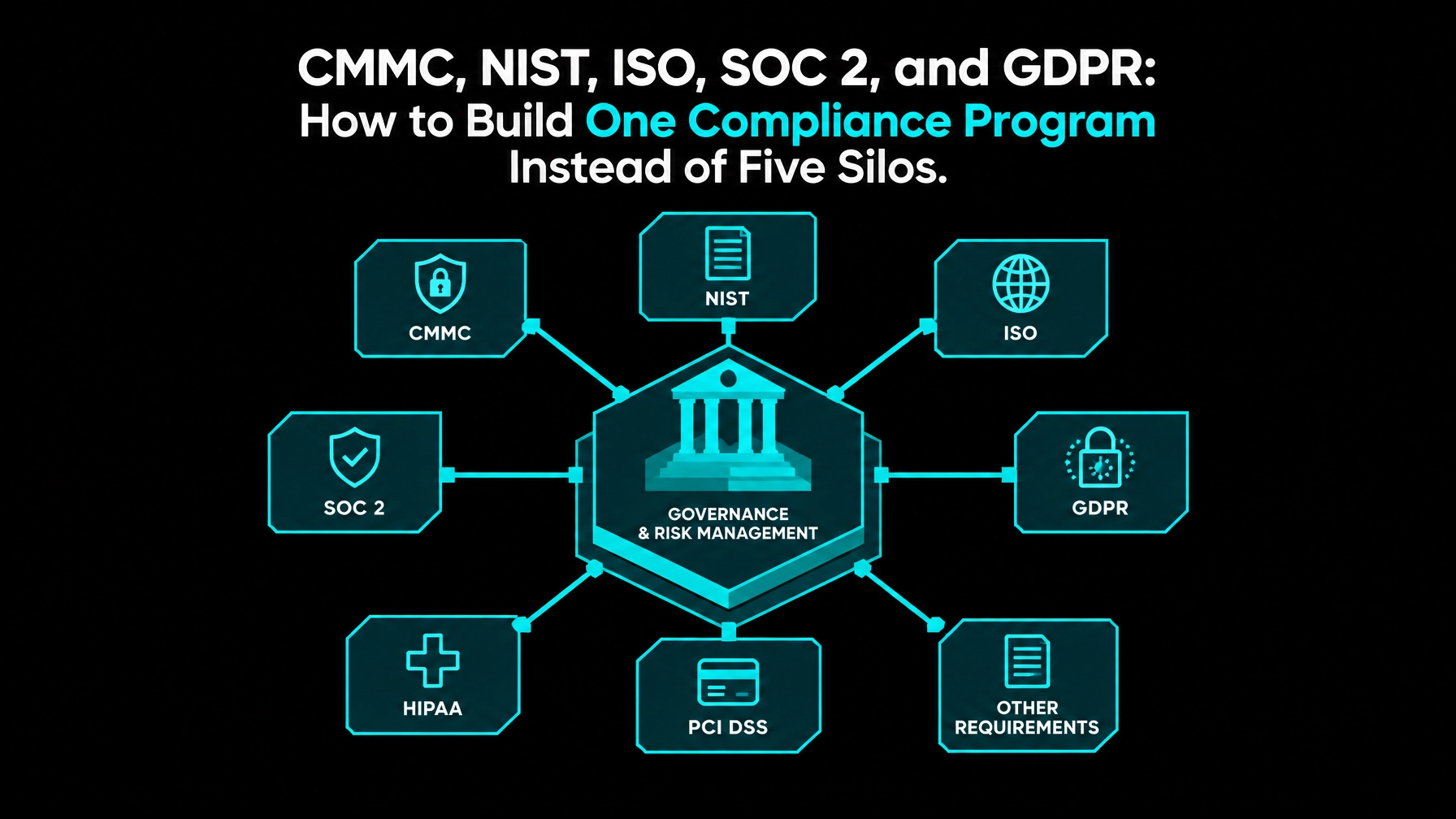
    One control spine mapped across multiple compliance frameworks

    Build One Control Spine Instead of Five Silos

    Companies need one operational control catalog. We have the capability to help normalize requirements into a structure your leadership, technical teams, assessors, customers, and investors can understand.

    A control spine organizes requirements around real business activities:

    • Identity and access management
    • Multifactor authentication
    • Asset inventory and configuration management
    • Vulnerability and patch management
    • Logging, monitoring, and auditability
    • Incident response and breach notification
    • Encryption and data protection
    • Business continuity and disaster recovery
    • Secure software development
    • Workforce security and training
    • Physical and environmental protection
    • Vendor and supply-chain risk management
    • Privacy governance and data subject rights
    • Risk assessment and continuous improvement

    Each operational control then receives framework references. One access-control process may support a CMMC practice, a NIST outcome, an ISO 27001 Annex A control, a SOC 2 Trust Services Criterion, a HIPAA safeguard, a PCI DSS requirement, and part of a GDPR security analysis.

    That does not mean one control automatically satisfies every requirement. Mapping must account for intent, testing method, frequency, population, evidence quality, and scope. Some mappings are strong. Some are partial. Some are not appropriate.

    The control matrix should therefore identify:

    1. The control objective
    2. The control owner
    3. The systems and data in scope
    4. The applicable framework references
    5. The operating procedure
    6. The required evidence
    7. The testing frequency
    8. The current maturity or status
    9. The related risk and remediation action
    10. The independent validation required

    This structure reduces duplication without reducing rigor.

    Assign Control Ownership and Executive Accountability

    Companies need clear responsibility. We have the expertise to establish a governance model that connects executive decisions with day-to-day control operation.

    Compliance cannot belong only to the security department. Effective ownership may include:

    • The board or executive sponsor for risk tolerance and strategic direction
    • The GRC program lead for coordination and reporting
    • IT and security for technical safeguards
    • Human resources for workforce processes and training
    • Legal for contractual obligations and regulatory interpretation
    • Privacy leadership for data inventories, privacy rights, and impact assessments
    • Procurement for supplier reviews and contract requirements
    • Finance for payment-related controls and financial risk
    • Operations for business continuity and process execution
    • Product and engineering for secure development and change management

    Every important control needs a named owner and an evidence custodian. The owner operates or supervises the control. The evidence custodian retains records that show the control operated as represented.

    Compliance control ownership model from executive sponsor to evidence custodian

    We will help establish meeting rhythms, escalation paths, management reporting, and risk acceptance procedures. We will also help translate technical findings into business decisions: revenue exposure, contract impact, operational disruption, customer confidence, and funding readiness.

    Policies Must Match the Way Your Business Operates

    Companies need policies that are specific enough to guide behavior and practical enough to be followed. We have that capability.

    A unified policy library may include:

    • Information security policy
    • Access control policy
    • Incident response plan
    • Risk management policy
    • Data retention and destruction policy
    • Privacy policy and data subject request procedures
    • Vendor risk management policy
    • Business continuity and disaster recovery plans
    • Secure development policy
    • Encryption and key management standards
    • Acceptable use and remote access standards
    • Workforce training and disciplinary procedures

    Policy development must follow the control matrix and the actual operating environment. A policy that describes controls you do not operate creates evidence problems and increases exposure during customer reviews or assessments.

    We can coordinate policy development with technical procedures, contractual commitments, privacy obligations, and executive approvals. We can also help identify where qualified legal counsel, a privacy professional, or another subject-matter expert must review the language before adoption.

    Collect Evidence Once and Use It Intelligently

    Companies need evidence that is complete, current, traceable, and connected to control objectives. We have the experience to organize evidence collection so that your team does not repeatedly answer the same question for five different reviewers.

    Common evidence includes:

    • Access reviews and termination records
    • MFA and endpoint configuration reports
    • Vulnerability scans and remediation tickets
    • Security awareness completion records
    • Incident response exercises
    • Backup and recovery test results
    • Vendor questionnaires and risk ratings
    • Change-management approvals
    • System inventories and data-flow diagrams
    • Penetration testing reports
    • Privacy impact assessments
    • Records of processing activities
    • Management review minutes
    • Exception approvals and risk acceptance records

    Evidence should be tagged to the unified control and then cross-referenced to applicable frameworks. This approach supports an ISO audit, a SOC 2 examination, a customer due-diligence request, a CMMC readiness effort, or a HIPAA security review without rebuilding the evidence package each time.

    The AICPA SOC resource library explains that SOC services provide assurance reporting around system-level and entity-level controls. The report itself is not interchangeable with CMMC, ISO 27001, HIPAA, PCI DSS, or GDPR compliance. The evidence may overlap, but the assessment purpose and criteria remain distinct.

    Track Risk and Execute Remediation

    Companies need more than a list of missing documents. We have the capability to turn identified gaps into a prioritized remediation plan.

    A useful remediation register records:

    • The control or requirement affected
    • The risk created by the gap
    • The business owner
    • The technical or operational fix
    • The estimated cost
    • The target completion date
    • Dependencies and resource needs
    • Interim safeguards
    • Verification requirements
    • Residual risk and executive disposition

    Priorities should reflect contract deadlines, customer commitments, sensitive data, likelihood of exploitation, operational impact, and financial consequences.

    This is where compliance becomes business development. A company that can explain its scope, controls, evidence, risks, and remediation plans is better prepared for government contracting, enterprise sales, mergers, acquisitions, lender reviews, and investor due diligence.

    Readiness does not guarantee certification, an attestation, a contract award, or an investment. It gives decision-makers a stronger basis for evaluating the organization and moving forward.

    Compliance lifecycle from scope definition through readiness and ongoing assurance

    Coordinate the Right Independent Experts

    Companies need qualified outside input when the engagement requires independent assessment, legal interpretation, privacy judgment, or specialized validation. We have the strategic coordination experience to help you identify and manage those needs.

    The Infinity Group can help architect the program, coordinate workstreams, organize documentation, and support executive decision-making. We do not replace an authorized or qualified assessor, licensed attorney, CPA, privacy professional, QSA, or other required authority.

    Depending on your scope, you may need:

    • A qualified CMMC assessment professional or authorized assessment organization
    • A CPA firm conducting a SOC 2 examination
    • An accredited ISO certification body
    • A PCI SSC Qualified Security Assessor
    • Qualified HIPAA, privacy, or healthcare regulatory counsel
    • Data protection counsel or a data protection officer
    • Specialized penetration testing and technical assessment providers

    The right model separates preparation from independent evaluation. It also prevents conflicts of interest and keeps your claims accurate.

    The Infinity Group Approach

    We are Business Development Architects. We assist organizations from A to Z: strategic planning, federal-facing growth, contract positioning, technical operations, capital strategy, stakeholder coordination, and investor readiness.

    For compliance-driven businesses, we can support:

    • Scope and obligation discovery
    • Framework selection and mapping
    • Unified control catalog development
    • Governance design and control ownership
    • Policy and procedure coordination
    • Evidence architecture
    • Risk registers and remediation roadmaps
    • Vendor due diligence
    • Executive reporting
    • Assessor and legal/privacy coordination
    • Customer questionnaire preparation
    • Government contracting readiness
    • Funding and investor due-diligence preparation

    A compliance program is an operating asset. It protects information, supports customer trust, strengthens proposal positioning, and gives investors a clearer view of execution discipline.

    What is the value of replacing five disconnected compliance projects with one coordinated program? What is the value of reducing repeated evidence requests, identifying risk earlier, and presenting a more credible readiness position to a government customer, strategic partner, lender, or investor?

    The answer is measured in saved time, reduced duplication, stronger decision-making, and more opportunities pursued with confidence.

    Start With One Plan

    Contact The Infinity Group at connect@infinity-us.com to discuss your contracts, data, geography, current frameworks, business goals, and next steps. We will help you review the scope, identify the right control spine, establish a practical roadmap, and determine which qualified assessors or legal and privacy professionals should participate.

    Comments and replies are disabled for this article.
    ONE PROGRAM. ONE CONTROL SPINE. ONE CLEARER PATH TO READINESS.

    Strategies + Execution = Funding and Growth.

    Sources

    General Information Disclaimer

    This article is provided for general informational and business-planning purposes only. It is not legal advice, privacy advice, cybersecurity certification advice, accounting advice, an audit opinion, or a guarantee of compliance, certification, attestation, contract award, funding, or investment. Requirements vary according to contracts, data, geography, industry, systems, and organizational scope. Consult qualified assessors, legal counsel, privacy professionals, CPAs, QSAs, and other appropriate specialists for advice specific to your circumstances.

    The official Infinity Group corporate logo with the tagline Strategies + Execution = Funding and Growth

  • Congress, Appropriations, and Oversight: A Legitimate Engagement Strategy for Federal Business

    Congress, Appropriations, and Oversight: A Legitimate Engagement Strategy for Federal Business

    Figure 1. Federal business engagement is strongest when mission relevance, evidence, timing, and compliance are treated as one coordinated strategy.

    From the Roman legions to modern national institutions, successful campaigns have always depended on the same discipline: understand the terrain, identify the decision-makers, prepare the facts, and move with purpose. Federal business development follows the same rule.

    Companies pursuing contracts, grants, technology programs, infrastructure work, or regulated-market opportunities cannot rely on registrations and proposal submissions alone. You must understand how Congress authorizes programs, how appropriators provide funding, how oversight committees evaluate performance, and how agencies translate statutory direction into procurement and program decisions.

    The Infinity Group operates as a Business Development Architect, with a Washington Metropolitan Area focus, Congressional contacts, private-sector experience, and a deep understanding of federal and state government institutions. We help companies organize the full strategy from A to Z.

    Engagement must be lawful, transparent, factual, and properly documented. We do not guarantee access, legislative action, contract awards, grants, or other government results. We help you prepare and execute a disciplined strategy that is relevant to public priorities and compliant with applicable requirements.

    Start with the federal decision structure

    Federal engagement becomes more effective when you separate three related but distinct functions:

    • Authorization establishes or changes a program’s legal authority.
    • Appropriations provide budget authority and may establish funding conditions.
    • Oversight examines how agencies and programs perform, spend resources, and comply with law.

    Authorizing committees may shape a program’s mission, eligibility rules, reporting requirements, and long-term structure. Appropriations committees and their subcommittees determine how authorized activities receive discretionary funding. Oversight committees, the Government Accountability Office, inspectors general, and agency officials examine whether public resources are producing results.

    The Congress.gov legislative database and Congressional Research Service resources such as the Congressional Oversight Manual provide a starting point for understanding bills, committee activity, hearings, reports, and statutory language.

    A company that approaches Congress without understanding this structure usually presents the wrong request to the wrong office at the wrong time. A company that maps its mission to the correct program, committee, subcommittee, agency, and budget account has a much stronger foundation.

    Flat navy-and-gold infographic showing Authorization, Appropriations, and Oversight as three connected federal business functions

    Figure 2. Authorization, appropriations, and oversight are separate functions that must be coordinated in a federal business strategy.

    Map committees and subcommittees before requesting meetings

    Your first task is jurisdictional mapping.

    Identify the authorizing committees connected to your industry and mission. Depending on the opportunity, this may involve committees dealing with defense, energy, commerce, transportation, science, homeland security, small business, health, agriculture, or other policy areas.

    Then identify the relevant appropriations subcommittee. Funding for a technology program, agency activity, infrastructure initiative, or defense requirement may be addressed through a specific account and subcommittee. The same company may need to understand both the committee that shapes the program and the committee that funds it.

    Finally, identify oversight bodies that may review the agency or mission area. Oversight priorities can affect reporting requirements, program management, agency performance, and future funding.

    This work is not simply a search for influential names. It is an analysis of jurisdiction, timing, public purpose, and institutional responsibility. We build that analysis into a practical engagement plan that can include:

    • Committee and subcommittee mapping
    • Agency and program identification
    • District and state office engagement
    • Legislative calendar tracking
    • Budget and appropriations monitoring
    • Federal acquisition research
    • Competitor and incumbent analysis
    • Coalition and trade association coordination
    • Briefing preparation and meeting follow-up

    Engage district and state offices year-round

    Many companies contact elected offices only after a proposal is delayed, a program is threatened, or a procurement appears to favor an incumbent. That is a mistake.

    District and state offices are important year-round. They understand local employers, workforce needs, economic development, infrastructure, research institutions, defense communities, and constituent concerns. A company with a genuine local connection should communicate that value clearly and consistently.

    Your engagement may include:

    • A facility or operations overview
    • Local employment and supplier data
    • Workforce development commitments
    • Research and technology capabilities
    • State and regional economic effects
    • Support for agency mission outcomes
    • A clear explanation of the federal barrier or opportunity

    The objective is not to ask an office to pressure an agency improperly. The objective is to provide accurate information that helps public officials understand the company’s constituent value and mission relevance.

    A strong year-round relationship is factual, professional, and useful. It gives an office information it can evaluate and, where appropriate, share through lawful and proper channels.

    Build a briefing that can withstand scrutiny

    A Congressional or agency briefing should be short, factual, and prepared for review by people who did not attend the meeting.

    Your briefing should answer five questions:

    1. What does the company provide?
    2. Which public mission does it support?
    3. What evidence demonstrates capability?
    4. What specific obstacle or policy issue requires attention?
    5. What action is being requested, if any?

    Use verifiable numbers. Distinguish current facts from projections. Identify assumptions. Explain the source of market, employment, cost, performance, and technical claims.

    Avoid exaggerated language such as “the only solution,” “guaranteed savings,” or “unmatched access.” Federal decision-makers need credible information, not promotional statements that create avoidable questions.

    If the subject relates to a pending procurement, protect proprietary data, source-selection information, competitor information, and other restricted material. The Federal Acquisition Regulation’s Procurement Integrity provisions should be reviewed with qualified counsel and contracting professionals before sensitive information is shared.

    Connect constituent value to mission relevance

    Federal engagement is strongest when private benefit and public value are connected honestly.

    A company may create jobs, but it should also explain how its capabilities support a federal mission. A technology company may have a strong product, but it should explain how the product addresses a documented agency requirement, capability gap, security need, operational challenge, or statutory objective.

    This is where many companies fail. They describe what they sell instead of explaining why the government should care.

    We help clients translate business capabilities into decision-useful language:

    • Product capability becomes mission performance.
    • Local employment becomes constituent value.
    • Research investment becomes national capacity.
    • Supply-chain strength becomes resilience.
    • Compliance readiness becomes execution confidence.
    • Commercial traction becomes evidence of delivery capability.

    The connection must be real. It cannot be manufactured through slogans.

    Coordinate with associations and coalitions carefully

    Trade associations, chambers of commerce, research networks, and industry coalitions can provide useful channels for policy education and collective engagement. They may help identify common industry concerns, coordinate written comments, organize educational events, and present broader economic or technical evidence.

    Coalition participation must remain transparent. Your company should understand:

    • Who is speaking on behalf of the coalition
    • What position the coalition is advancing
    • Whether your company’s name or data will be used
    • Whether lobbying activity is being conducted
    • Whether disclosure obligations apply
    • Whether the coalition’s position accurately reflects your company

    A coalition should strengthen factual engagement, not conceal the identity or interests behind a policy request.

    Navy-and-gold circular infographic showing the federal engagement cycle from mission relevance through compliance review

    Figure 3. A year-round engagement cycle keeps companies focused on evidence, relevance, relationships, and compliance rather than crisis activity.

    Put compliance at the center of the strategy

    Legitimate engagement is not only about what you say. It is also about how you document, disclose, and conduct the activity.

    Companies should establish internal controls covering:

    • Lobbying registration and reporting
    • Congressional and executive-branch contacts
    • Ethics and gift restrictions
    • Sponsored travel and event participation
    • Former-government-employee restrictions
    • Conflicts of interest
    • Procurement-integrity protections
    • Proprietary and non-public information
    • Meeting records and briefing approvals

    The Lobbying Disclosure Act guidance, reviewed and revised by the Clerk of the House and Secretary of the Senate, explains registration and reporting requirements. The House Committee on Ethics provides guidance on gifts, travel, outside entities, and other House ethics matters. The Senate Select Committee on Ethics provides Senate rules and resources covering gifts, travel, conflicts, constituent service, and official conduct.

    The USAspending.gov database is also valuable for examining federal awards, agencies, recipients, locations, award amounts, and spending patterns. It helps companies replace assumptions with public data.

    You should consult qualified legal counsel regarding whether your activities require lobbying registration, how gift and ethics rules apply, and what procurement-integrity restrictions affect your communications.

    Navy-and-gold compliance checklist infographic showing factual briefings, disclosure, ethics, procurement integrity, and recordkeeping

    Figure 4. Compliance controls protect the company and improve the credibility of every federal engagement.

    The Infinity Group’s role

    The Infinity Group provides government relationship strategy as part of a broader business development architecture. We can help you assess your federal objective, map the institutional environment, identify relevant stakeholders, prepare credible materials, develop an engagement calendar, coordinate communications, and connect government strategy to capital, partnerships, contracting, and growth.

    We support startups, established companies, and mid-sized businesses across industry sectors. We understand that federal business requires more than a single meeting. It requires preparation, persistence, disciplined follow-up, and a clear connection between your company’s capability and the government’s mission.

    Are you investing in the right government relationship strategy? Is the potential value of a federal market, program, contract vehicle, grant, or policy opportunity substantially greater than the reasonable cost of preparing correctly?

    We can review your objectives and outline practical next steps.

    Contact The Infinity Group at connect@infinity-us.com.

    Authoritative sources

    General-information disclaimer

    This article provides general information for business planning and public education. It is not legal, lobbying, ethics, procurement, tax, financial, or investment advice. Laws, regulations, agency practices, committee rules, and disclosure requirements may change and may apply differently based on specific facts. Consult qualified counsel and appropriate compliance professionals before engaging Congress, federal agencies, public officials, trade associations, or coalitions. The Infinity Group does not guarantee access, legislative action, agency action, contracts, grants, awards, funding, or any other government result.

    Comments and replies: Disabled.

    Official full horizontal Infinity Group navy-and-gold corporate logo with tagline

  • Access Is Not Alignment: Building a Real Government Relationship Strategy

    Access Is Not Alignment: Building a Real Government Relationship Strategy

    Draft for review, Comments and replies disabled

    From military campaigns to major infrastructure programs, serious objectives have never been achieved through access alone. Leaders succeed by understanding the mission, identifying the decision structure, positioning resources at the correct time, and executing with discipline.

    Federal business works the same way.

    A meeting, introduction, conference invitation, or familiar name may open a door. It does not establish a government relationship strategy. It does not create a requirement, validate a capability, influence a lawful acquisition decision, or guarantee an award.

    Access is an entry point. Alignment is the strategy.

    For CEOs, founders, capture executives, and mid-sized companies entering federal markets, the objective is not simply to “know people.” The objective is to build a compliant, durable network around mission needs, acquisition pathways, credible performance, and continuity.

    At The Infinity Group, we are Business Development Architects. We combine private-sector expertise with deep understanding of Federal and State government agencies and Congress. With a Washington Metropolitan Area focus, we support companies from A to Z: market positioning, agency research, relationship strategy, capture planning, partnerships, capital, and execution.

    Access Without Alignment Produces Activity, Not Business

    Companies often measure government development by the number of meetings held, business cards collected, or introductions received. Those activities can be useful. They are not outcomes.

    A government relationship becomes strategically valuable when it connects your company to:

    • A defined agency mission;
    • A documented program or operational need;
    • A realistic acquisition path;
    • A decision chain with identifiable roles;
    • A capability the government can evaluate;
    • Evidence that your company can perform; and
    • A compliant plan for continued engagement.

    The Federal Acquisition Regulation remains central to this environment. FAR Part 19, displayed on Acquisition.gov with FAC 2026-01 effective March 13, 2026, addresses small-business eligibility, size standards, set-asides, socio-economic programs, subcontracting assistance, and the respective roles of agencies and the Small Business Administration.

    That framework creates opportunity. It does not replace preparation.

    SBA resources likewise emphasize registrations, certifications, size standards, Small Business Search, subcontracting channels, and data tools. These resources help a company become visible and eligible. They do not convert visibility into a contract without capability, timing, performance, and a fit with the agency’s actual requirements.

    Map the Real Decision Chain

    Federal buying decisions rarely belong to one person. A company that engages only with a senior official, only with a contracting officer, or only with a small-business office is viewing one part of a larger system.

    Navy-and-gold decision-chain diagram showing mission owners, program offices, contracting officers, small-business offices, SBA representatives, prime integrators, and Congressional stakeholders connected by an alignment framework

    Figure 1. Federal relationship strategy must account for mission, requirements, acquisition, small-business, industry, and policy stakeholders.

    A practical relationship map should distinguish among the following participants:

    1. Agency leadership and mission owners

    Senior leaders establish priorities, budgets, operational direction, and performance expectations. They may not manage a specific procurement, but their priorities shape the environment in which programs are funded and executed.

    2. Program offices and requirements officials

    Program managers, technical teams, end users, and requirements officials understand the operational problem. They help define legitimate needs, performance objectives, technical requirements, and desired outcomes.

    Your capability must make sense to this group first. A generic corporate presentation will not substitute for mission understanding.

    3. Contracting officers and acquisition professionals

    The contracting officer manages the formal acquisition process. This role includes solicitation, competition, evaluation, contract formation, and compliance with applicable acquisition rules.

    A contracting officer is not a sales gatekeeper who can simply “put you on the contract.” Engagement must respect procurement integrity, equal treatment, disclosure restrictions, and the specific acquisition process.

    4. Small-business specialists and SBA Procurement Center Representatives

    FAR Part 19 recognizes the role of agency small-business offices and SBA representatives in identifying sources, evaluating acquisition strategies, supporting small-business participation, and addressing consolidation or bundling concerns.

    This is a critical channel for companies that understand their NAICS codes, certifications, workshare, past performance, and actual delivery capacity.

    5. Prime contractors and systems integrators

    Many companies enter federal markets through subcontracting, teaming, mentor-protégé arrangements, or joint ventures. Prime contractors need more than an attractive capability statement. They need reliable partners with defined responsibilities, competitive pricing, security readiness, staffing capacity, and contract-performance discipline.

    6. Congressional offices and committee staff

    Congressional offices and committee staff contribute to policy, oversight, authorization, appropriations, constituent services, and broader public-sector priorities. They are not contracting officers and cannot guarantee a procurement outcome.

    Their relevance is strategic and policy-based: understanding legislative priorities, communicating accurate information through lawful channels, and recognizing how public policy affects an industry or mission. Any engagement in this area must be conducted in accordance with applicable ethics, lobbying, disclosure, and procurement rules.

    Build the Strategy Around Six Operating Principles

    1. Start with the agency mission

    Companies need to know what an agency is trying to accomplish before describing what they sell. We have the expertise to connect private-sector capabilities to public-sector missions.

    Research the agency’s strategic plan, budget materials, operating priorities, program structure, current contracts, and public performance requirements. Then answer a direct question:

    What government problem does your company solve, and how does the agency measure success?

    The answer should be specific, evidence-based, and understandable to both technical and business audiences.

    2. Establish credibility through capability and performance

    Relationships become durable when the company is credible.

    Credibility includes technical capability, but it also includes:

    • Relevant commercial or government past performance;
    • Qualified personnel;
    • Financial capacity;
    • Cybersecurity and data controls;
    • Quality systems;
    • Realistic delivery schedules;
    • Accurate representations and certifications;
    • A capable accounting and timekeeping environment; and
    • The ability to manage subcontractors and reporting obligations.

    Do not overstate experience. Do not present a partner’s work as your own. Do not claim readiness that your systems cannot support. Government customers, primes, and oversight personnel remember the difference between a company that is ambitious and a company that is prepared.

    3. Engage during market research

    The most valuable relationship work often occurs before a solicitation is released.

    Navy-and-gold acquisition lifecycle diagram showing agency mission, market research, sources sought and industry day, draft requirement or solicitation, and proposal and performance, with relationship work beginning before the RFP

    Figure 2. Effective engagement begins during mission definition and market research, not after the final RFP appears.

    Industry days, sources-sought notices, Requests for Information, draft solicitations, small-business outreach, technical exchanges, and pre-solicitation conferences provide lawful opportunities to understand requirements and communicate relevant capabilities.

    Respond with discipline. Explain what your company can perform, identify realistic constraints, describe commercial or technical alternatives, and answer the agency’s questions directly. Do not use an RFI as a disguised sales brochure.

    Recent federal acquisition policy coverage reinforces the importance of monitoring the policy environment. In a September 21, 2026 report, Federal News Network described substantial debate surrounding SBA’s proposed size-standard changes, including concerns about how larger thresholds could alter competition for small-business opportunities. This is a practical reminder: companies must monitor policy, size standards, and agency implementation, not merely solicitations.

    4. Time engagement to the acquisition lifecycle

    A relationship strategy must include timing.

    Early engagement is useful for understanding mission needs and market conditions. Once an acquisition moves into formal solicitation, communications must follow the applicable rules and instructions. After award, relationship work shifts toward performance, contract administration, reporting, customer satisfaction, and future requirements.

    We help companies organize engagement around clear phases:

    1. Mission and agency research;
    2. Market and competitor analysis;
    3. Capability positioning;
    4. Industry and small-business engagement;
    5. Capture and teaming;
    6. Proposal or subcontract pursuit;
    7. Performance and continuity.

    The strategy is not to contact everyone at once. The strategy is to engage the right stakeholders with the right information at the right time.

    5. Create continuity across fiscal cycles

    Federal priorities change across fiscal years. Budgets move. Continuing resolutions affect timing. Programs are reorganized. Incumbents change. Personnel rotate.

    A relationship strategy that depends on one contact is not a strategy. It is a vulnerability.

    Maintain a structured record of:

    • Agency missions and program priorities;
    • Key offices and stakeholder roles;
    • Active and anticipated requirements;
    • Contract vehicles and incumbents;
    • Industry-day and RFI participation;
    • Capability briefings and follow-up actions;
    • Performance evidence;
    • Fiscal-year changes; and
    • Personnel transitions.

    Navy-and-gold continuity matrix showing fiscal years, mission priorities, program owners, contracting paths, performance evidence, and Congressional or stakeholder context connected across personnel changes

    Figure 3. Continuity protects business development when fiscal priorities, program offices, and personnel change.

    Your company should be able to brief a new program official without restarting the entire relationship from the beginning. That requires organized information, current materials, accurate records, and a consistent message.

    6. Keep relationships inside a compliant strategy

    Relationships are one component of a compliant government-business strategy. They are not a substitute for competition, eligibility, responsibility, proposal quality, or performance.

    Nothing guarantees an award. Nothing creates entitlement to a set-aside. Nothing permits preferential treatment. Nothing replaces the contracting officer’s responsibility to conduct a lawful acquisition.

    A sound strategy includes qualified legal, ethics, lobbying, accounting, cybersecurity, and contracting advice where appropriate. The Infinity Group coordinates the broader business-development architecture so your leadership team can see how agency relationships, market intelligence, capital, partners, compliance, and execution fit together.

    The Infinity Group Builds the Architecture Around Your Objective

    Companies need more than introductions. They need a deliberate operating plan.

    We can support:

    • Federal and State agency research;
    • Washington Metropolitan Area relationship strategy;
    • Mission and program-office mapping;
    • Congressional policy and stakeholder analysis;
    • Small-business and SBA engagement planning;
    • Industry-day and market-research preparation;
    • Prime-contractor and teaming strategy;
    • Capability positioning;
    • Capture planning;
    • Bid/no-bid analysis;
    • Proposal readiness;
    • Capital and working-capital strategy;
    • Performance continuity; and
    • Long-term business development execution.

    Our work is direct. We identify the mission, map the decision chain, establish the capability case, plan the timing, support compliant engagement, and maintain continuity from beginning to end.

    If your company is entering federal markets or attempting to expand an existing government pipeline, contact The Infinity Group at connect@infinity-us.com to discuss your objectives, review the appropriate strategy, and determine the next steps at reasonable costs.

    Access opens the door.
    Alignment builds the position.
    Execution creates the result.

    Authoritative Sources

    General Information Disclaimer

    This article is provided for general informational purposes only. It is not legal, lobbying, ethics, procurement, contracting, accounting, cybersecurity, or other professional advice. Government requirements, agency procedures, acquisition rules, ethics restrictions, and small-business eligibility standards may change and may apply differently to particular companies or procurements. Obtain qualified professional advice for your specific circumstances. No relationship, introduction, communication, certification, or strategy guarantees a government contract award or preferential treatment.

    Official full horizontal Infinity Group corporate logo with the tagline Strategies + Execution = Funding and Growth

  • 5 More Government Business Mistakes That Stall Growth, and How to Fix Them

    5 More Government Business Mistakes That Stall Growth, and How to Fix Them

    From military campaigns to major public works, success has always depended on logistics as much as strategy. An objective may be won in the field and still lost through poor supply lines, weak accounting, inadequate staffing, or failed follow-through.

    Federal contracting works the same way.

    Winning an award is not the finish line. It is the point at which cash flow, cost controls, personnel, teaming arrangements, compliance, and customer performance must operate together. Startups and mid-sized companies often stall not because their capabilities are weak, but because the business infrastructure behind those capabilities is incomplete.

    The Infinity Group serves as a Business Development Architect. We connect strategy, execution, funding, and growth so your government-business plan is built for both pursuit and performance. In this second article on common government-business mistakes, we address five additional errors that can undermine an otherwise promising federal contracting strategy.

    1. Underestimating the Cash-Flow and Working-Capital Cycle

    A contract can be profitable on paper and still place serious pressure on your company’s cash position.

    Federal contractors may incur payroll, recruiting, travel, equipment, insurance, subcontractor, security, and compliance expenses before receiving payment. The timing also depends on whether an invoice is proper, whether supplies or services have been accepted, whether required receiving documentation has been processed, and what payment clauses apply.

    Under the standard FAR 52.232-25 Prompt Payment clause, the payment due date for many federal supply and service contracts is generally the later of 30 days after receipt of a proper invoice or 30 days after Government acceptance. A defective invoice, disputed performance, delayed acceptance, or missing documentation can extend the practical collection cycle.

    Cost-reimbursement contracts introduce additional controls. Under FAR 52.216-7 Allowable Cost and Payment, interim payments are tied to allowable costs, billing procedures, indirect rates, and contract administration. Final rates and completion invoices may be addressed much later.

    Navy-and-gold infographic showing the federal contract cash-flow cycle from delivery and invoicing through acceptance, payment timing, and working-capital reserves

    Figure 1. Federal contract revenue does not arrive at the same moment that performance costs are incurred.

    Corrective action: Build a contract-specific cash model before you bid

    For every serious opportunity, map:

    • Hiring and onboarding costs;
    • Payroll timing;
    • Equipment and material purchases;
    • Subcontractor payment terms;
    • Invoice submission requirements;
    • Acceptance milestones;
    • Expected payment dates;
    • Retainage, withholds, or disputed amounts;
    • Financing needs; and
    • A reserve for delayed collections.

    Your capital strategy must match your pursuit strategy. We can help evaluate whether your company needs additional equity, debt, a working-capital facility, strategic investment, or a staged subcontracting approach before committing to a major award.

    This is planning, not a guarantee of payment timing. Contract-specific requirements should be reviewed with qualified financial and contracting professionals.

    2. Failing to Build an Accounting and Cost-Accounting Foundation

    Many companies treat accounting as a back-office function that can be upgraded after the first award. That approach creates risk.

    Government contracting requires management to understand what each contract costs, how labor is charged, how indirect costs are allocated, how pricing is developed, and whether billings can be supported by auditable records. A company that cannot reliably distinguish direct contract costs from indirect operating expenses will struggle with pricing, billing, audits, rate management, and contract closeout.

    DCAA guidance emphasizes core accounting-system capabilities such as:

    • Accumulating direct costs by contract or job;
    • Separating direct and indirect costs;
    • Maintaining logical allocation pools and bases;
    • Reconciling job-cost records to the general ledger;
    • Recording labor by cost objective;
    • Excluding unallowable costs;
    • Supporting interim contract-cost determinations; and
    • Maintaining traceable timekeeping and labor distribution.

    Navy-and-gold geometric diagram showing the government-contract accounting foundation from general ledger control through direct costs, indirect pools, pricing, and audit readiness

    Figure 2. A reliable accounting foundation connects the general ledger to job costs, indirect rates, pricing, and audit support.

    Under FAR 52.216-7, contractors may be required to submit final indirect cost rate proposals supported by actual cost experience, allocation bases, account schedules, contract cost information, and reconciliations. That is a substantial operating requirement, not a spreadsheet exercise completed at year-end.

    Corrective action: Conduct an accounting-system readiness review

    Before pursuing cost-type, time-and-materials, or other flexibly priced work, document:

    • Your chart of accounts;
    • Direct-cost and indirect-cost treatment;
    • Fringe, overhead, and G&A pools;
    • Allocation bases;
    • Timekeeping procedures;
    • Labor-distribution controls;
    • Unallowable-cost procedures;
    • Contract and CLIN-level reporting;
    • Billing reconciliation; and
    • Audit-trail retention.

    Engage a qualified government-contract accounting professional or CPA when specialized accounting, cost-principle, indirect-rate, or audit matters arise. The Infinity Group can help coordinate the business-development and capital implications of these requirements, but we do not provide accounting, tax, or audit advice.

    3. Staffing for the Award Instead of Staffing for the Pursuit

    A common mistake is to assume that the founder, technical lead, CFO, and delivery manager can simply “fit in” the capture and proposal effort around their existing responsibilities.

    That rarely produces a strong result.

    A serious pursuit requires customer research, opportunity qualification, capture planning, partner development, solution design, pricing coordination, proposal management, compliance review, executive decisions, and submission control. If those activities are assigned to people who are already responsible for delivery, the company may create two problems at once: a weak proposal and distracted performance.

    The reverse is also dangerous. Some companies build an aggressive pursuit team but have no delivery leadership, recruiting plan, transition manager, or contract administrator ready for award.

    Corrective action: Create two connected staffing plans

    Build a pursuit staffing plan that identifies:

    • Executive sponsor;
    • Capture lead;
    • Proposal manager;
    • Technical solution lead;
    • Pricing and finance lead;
    • Contracts or compliance reviewer;
    • Teammate and subcontractor coordinator; and
    • Final quality-control authority.

    Then build a separate performance staffing plan covering:

    • Program or project manager;
    • Key personnel;
    • Recruiting pipeline;
    • Backup personnel;
    • Security and onboarding requirements;
    • Quality-control responsibility;
    • Reporting ownership; and
    • Customer escalation procedures.

    We can help structure both plans so your proposal commitments are realistic and your operating team is not surprised by the award.

    4. Making Bad Teaming and Subcontracting Decisions

    A partner can expand your capacity, or expand your exposure.

    Weak teaming arrangements often begin with vague promises: “We will work together,” “We will divide the scope later,” or “We will figure out the intellectual property after award.” Those statements do not establish a reliable business relationship.

    Problems arise when the scope split is unclear, flow-down clauses are applied one-sidedly, workshare is not defined, pricing responsibilities are inconsistent, or a subcontractor’s data and intellectual property are left unprotected. Small businesses must also consider applicable SBA requirements, including limitations on subcontracting and the terms of any formal program structure.

    The SBA’s contracting resources provide information on small-business programs, set-asides, certifications, and subcontracting-related opportunities. Eligibility and compliance must be evaluated for the specific company, contract, and structure.

    Corrective action: Put the business architecture in writing before submission

    A serious teaming arrangement should address:

    • Prime and subcontractor roles;
    • Scope by task, CLIN, or deliverable;
    • Workshare percentages or responsibilities;
    • Proposal-content ownership;
    • Pricing and cost-data responsibilities;
    • Key personnel;
    • Customer communication;
    • Flow-down obligations;
    • Confidential information;
    • Intellectual property and data rights;
    • Exclusivity and non-circumvention terms;
    • Changes after award; and
    • Dispute and termination procedures.

    Engage qualified legal counsel for teaming agreements, subcontracts, intellectual-property protections, data rights, flow-down clauses, and regulatory interpretation. The Infinity Group can help evaluate the strategic fit, capital implications, workshare logic, and growth value of a proposed relationship. We do not provide legal advice.

    5. Having No Transition or Performance Plan After Award

    Some companies treat the award notice as the moment when operations begin. In reality, performance planning should be substantially developed before award.

    The Government and the prime contractor expect the winning team to start with control. Staffing must occur. Systems must be activated. Reporting must begin. Deliverables must be understood. Subcontractors must be managed. Inherited knowledge may need to be transferred. Customer expectations must be confirmed.

    A disorganized transition can damage past performance before the company has a meaningful opportunity to establish it. Poor early execution can affect references, award-fee outcomes, option periods, task orders, and recompete positioning.

    Navy-and-gold illustration showing the path from capture and proposal through award, transition staffing, measured performance, and recompete readiness

    Figure 3. A contract award creates a performance pathway: transition, delivery, measurement, customer confidence, and future positioning.

    Corrective action: Build a 30-60-90 day transition and performance plan

    Your plan should identify:

    First 30 days: personnel onboarding, customer introductions, deliverable confirmation, access requirements, reporting calendars, accounting setup, and risk review.

    Days 31–60: process stabilization, quality-control checks, subcontractor alignment, performance metrics, invoice validation, and customer feedback.

    Days 61–90: trend analysis, corrective actions, operating improvements, past-performance documentation, and preparation for option-year or follow-on discussions.

    Track measurable results. Record customer approvals, completed milestones, response times, quality results, cost performance, and corrective actions. Past performance should become an asset that supports the next pursuit, not simply a contract that ended.

    The Infinity Group Approach: Strategy, Execution, Funding, and Growth

    Government business is not built through registration alone. It requires a coordinated plan for market positioning, government relationships, capture, proposal execution, accounting readiness, capital, staffing, teaming, compliance, and delivery.

    The Infinity Group is a Business Development Architect. We support companies from A to Z by connecting:

    • Government contracting strategy;
    • Federal and state market development;
    • Capture and proposal planning;
    • Teaming and partnership strategy;
    • Capital and investment planning;
    • Working-capital preparation;
    • Operational readiness;
    • Transition and performance planning; and
    • Long-term growth positioning.

    Read our related guidance on government contracting consulting for startups and building a government pipeline that can perform.

    If your company is pursuing federal business, contact us at connect@infinity-us.com to discuss your strategy, operating needs, capital requirements, and next steps.

    Comments and replies are disabled.

    PLAN THE PURSUIT. FUND THE PERFORMANCE. BUILD THE GROWTH.

    Strategies + Execution = Funding and Growth.

    General Information Disclaimer

    This article is provided for general informational and business-development purposes only. It is not accounting, audit, legal, tax, financial, procurement, or government-relations advice, and it does not create a professional relationship. Federal requirements vary by solicitation, contract type, agency, clause, business structure, and facts. Consult qualified accounting, legal, tax, contracting, cybersecurity, and other specialized professionals before making decisions or submitting an offer.

    Authoritative Sources

    Official full horizontal Infinity Group corporate logo with the tagline “Strategies + Execution = Funding and Growth.”

  • 5 Mistakes Companies Make When Pursuing Government Business

    5 Mistakes Companies Make When Pursuing Government Business

    Hero artwork: Government business is won through disciplined strategy, qualification, compliance, pricing, and capture, not registration alone.

    In military history, a campaign was not won because an army arrived at the battlefield. Victory depended on preparation, intelligence, logistics, command discipline, and the ability to sustain performance after the first engagement.

    Government business follows the same rule.

    Federal agencies do not purchase based only on a company’s registration, website, or enthusiasm. They evaluate responsibility, capability, past performance, compliance, price, delivery, and mission fit. The companies that approach government business as a complete development strategy are positioned to compete with greater discipline and protect their long-term growth.

    The companies that treat it as a series of forms and last-minute proposals create unnecessary risk.

    Below are five common mistakes CEOs, founders, and business development leaders should correct before pursuing federal opportunities.

    1. Treating SAM.gov registration as a strategy

    Registration in the System for Award Management is necessary for many federal contracting activities. It is not a government-business strategy.

    SAM.gov provides an important foundation: entity registration, the Unique Entity ID, representations and certifications, contracting information, and access to federal opportunity and award data. However, an active registration does not establish market position, create agency demand, demonstrate past performance, or identify which opportunities are commercially viable.

    A company may be fully registered and still have:

    • The wrong primary NAICS code;
    • An unclear capability narrative;
    • Outdated points of contact;
    • No target-agency plan;
    • No contract-vehicle strategy;
    • No relevant past-performance positioning;
    • No compliance-readiness documentation;
    • No capture calendar.

    FAR Part 19 places importance on NAICS codes, size standards, small-business representations, socioeconomic eligibility, and fair market pricing. These are not passive profile fields. They affect which competitions a company may pursue and how it represents itself at the time of offer.

    Corrective action: turn registration into a managed market position

    Review your SAM.gov profile at least quarterly and after any major change in ownership, leadership, capabilities, location, banking information, or business direction. Confirm that your NAICS codes, capabilities, certifications, representations, and points of contact are accurate.

    Then connect the profile to a written federal go-to-market plan:

    1. Select target agencies and mission areas.
    2. Identify the problems your company can solve.
    3. Map relevant NAICS codes and contract vehicles.
    4. Document past performance and proof points.
    5. Define prime, subcontract, and teaming objectives.
    6. Establish a pipeline review process.

    Registration opens the door. Strategy determines whether you know where to go.

    2. Bidding on keywords instead of qualifying opportunities

    A keyword match is not a bid decision.

    Companies often search SAM.gov for a product or service term, find a solicitation containing that term, and immediately begin preparing a proposal. This approach confuses visibility with suitability. A solicitation can contain the right keyword and still be wrong for your company because of capability gaps, incumbent strength, staffing requirements, geographic restrictions, contract type, compliance obligations, or unacceptable margin.

    The correct question is not, “Can we technically submit?”

    The correct question is, “Can we perform this requirement better than the likely competition, at a price that supports delivery and growth?”

    A serious bid/no-bid review should examine:

    • Capability fit: Can your team perform the statement of work now?
    • Past performance: Can you show relevant, credible results?
    • Customer fit: Do you understand the agency’s mission and operating environment?
    • Competitive position: Who is the incumbent, and what advantages do competitors hold?
    • Contract vehicle: Are you eligible and properly positioned to compete?
    • Resource capacity: Can you staff the effort without damaging current operations?
    • Compliance burden: Can you meet the applicable requirements?
    • Profitability: Can you perform at the proposed price and remain financially sound?
    • Capture timing: Did you engage early enough to understand the requirement?

    Corrective action: use a documented bid/no-bid gate

    Create a written scoring process before assigning proposal resources. Require leadership approval for opportunities that do not meet minimum thresholds for capability, past performance, strategic fit, compliance readiness, and profitability.

    Do not use a keyword as the deciding factor. Use evidence.

    Flat vector infographic showing a five-gate bid/no-bid qualification funnel labeled SAM, FIT, READY, PRICE, and CAPTURE

    Figure 1: A qualified opportunity must pass five gates before proposal investment begins.

    The SBA’s federal contracting resources can help companies understand certifications, size standards, set-asides, subcontracting, and federal contracting assistance. Those resources are most valuable when they support a defined market strategy rather than a general search for anything available.

    3. Ignoring compliance and cybersecurity until after award

    Compliance is not an administrative issue to solve after winning. It is part of the cost and performance model that must be understood before bidding.

    Government requirements may include solicitation instructions, representations and certifications, labor standards, recordkeeping, data protection, reporting, subcontracting limitations, cybersecurity controls, incident reporting, supply-chain restrictions, and contract-specific clauses.

    For small-business set-asides and certain socioeconomic programs, FAR Part 19.505 also addresses limitations on subcontracting and the nonmanufacturer rule. A company that builds a proposal around subcontracting arrangements without checking those requirements may create a performance problem before work begins.

    Cybersecurity creates a similar risk. Requirements may apply to Federal Contract Information, Controlled Unclassified Information, information systems, cloud environments, incident response, and subcontractor flow-downs. Even when a particular certification or assessment is not required for a specific opportunity, the underlying security obligations may remain relevant.

    Unexpected compliance expenses can include:

    • Security assessments and remediation;
    • Controlled environments for sensitive information;
    • Additional personnel and training;
    • Specialized software and monitoring;
    • Contract administration;
    • Reporting and audit preparation;
    • Subcontractor due diligence;
    • Legal or technical support.

    Corrective action: build a compliance map before proposal development

    For every serious opportunity, prepare a compliance matrix that identifies:

    • Each solicitation instruction;
    • Each mandatory deliverable;
    • Each required representation;
    • Each cybersecurity and data-handling obligation;
    • Each flow-down requirement;
    • Each internal owner;
    • The cost, schedule, and evidence required for compliance.

    Review FAR 52.204-21 when basic safeguarding requirements may apply, and review all agency-specific and contract-specific clauses. Do not assume that a general cybersecurity policy satisfies a contract requirement.

    Compliance should be priced, staffed, documented, and tested before award.

    4. Underpricing to win and then failing to perform

    Winning at an unsustainable price is not a success.

    Companies underprice because they want a first contract, a reference customer, or a place in the federal market. The danger is that the contract becomes a financial strain immediately after award. Staffing is reduced, senior personnel are stretched across too many tasks, quality controls are weakened, and the company begins requesting changes that should have been anticipated during proposal development.

    The consequences reach beyond one contract:

    • Schedule delays;
    • Missed deliverables;
    • Unplanned overtime;
    • Margin loss;
    • Contract disputes;
    • Weak customer confidence;
    • Negative past-performance information;
    • Reduced competitiveness on future opportunities.

    FAR 19.202-6 defines fair market price in terms of reasonable costs under normal competitive conditions, not simply the lowest possible cost. That principle is important for every company building a defensible federal pricing model.

    Corrective action: perform a price-to-perform review

    Before submitting a proposal, confirm that the price covers:

    • Fully burdened labor;
    • Required qualifications and wage rates;
    • Direct and indirect costs;
    • Security and compliance obligations;
    • Travel, equipment, software, and materials;
    • Subcontractor costs;
    • Management and quality assurance;
    • Schedule risk and contingency;
    • A reasonable operating margin.

    Then test the model against multiple scenarios: staffing turnover, schedule compression, inflation, subcontractor increases, cybersecurity remediation, and delayed government decisions.

    The objective is not to submit the lowest number. The objective is to submit a credible price that supports reliable performance.

    5. Neglecting relationships, capture planning, and recompete positioning

    Many companies begin government business development when the solicitation drops. By then, the requirement may already be shaped, the incumbent may have a strong position, the acquisition strategy may be established, and the proposal timeline may be too short for meaningful relationship development.

    Government relationship strategy does not mean seeking improper influence or special access. It means conducting legitimate, professional market research and learning how an agency defines its mission requirements.

    Useful activities include:

    • Reviewing prior awards and agency spending;
    • Attending industry days;
    • Responding to requests for information;
    • Engaging through appropriate small-business and industry channels;
    • Understanding agency mission priorities;
    • Building lawful relationships with primes and qualified teaming partners;
    • Tracking incumbent performance and contract timelines;
    • Preparing for recompetes well before expiration.

    The SBA’s contracting programs and resources and SAM.gov award-search tools provide useful starting points. Federal News Network’s September 2026 coverage of feedback on SBA’s proposed size-standard changes also demonstrates why companies must monitor policy developments that can affect eligibility, set-aside positioning, and long-term pipeline planning. Federal procurement conditions change. Capture plans must change with them.

    Flat vector diagram showing the government-business lifecycle from before solicitation through proposal, award, and recompete, with a warning barrier labeled TOO LATE

    Figure 2: Capture begins before the solicitation and continues through performance and recompete.

    Corrective action: build a capture and recompete calendar

    For each target opportunity, record:

    • Current contract and incumbent;
    • Expected recompete date;
    • Agency mission need;
    • Procurement history;
    • Key capability gaps;
    • Potential teaming requirements;
    • Industry engagement milestones;
    • Proposal preparation deadlines;
    • Performance and recompete objectives.

    Your first contract should not be treated as an isolated transaction. It should become a platform for reliable delivery, stronger past performance, customer understanding, and future growth.

    The Infinity Group Business Development Architect approach

    At The Infinity Group, we approach government business as a complete development assignment: strategy, execution, funding, and growth.

    We support startups and mid-sized companies with:

    • Government market strategy;
    • Agency and opportunity qualification;
    • Capture planning;
    • Proposal development;
    • Government contracting consulting;
    • Compliance and readiness planning;
    • Teaming and subcontracting strategy;
    • Capital and resource development;
    • Growth planning from beginning to end.

    Our role is not to encourage companies to bid on everything. Our role is to help you identify where your capabilities, relationships, resources, pricing, and long-term objectives align.

    A federal opportunity should answer five questions:

    1. Are we eligible?
    2. Can we perform?
    3. Can we prove our value?
    4. Can we price the work responsibly?
    5. Can this opportunity support our broader growth plan?

    If the answer is not clear, the bid requires more work before submission.

    Flat vector risk-control matrix showing five government-business risks positioned by business impact and readiness effort

    Figure 3: The highest-impact risks are the ones companies postpone until the proposal is already due.

    Build the strategy before the solicitation

    Government business is a market, not a lottery. SAM.gov registration matters. Certifications matter. Proposals matter. Compliance matters. Pricing matters. Relationships and timing matter.

    Together, they form a system.

    The question is straightforward: would you rather invest in disciplined preparation before the opportunity appears, or absorb the cost after a rushed bid creates an avoidable problem?

    We can help you review your government-business position, develop a capture plan, strengthen proposal readiness, and connect strategy to execution, funding, and growth.

    Contact The Infinity Group at connect@infinity-us.com to discuss your government relationship strategy and next steps.

    Plan with discipline. Execute with purpose. Build for growth.

    Authoritative sources

    General-information disclaimer

    This article is provided for general informational and educational purposes. It is not legal, accounting, cybersecurity, procurement, or other professional advice, and it does not guarantee eligibility, contract awards, funding, or business results. Government requirements vary by agency, solicitation, contract type, and applicable law. Companies should review the governing solicitation and contract documents and obtain qualified professional advice for their specific circumstances.

    Comments and replies: disabled.

    Official full horizontal The Infinity Group logo with the tagline “Strategies + Execution = Funding and Growth”

  • The Multi-Platform Media Company: Turning Audio, Video, Live Streaming, and Photography Into Growth

    The Multi-Platform Media Company: Turning Audio, Video, Live Streaming, and Photography Into Growth

    Military campaigns are not won by one asset, one unit, or one moment. They are won through coordinated intelligence, disciplined logistics, clear communications, and sustained execution. The same principle applies to modern media businesses.

    A podcast by itself is content. A video by itself is content. A live broadcast, photograph, training session, or branded interview is content. The business opportunity appears when these capabilities are organized into a coherent operating system that produces audience growth, partnerships, funding opportunities, and recurring revenue.

    That is where The Infinity Group provides value.

    We help entrepreneurs, producers, broadcasters, public-affairs organizations, and mid-sized companies turn creative capability into a structured business-development strategy. We provide the architecture around the opportunity: positioning, capital planning, relationships, packaging, distribution strategy, and execution support.

    Through our partner network, including Spokane Productions, we can also connect clients with specialized production resources without suggesting that The Infinity Group owns or operates those facilities.

    One Production Should Create Many Business Assets

    Companies often spend significant money producing a single event, interview, campaign, or show. The mistake is treating that production as one finished item.

    A strategically planned production can create:

    • A full-length podcast episode
    • A video interview or broadcast
    • Live-stream content
    • Short-form social clips
    • Professional photography
    • Training material
    • Branded articles and newsletters
    • Sponsor inventory
    • Investor and partner presentations
    • Public-affairs communications
    • Sales enablement materials
    • Distribution-ready audio and video files

    The production cost may be concentrated in one recording session, but the commercial value can continue across multiple channels and audiences.

    Content repurposing workflow from one production into podcast, video, live stream, photography, training, and sponsor assets

    Our role is to help you design that system before production begins. We identify the audience, define the business objective, establish the deliverables, determine the distribution plan, and build the financial model around the complete asset library.

    The Production Capability Is Broad. The Strategy Must Be Broader.

    Public information from Spokane Productions reflects a broad production resource for audio, video, live streaming, photography, drone work, ADR, voiceover, and post-production. Its public materials describe multi-camera production, live streaming, an eight-camera capability, professional audio support of up to 32 channels, studio photography, aerial production, and editing and finishing services.

    Those capabilities matter because modern business communications are no longer limited to a single camera and a single platform.

    A company may need:

    • A multi-camera executive broadcast
    • A podcast network with consistent audio quality
    • Voiceover and ADR for training or documentary content
    • Product and executive photography
    • Drone footage for facilities, infrastructure, or location-based storytelling
    • Live event coverage
    • Post-production for multiple aspect ratios and platforms
    • Distribution-ready files for broadcasters, platforms, sponsors, and partners

    Spokane Productions can serve as a specialized production partner or resource where the project requires those capabilities. The Infinity Group remains focused on the business side: why the project should exist, who it should reach, how it should be financed, which relationships are required, and how the finished work supports growth.

    Building a Podcast Network Instead of a Single Show

    A single podcast can build authority. A podcast network can build an operating platform.

    We help clients evaluate whether one show should become a broader collection of programs organized around distinct audiences. A network might include:

    • An executive leadership show
    • An industry and policy program
    • A customer education series
    • A technical interview format
    • A public-affairs briefing
    • A training and workforce program
    • A partner or sponsor-supported series

    Each program can serve a different audience while sharing production infrastructure, guest relationships, distribution systems, and commercial support.

    This structure creates cross-promotion. It also allows sponsors and partners to purchase broader campaigns instead of isolated placements. A sponsor may support a podcast episode, a live-stream segment, a video series, photography, and a downloadable briefing package as one coordinated engagement.

    The Infinity Group helps develop that packaging strategy. We can define the offer, identify appropriate partners, prepare presentation materials, support funding conversations, and coordinate with production professionals.

    Live Streaming Creates Immediate Reach and Reusable Assets

    Live streaming is not only a broadcast format. It is a business-development tool.

    A live event can support direct audience engagement, executive visibility, public education, investor communications, customer training, and sponsor activation. It can also create a recorded master that becomes a library of future assets.

    Abstract multi-camera live production system with audio channels, switching, streaming signal, and audience endpoints

    A multi-camera production approach gives the project greater flexibility. Different camera angles can support the live program, post-event edits, social clips, speaker reels, and archival material. Strong audio capture supports podcast distribution, transcripts, training modules, and accessible content.

    For clients using Spokane Productions as a production resource, the public capabilities described on its live streaming and recording page and studio page can be evaluated against the project’s requirements.

    We will help determine what should happen live, what should be recorded for later release, and what should be reserved for premium, sponsor, or training use.

    Photography and Aerial Video Strengthen the Commercial Package

    Photography is often treated as an afterthought. It should be planned as part of the original business strategy.

    Professional photography can provide:

    • Executive portraits
    • Speaker and guest images
    • Product photography
    • Facility and location images
    • Campaign visuals
    • Album and program artwork
    • Sponsor materials
    • Website and investor-deck assets
    • Press and public-affairs content

    Aerial video can add context to infrastructure, campuses, events, real estate, transportation, industrial operations, and community initiatives. Spokane Productions’ public information describes UHD aerial production using FAA Part 107-certified pilots. That capability can be useful when a project requires visual scale or location-based storytelling.

    The Infinity Group helps determine how those images support the larger commercial objective. We connect the production plan to business development, communications, investor readiness, and distribution.

    Branded Content, Training, and Public-Affairs Communications

    The same production workflow can serve multiple sectors.

    A technology company may need a branded podcast, customer training library, product demonstration, and executive video series. A government-facing company may need public education, stakeholder briefings, workforce training, and policy communications. A political or public-affairs organization may require rapid, professional, distribution-ready content across broadcast, digital, and social channels.

    The Infinity Group understands that each audience requires a different message and packaging structure.

    We help separate:

    • Public-facing education
    • Private stakeholder communications
    • Customer and partner content
    • Investor materials
    • Internal training
    • Sponsored programming
    • Policy and public-affairs messaging

    The content should remain consistent, but it should not be identical. Audience segmentation improves relevance, protects the value of premium material, and gives sponsors and partners clearer opportunities.

    Designing Recurring Revenue Around the Content

    A media operation becomes stronger when revenue is planned before the first production day.

    Potential revenue structures include:

    • Monthly production retainers
    • Podcast sponsorship packages
    • Branded series agreements
    • Live-stream production contracts
    • Training and licensing fees
    • Membership or premium-access programs
    • Event sponsorships
    • Distribution and syndication arrangements
    • Partner-funded public education
    • Photography and content libraries
    • Production support for corporations and agencies

    Recurring media revenue flywheel connecting audience segments, packaged content, sponsors, recurring production, measurement, and reinvestment

    We help clients determine which revenue model fits the audience, production cost, intellectual property, and distribution environment. We also help prepare the business plan, financial presentation, investor materials, and relationship strategy needed to support funding conversations.

    The question is direct: if one coordinated production can create months of usable content, strengthen stakeholder relationships, attract sponsors, and generate qualified business opportunities, what is the value of planning it correctly from the beginning?

    Measurement Turns Media Into a Management System

    Reach is useful. Business measurement is better.

    We help clients establish practical performance indicators such as:

    • Audience growth by segment
    • Completion and watch-time rates
    • Podcast downloads and subscriber activity
    • Live attendance and replay views
    • Qualified inquiries
    • Sponsor impressions and engagement
    • Partner referrals
    • Training completion
    • Influenced sales opportunities
    • Cost per production asset
    • Revenue per campaign
    • Renewal and retention rates

    Measurement also informs capital planning. A production company, network, or branded-content operation is easier to evaluate when its audience, assets, costs, revenue sources, and renewal potential are clearly documented.

    Infinity Group Builds the Architecture Around the Opportunity

    The Infinity Group does not approach media as a collection of disconnected creative services. We approach it as a business platform.

    We can help you:

    • Define the commercial purpose
    • Segment audiences
    • Package production capabilities
    • Build a podcast or video network
    • Develop sponsor and partner offers
    • Coordinate specialized production resources
    • Prepare funding and investor materials
    • Establish distribution pathways
    • Support public-affairs and government-facing communications
    • Build recurring revenue plans
    • Measure performance and refine execution

    Our Entertainment and Media practice supports producers, screenwriters, directors, broadcasters, podcasters, and production companies. Our strategic partner model allows us to bring specialized expertise around the opportunity, including production resources such as Spokane Productions.

    You bring the vision. We help build the strategy, relationships, resources, and execution framework that can move it forward.

    Start the Conversation

    If you are developing a podcast network, branded-content studio, live-streaming operation, training platform, public-affairs program, or multi-platform media company, contact The Infinity Group at connect@infinity-us.com.

    We will review your objectives, current capabilities, production needs, funding requirements, and next steps. We can then help structure a practical plan around the opportunity.

    Audio. Video. Live. Photography. Strategy. Funding. Growth.

    ONE COORDINATED PLATFORM.

    ONE CLEARER PATH FORWARD.

    Sources and Partner Links

    Comments and replies: Disabled

    The Infinity Group official corporate logo

  • Production-Ready Capital: Financing Film, Television, Podcasts, and Digital Media Before the First Shoot

    Production-Ready Capital: Financing Film, Television, Podcasts, and Digital Media Before the First Shoot

    From military campaigns to major industrial programs, successful objectives have always depended on preparation before deployment. Entertainment financing follows the same rule. A strong idea matters, but investors, lenders, sponsors, distributors, and strategic partners need to see a complete plan before capital moves.

    At The Infinity Group, we help producers and media companies prepare that plan. Our work combines business development, project positioning, capital strategy, investor readiness, strategic relationships, and execution support. We help move projects from creative concept to financeable opportunity.

    Our partner, Spokane Productions, provides a valuable production resource in audio recording, ADR, podcasts, music, video, live streaming, studio rental, and post-production. Its public projects page demonstrates experience across music-video and promotional-video work. We use that capability as part of a broader Infinity Group strategy: strategy + execution + funding + growth.

    Production-Ready Means More Than a Good Idea

    A producer may have a compelling script, a talented host, an experienced director, or a strong audience concept. That is the beginning: not the complete financing package.

    A production-ready opportunity should establish:

    • What rights are controlled;
    • Who owns the project entity;
    • What the project will cost;
    • When production will begin and finish;
    • Who will execute the work;
    • What the audience is;
    • How the content will be distributed;
    • How revenue will be generated;
    • What capital is required;
    • How funds will be used;
    • How risks will be managed;
    • How investors or lenders may be repaid.

    We help organize these elements into a professional package that can be reviewed by private investors, strategic partners, sponsors, specialist financiers, public programs, and other appropriate funding sources.

    Infographic showing the components of a production-ready media finance package

    Start With Rights and Chain of Title

    Capital providers need confidence that the production entity has the authority to create, distribute, license, and monetize the project.

    For film and television, the package should address underlying books, scripts, formats, life rights, music, trademarks, archival materials, likeness rights, and other intellectual property. For podcasts and digital media, it should address the show concept, episode materials, music, guest releases, brand assets, platform rights, and ownership of the finished catalog.

    The package should include a clear rights summary and copies of relevant agreements. It should identify what rights are controlled, for what term, in which territories, and across which forms of media.

    This is an area where producers should work with qualified entertainment counsel. The Infinity Group does not provide legal advice. We help identify the business questions, organize the information, and coordinate with appropriate legal and industry professionals.

    Build the Budget, Schedule, and Production Plan

    Investors do not finance vague production costs. They finance a defined plan.

    Your budget should separate development, pre-production, production, post-production, marketing, distribution, administration, insurance, delivery, and contingency. It should distinguish one-time costs from recurring costs. It should identify assumptions that require confirmation.

    Your schedule should show:

    • Rights and development;
    • Casting or host attachment;
    • Pre-production;
    • Studio or location bookings;
    • Principal photography or recording;
    • ADR and voice work;
    • Editing and post-production;
    • Music, mixing, and mastering;
    • Review and approvals;
    • Delivery and launch.

    Spokane Productions’ public studio information describes resources relevant to this planning process, including studio rental, audio recording, voiceover, music recording, podcast production, and video production support. Its audio services and live-streaming and recording capabilities can help producers think through the actual production requirements before requesting capital.

    The Infinity Group connects those operational requirements to a budget and financing plan. We help ensure that production capability is reflected in the capital request rather than treated as an afterthought.

    Present the Team as an Execution Asset

    A financeable package must show who will deliver the work.

    List the producer, director, showrunner, hosts, writers, cinematographer, editor, sound team, production accountant, distribution adviser, and other key personnel. Explain their responsibilities. Provide relevant credits and availability where appropriate.

    The goal is not to create a long biography section. The goal is to show that the team can execute the schedule, manage the budget, complete delivery, and respond to production problems.

    A partner such as Spokane Productions may provide specialized support in recording, mixing, mastering, ADR, studio operations, video, or post-production. The Infinity Group adds the business-development layer: we help connect production resources to the schedule, sources-and-uses statement, investor presentation, and growth strategy.

    Define the Audience and Distribution Path

    A project is not financeable simply because it can be produced. It must have a credible path to viewers, listeners, customers, subscribers, sponsors, or licensing partners.

    Your package should identify:

    • Primary audience;
    • Comparable projects;
    • Geographic markets;
    • Platform strategy;
    • Distribution partners;
    • Marketing channels;
    • Release schedule;
    • Licensing opportunities;
    • Ancillary products or extensions.

    For a podcast, this may include advertising, sponsorship, premium subscriptions, live events, licensing, or a network agreement. For film or television, it may include presales, minimum guarantees, licensing, theatrical release, streaming, broadcast, or catalog value. For digital media, it may include platform revenue, branded content, memberships, commerce, and strategic distribution.

    We help separate projected revenue from contracted revenue. That distinction is essential. A forecast can support a business case, but signed agreements, reliable historical data, and documented demand generally provide stronger support in funding conversations.

    Choose the Correct Capital Structure

    Companies need to distinguish project-level financing from company-level funding. We have the expertise to develop both.

    Project-Level Financing

    Project capital supports a specific film, series, season, podcast, documentary, music project, or digital production. Sources may include:

    • Private equity;
    • Production loans;
    • Gap financing;
    • Presales;
    • Minimum guarantees;
    • Sponsorship;
    • Distribution advances;
    • Grants or public funds where applicable;
    • Tax credits or rebates where eligible.

    Project financing requires a defined budget, schedule, rights position, production entity, and plan for repayment or recoupment.

    Company-Level Funding

    Company-level funding supports the broader media business. It may finance:

    • Staff and production overhead;
    • Rights acquisition;
    • Development of a slate;
    • Studio or equipment investment;
    • Sales and marketing;
    • Technology;
    • Audience acquisition;
    • Catalog expansion;
    • Working capital.

    A media company with several projects may be better positioned for growth equity or a strategic investment than for one-off project financing. We help determine whether the request should be presented as a project, a company, a slate, or a combination.

    Structured vector diagram showing project finance, company finance, production, partnerships, and revenue

    Use Strategic Partners, Sponsorship, Grants, and Incentives Properly

    Strategic partners can contribute more than money. They may provide distribution, equipment, audience access, locations, technology, production services, marketing, or commercial relationships.

    Spokane Productions’ public work: including music-video production, promotional video, studio operations, podcasts, audio, and live streaming: illustrates how a specialized production partner can support the execution side of an opportunity. We use partner capabilities to strengthen the overall plan, not to replace the need for business discipline.

    Sponsorship can support production when the audience, brand alignment, deliverables, and commercial value are clearly defined. A sponsor may fund branded content, a live event, a podcast season, or a digital series, but the proposal must explain what the sponsor receives and how performance will be measured.

    Grants and incentives may be available for qualifying projects, but eligibility varies by program and jurisdiction. Film incentives, arts funding, documentary programs, workforce initiatives, and public-interest media opportunities each have specific rules, deadlines, applicant requirements, and reporting obligations.

    We help review the opportunity, identify potential fit, coordinate with qualified professionals, and build the funding source into the broader finance plan. We do not guarantee awards, credits, grants, investment, or financing.

    Protect Working Capital Before Production Begins

    Many productions fail financially because the budget covers the shoot but not the period around it.

    Working capital may be needed for:

    • Development;
    • Legal and rights clearance;
    • Deposits;
    • Studio reservations;
    • Talent commitments;
    • Insurance;
    • Payroll;
    • Editing and post-production;
    • Marketing;
    • Distribution materials;
    • Delayed receivables;
    • Incentive timing;
    • Contingency.

    A production can be technically complete and still face a cash-flow problem if revenue arrives after delivery. We help create a cash-flow schedule that shows when money enters and leaves the business.

    The result is a more practical funding request. Instead of asking for a general amount, you can explain what each dollar supports, when it is needed, and how the capital connects to production and revenue milestones.

    Production pipeline illustration connecting studio capability, post-production, distribution, and growth

    The Infinity Group Brings the Full Business Structure

    At The Infinity Group, we help producers and media companies develop:

    • Project and company strategy;
    • Rights and information checklists;
    • Production budgets and schedules;
    • Sources-and-uses statements;
    • Capital-stack planning;
    • Investor decks and executive summaries;
    • Sponsorship and strategic-partner positioning;
    • Grant and incentive research;
    • Distribution and revenue planning;
    • Working-capital analysis;
    • Growth and execution roadmaps.

    Our partner network extends the team when specialized capabilities are required. Spokane Productions contributes production resources across audio, ADR, music, podcasts, live streaming, video, studio operations, and post-production. The Infinity Group coordinates the business-development framework around that capability.

    The practical question is straightforward: if your project requires $250,000, $2 million, or $20 million, can you clearly show what the money will accomplish, why your team can deliver, what audience will be served, and how the opportunity can generate revenue?

    We can help you prepare those answers before the first shoot.

    Contact The Infinity Group at connect@infinity-us.com to discuss your production, media company, capital requirements, and next steps. We will review the opportunity, identify the gaps, and help build a plan at reasonable cost.

    STRATEGY. EXECUTION. FUNDING. GROWTH.

    Prepare the Project. Build the Structure. Find the Capital.

    Sources and Partner Reading

    This article is for general business-development and informational purposes only. It is not legal, tax, investment, or financial advice. Funding availability, eligibility, financing terms, and investor decisions vary by project and provider.

    Comments and replies are disabled for this article.

    Official The Infinity Group corporate logo with the tagline Strategies + Execution = Funding and Growth{width=100%}

  • SBIC-E Is Open: A New Public-Private Capital Channel for Critical Technology Companies

    SBIC-E Is Open: A New Public-Private Capital Channel for Critical Technology Companies

    Alexander the Great did not build an empire by relying on one formation, one supply line, or one source of strength. He combined intelligence, logistics, disciplined execution, and strategic alliances. Critical technology companies must operate with the same discipline when raising capital.

    A new federal capital channel is now taking shape.

    On August 24, 2026, the U.S. Department of Energy and the U.S. Small Business Administration signed a Memorandum of Agreement establishing the Small Business Investment Company-Energy, or SBIC-E, Initiative. The initiative is designed to expand private investment in U.S. small businesses developing technologies important to energy production, advanced manufacturing, supply-chain resilience, and national and economic security.

    The program name is officially SBIC-Energy, not “Emerging,” although its priority areas include many critical and emerging technologies.

    For companies developing artificial intelligence, semiconductors, clean energy systems, advanced manufacturing, quantum technologies, critical minerals, biotechnology, or next-generation communications, this is an important development in the market for investment capital for startups and growth-stage businesses.

    SBIC-E Connects Federal Priorities With Private Capital

    Diagram showing DOE priorities, SBA SBIC framework, private funds, and small businesses connected through a capital channel

    SBIC-E is not a new DOE grant program. It is not a direct DOE investment portal. It does not create a simple application where a company submits a proposal and receives federal equity funding.

    Instead, SBIC-E uses the existing SBA Small Business Investment Company structure.

    Under the traditional SBIC model, SBA licenses professionally managed private investment funds and provides SBA-backed financing that can increase the funds’ ability to invest in qualifying U.S. small businesses. The private fund remains the investor. SBA provides the program structure and leverage framework.

    Under SBIC-E:

    • DOE identifies strategic technology priorities;
    • DOE provides technical and commercialization expertise;
    • DOE helps engage the investment community;
    • SBA administers the SBIC framework;
    • Participating funds commit to directing a significant portion of investments toward DOE priority areas;
    • Qualifying small businesses receive access to additional private capital channels.

    The official DOE SBIC-E Initiative page explains that the initiative combines DOE’s scientific, technical, and commercialization expertise with SBA’s established SBIC Program.

    The SBA SBIC program states that its program has supported private equity capital and long-term debt financing for American small businesses since 1958. SBA reports that the SBIC program currently represents approximately $58 billion in combined portfolio value, with $147 billion invested in American small businesses since the program began.

    This is not a minor administrative change. It is a new alignment between federal technology priorities, private investment funds, and the companies expected to build the next generation of American industrial capacity.

    The Initial SBIC-E Priority Areas

    Official DOE graphic showing SBIC-E priority areas including AI, quantum science, semiconductors, energy security, advanced manufacturing, and advanced materials

    The initial SBIC-E priorities include four broad groups of technology and industrial activity:

    1. American Energy Production and Energy Security

    This category includes energy production, infrastructure, storage, electric power, nuclear technologies, and systems that strengthen domestic energy reliability.

    Companies developing grid equipment, power systems, energy storage, fuel technologies, nuclear applications, or infrastructure supporting energy security should evaluate how their technology fits this priority.

    2. Critical Minerals, Advanced Manufacturing, and Advanced Materials

    The United States requires stronger domestic capability in mineral processing, materials development, manufacturing equipment, and industrial production.

    Companies working in battery materials, specialty metals, robotics, industrial automation, precision production, composites, additive manufacturing, or domestic supply-chain development may align with this category.

    3. Artificial Intelligence, Quantum Information Science, Semiconductors, and Future Computing

    AI continues to capture a significant share of venture capital attention, but SBIC-E creates an additional public-private framework around a broader technology base.

    The opportunity includes semiconductor design and manufacturing, advanced packaging, quantum systems, high-performance computing, AI infrastructure, machine learning applications, and supporting hardware.

    Being in one of these fields does not guarantee investment. The company must still demonstrate a defensible technology, a capable management team, commercial demand, and a credible path to return.

    4. Advanced Communications, Biotechnology, and Other Critical Technologies

    The initiative also identifies advanced communications, biotechnology, and other critical and emerging technologies. This provides room for the priority areas to evolve as national economic and security requirements change.

    The DOE announcement specifically identifies companies connected to DOE’s innovation ecosystem, including SBIR/STTR awardees, ARPA-E performers, Technology Commercialization Fund recipients, Lab-Embedded Entrepreneurship Program participants, and companies commercializing National Laboratory technologies.

    What SBIC-E Means for Startups and Mid-Sized Companies

    SBIC-E creates an opportunity, but opportunity must be converted into an investable business case.

    Companies need more than a technology description. They need to show:

    • The commercial problem being solved;
    • The customer who will pay;
    • The market size;
    • The stage of product development;
    • The intellectual-property position;
    • Existing contracts, pilots, or purchase commitments;
    • Manufacturing and operational requirements;
    • The amount of capital required;
    • The milestone the capital will achieve;
    • The expected path to enterprise value and investor return.

    Executive readiness framework showing technology, commercial traction, capital plan, and governance

    A company may be technically impressive and still be unprepared for institutional investment. Funds evaluating critical technology businesses will examine development risk, regulatory requirements, manufacturing capacity, customer concentration, government dependencies, ownership structure, financial controls, and management depth.

    This is why raising capital for business requires preparation before outreach begins.

    A strong SBIC-E-oriented capital package should connect the technology to federal priorities without presenting the company as dependent on government support. The company must stand on its own commercially. Federal alignment is an advantage. It is not a substitute for customers, execution, or financial discipline.

    Build a Capital Stack, Not a Single Funding Request

    Capital stack diagram showing revenue, grants and programs, government contracts, strategic capital, and SBIC-E aligned private capital supporting scale

    Venture capital for startups remains important. It is not the only answer.

    A critical technology company may require several forms of capital over time:

    • Founder and angel investment;
    • Venture capital;
    • Strategic corporate investment;
    • SBIC-E-aligned private capital;
    • SBIR/STTR funding;
    • ARPA-E or other federal programs;
    • State economic-development resources;
    • Equipment financing;
    • Purchase-order financing;
    • Government contracts;
    • Customer-funded pilots;
    • Joint ventures and licensing;
    • Revenue from commercial customers.

    Each source serves a different purpose.

    Non-dilutive funding may support research and development. Government contracts may provide revenue and customer validation. Strategic investors may provide manufacturing, distribution, or technical access. Equity capital may fund hiring, market expansion, and commercialization. Debt may support equipment or working capital when revenue is sufficiently predictable.

    The objective is to determine which form of capital should be used at each stage, at what cost, and against which measurable milestone.

    A company that combines these resources effectively can reduce unnecessary dilution, improve negotiating leverage, and present a stronger case to private investors.

    How The Infinity Group Can Support the Process

    The Infinity Group is a Business Development Architect. We help startups and mid-sized companies identify, structure, and secure investment capital from beginning to end.

    Companies need a capital strategy. We can develop one.

    Companies need investor-ready materials. We can organize the business plan, financial narrative, use-of-funds strategy, milestone schedule, management presentation, and data room.

    Companies need access to government programs and public-private financing vehicles. We understand federal agencies, state resources, government contracting environments, and the requirements that influence commercial investment.

    Companies need relationships with investors, strategic partners, customers, agencies, and other decision-makers. We can support that business development process.

    Companies need to determine whether they are ready for venture capital, strategic equity, SBIC-related investment, government funding, contracts, debt, or a combined capital stack. We have that expertise.

    Our business growth services and broader consulting services are designed to support strategic business growth, capital development, market positioning, government opportunity development, and execution.

    The recent September 3, 2026 analysis from Foley Hoag confirms the practical importance of the initiative: SBIC-E may create new opportunities for both fund managers and companies operating in energy and critical technology sectors, but the details of participation will continue to develop.

    That means preparation should begin now.

    The Capital Opportunity Is Real. Readiness Is Required.

    SBIC-E gives critical technology companies another channel for private capital. It also increases the importance of disciplined positioning.

    You should be able to answer:

    • Why is this technology strategically important?
    • What commercial problem does it solve?
    • Who will purchase it?
    • What proof exists today?
    • What capital is required?
    • What milestone will that capital produce?
    • Which investors are most likely to understand the opportunity?
    • How will the company scale production, sales, compliance, and management?
    • What return can the investor reasonably expect?

    Is a reasonable investment in strategy, preparation, contacts, and execution worth the opportunity to secure substantially greater investment capital, revenue, contracts, or enterprise value?

    The answer is in the plan.

    We can help you review your SBIC-E positioning, evaluate your capital requirements, identify appropriate public and private resources, and establish the next steps. Contact us at connect@infinity-us.com or through The Infinity Group contact page.

    YES. YES. YES.

    CRITICAL TECHNOLOGY NEEDS CAPITAL.

    CAPITAL NEEDS STRATEGY.

    STRATEGY + EXECUTION = FUNDING AND GROWTH.

    Comments: Disabled.

    Official full horizontal Infinity Group corporate logo with the tagline “Strategies + Execution = Funding and Growth”

  • From Concept to Distribution: How Infinity Group Builds a Business Strategy Around Media Production

    From Concept to Distribution: How Infinity Group Builds a Business Strategy Around Media Production

    History has shown that successful campaigns are not won by force alone. They are won through planning, logistics, disciplined execution, and control of the supply line. Media projects work the same way. A strong concept is only the beginning. The real value is created when audience strategy, rights planning, capital, production, post-production, distribution, and revenue are aligned from the start.

    At The Infinity Group, we serve as Business Development Architects. We help you turn a film, television program, podcast, music project, live stream, photography campaign, or branded-content initiative into a complete business strategy.

    We do not replace your creative team. We build the structure around it.

    A Media Project Is Also a Business Asset

    A production may begin with a script, treatment, brand message, interview series, album, or visual concept. But before significant money is committed, the project requires answers:

    • Who is the audience?
    • What problem does the content solve?
    • Who owns the underlying rights?
    • Which platforms or buyers are being pursued?
    • What is the production budget?
    • What deliverables will be required?
    • How will the project generate revenue?
    • What strategic partners can accelerate execution?
    • What capital is appropriate for the stage of development?

    These questions determine whether a project remains a one-time production expense or becomes a repeatable business asset.

    Infinity Group develops the business plan, operating model, capital strategy, partnership structure, and growth pathway. We can support independent creators, production companies, corporate communications teams, media startups, investors, and organizations seeking a professional content platform.

    Your project may be a documentary, a branded campaign, a recurring podcast, a live event broadcast, a commercial, a music recording, or a larger entertainment property. We will evaluate the complete opportunity and organize the next steps.

    Strategic planning board for audience, rights, production, and capital

    Step One: Define the Concept, Audience, and Rights

    A good concept requires a clear market position. We help you define the intended audience, content format, release schedule, competitive position, and commercial purpose.

    For a podcast, that may mean identifying a professional audience and building a recurring sponsorship model. For a film or television project, it may mean defining the target market, buyer categories, festival strategy, geographic reach, and licensing possibilities. For a branded-content campaign, it may mean connecting the production directly to customer acquisition, public awareness, investor relations, or government outreach.

    Rights planning is equally important. A project may involve original intellectual property, commissioned work, licensed music, talent participation, location permissions, brand assets, archival material, or distribution restrictions. The business structure must account for these elements before production begins.

    We help organize the questions, documents, responsibilities, and commercial assumptions. This is general business guidance, not legal advice. You should obtain qualified legal counsel for contracts, intellectual property, securities, employment, licensing, and other legal matters.

    Infinity Group can also help evaluate whether a project is best structured as:

    • A production-services engagement
    • A work-for-hire assignment
    • A proprietary media property
    • A licensing opportunity
    • A recurring content platform
    • A joint venture or strategic partnership
    • A larger company requiring outside investment

    The correct structure affects capital, control, revenue, and future growth.

    Step Two: Build the Production Plan Around Real Capability

    A strategy is only useful when it can be executed. That requires an operating plan covering pre-production, production, audio, video, crew, equipment, scheduling, locations, post-production, delivery, and quality control.

    Spokane Productions is a resource we can bring into that broader strategy when the project requires professional production capabilities. Based on its public materials, Spokane Productions offers studio, audio, video, live-streaming, photography, crew, and post-production services. Its public pages describe capabilities including studio rental, a white cyclorama wall, green-screen production, audio recording, live multicamera work, photography, video production, and post-production.

    Relevant public pages include:

    These capabilities can support many types of assignments: interviews, commercial content, corporate communications, podcasts, music projects, live events, photography, branded material, and other studio or field productions.

    Infinity Group’s role is not to claim ownership of Spokane Productions’ work. Our role is to connect production capability to the larger business requirement. We help determine what needs to be produced, why it needs to be produced, what the budget should accomplish, which partners are required, and how the finished assets support the client’s growth plan.

    Professional studio workflow with camera, audio, lighting, and multicamera production elements

    Step Three: Prepare for Post-Production and Distribution

    Production does not end when the camera stops. The project must be edited, mixed, finished, reviewed, packaged, and prepared for its intended channels.

    A distribution-ready plan may require:

    • Broadcast and streaming masters
    • Short-form social edits
    • Vertical and square versions
    • Podcast audio and video files
    • Captions and transcripts
    • Promotional trailers and clips
    • Still photography and thumbnails
    • Press materials and electronic media kits
    • Brand-approved graphics
    • Archival and master-file management
    • Platform-specific technical deliverables

    The correct specifications should be considered before production begins. That approach prevents avoidable rework and helps ensure that one production can create multiple useful assets.

    Spokane Productions’ public materials emphasize production, studio, recording, live-streaming, photography, and post-production capabilities. Infinity Group adds the strategic layer: channel selection, audience positioning, partnership planning, market opportunity analysis, revenue design, and execution coordination.

    For example, one interview production may become a full episode, a podcast audio file, short social clips, a written article, executive communications, investor materials, and a library of still images. The value is not only in the original recording. The value is in the organized content system built around it.

    Step Four: Design the Revenue and Capital Strategy

    Media projects need financial discipline. A production budget should be connected to a business model, not treated as an isolated expense.

    Potential revenue sources may include:

    • Production fees
    • Corporate retainers
    • Sponsorships
    • Advertising
    • Subscription or membership revenue
    • Licensing
    • Distribution agreements
    • Brand partnerships
    • Event revenue
    • Educational or training products
    • Ancillary content and merchandising

    Infinity Group can develop financial assumptions, cash-flow requirements, investor materials, funding strategies, partnership structures, and growth scenarios. We can help you decide whether the next requirement is working capital, project financing, equipment investment, a strategic partner, a government or market opportunity, or a broader capitalization plan.

    We also help prepare the business for serious review. That may include a company overview, project summary, operating plan, market analysis, use-of-funds schedule, revenue model, management profile, production plan, and milestone schedule.

    Funding is not guaranteed. The appropriate source of capital depends on the project, company, risk profile, documentation, market position, and investor or financing requirements. Our responsibility is to help you become better organized, more credible, and more prepared for those conversations.

    Distribution and monetization network connecting media assets to markets and revenue

    Step Five: Coordinate Execution and Growth

    The strongest production strategy is designed for repeatability. One successful project should create a pathway to the next project, the next customer, the next partnership, and the next source of revenue.

    Infinity Group can help coordinate the broader execution environment:

    • Business development
    • Strategic partnerships
    • Investor readiness
    • Government and market opportunities
    • Corporate communications
    • Production planning
    • Vendor and resource coordination
    • Revenue development
    • Expansion into new sectors
    • Long-term operating strategy

    This is where our work connects to the rest of our practice. We support companies with business growth, entertainment and media, government opportunities, technical operations, and strategic services.

    You may need a production partner. You may need a capital plan. You may need a stronger presentation for investors, a government-facing strategy, or a method for turning a single project into a scalable content operation. We can support all of those needs from beginning to end.

    Build the Strategy Before the Spend

    A media project can be creative and commercially disciplined at the same time. It can have a strong story, professional execution, organized rights, credible financial planning, and a practical route to market.

    Spokane Productions provides a valuable production resource for studio, audio, video, live-streaming, photography, and post-production requirements. Infinity Group builds the business architecture around that capability.

    The question is straightforward: if a production investment can create a library of valuable assets, reach multiple audiences, support strategic objectives, and produce revenue over time, what is the cost of moving forward without a complete plan?

    We will help you answer that question.

    Contact The Infinity Group at connect@infinity-us.com to discuss your project, business plan, capital strategy, partnership needs, and next steps.

    CONCEPT. STRATEGY. PRODUCTION. DISTRIBUTION. GROWTH.

    We Build the Plan. We Coordinate the Execution. We Support the Result.

    General business information only. This article does not provide legal, tax, investment, or funding advice, and no financing or commercial result is guaranteed.

    Partner Reading

    Comments and replies: Disabled

    The Infinity Group : Strategies + Execution = Funding and Growth