
Infinity Group Insights : Article 3 of 7
Throughout history, successful military campaigns and major infrastructure projects have depended on one principle: command must be coordinated. Separate units may have different responsibilities, but they operate from one plan, one chain of accountability, and one view of the mission.
Your compliance program should operate the same way.
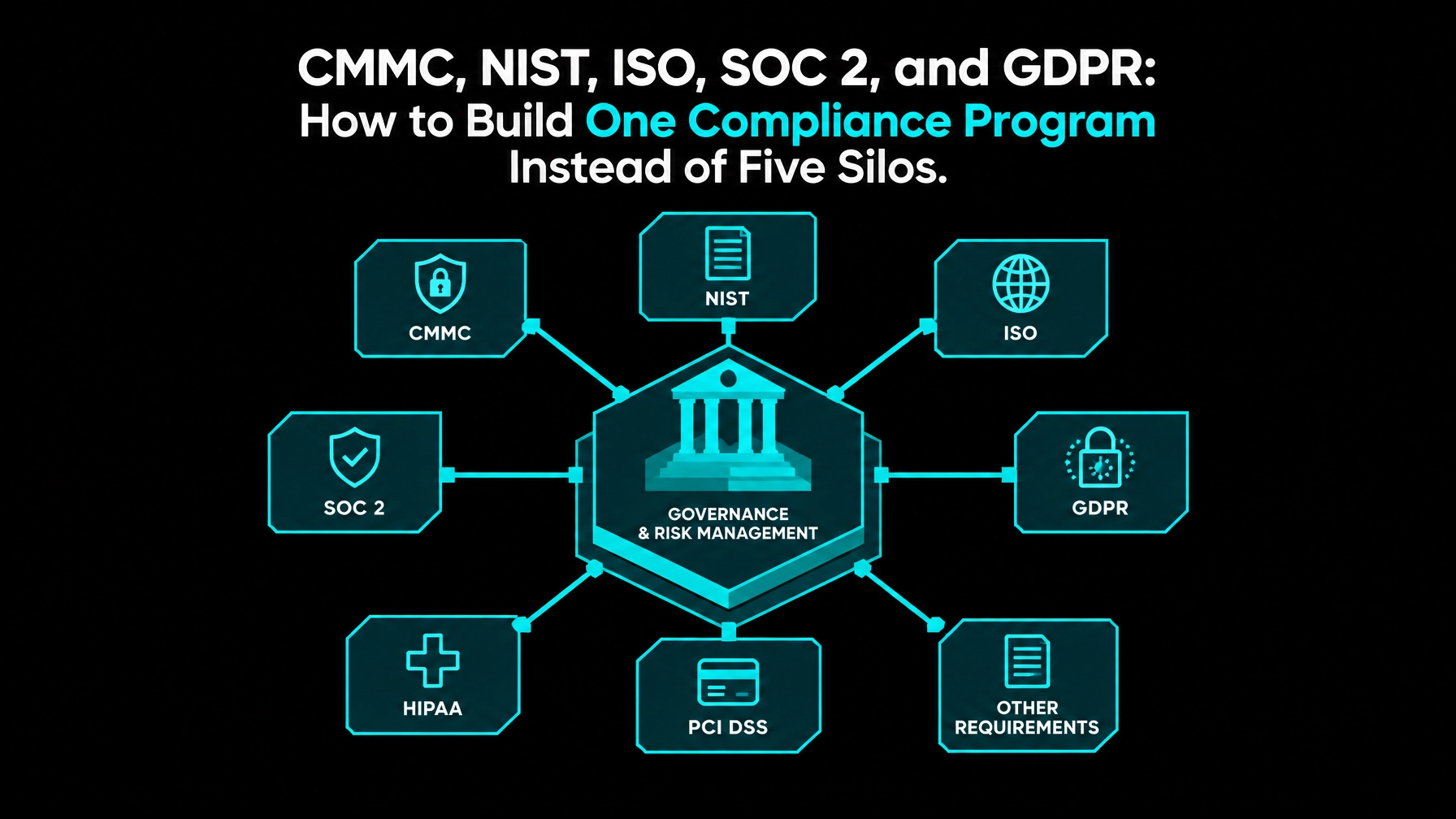
Many organizations manage CMMC, NIST, ISO 27001, SOC 2, GDPR, HIPAA, PCI DSS, and customer security questionnaires as separate projects. Each framework receives its own spreadsheet, policy set, evidence folder, audit calendar, and remediation list. The result is duplicated work, conflicting requirements, unclear ownership, and rising costs.
We have a better approach: one unified governance, risk, and compliance program with framework-specific views.
The objective is not to treat every framework as identical. They are not identical. The objective is to identify the common controls, document the differences, establish the correct scope, and operate one coordinated program from beginning to end.
Compliance Requirements Depend on Your Actual Scope
Companies need to begin with facts. We have the experience to help you establish those facts before policies are written or controls are purchased.
Your applicable requirements depend on several factors:
- Contracts, solicitations, flow-down clauses, and customer commitments
- Whether you process, store, or transmit Controlled Unclassified Information
- The type of personal, health, payment, financial, or proprietary data you handle
- Your geographic presence and the location of your customers and data subjects
- Your industry and state or federal regulatory obligations
- Your technology environment, cloud providers, applications, and vendors
- Your organization’s size, business model, and operating structure
- The services or products included in an audit, attestation, or customer review
CMMC may become relevant because of a Department of Defense contract and CUI obligations. HIPAA may apply because your business is a covered entity, business associate, or service provider handling electronic protected health information. PCI DSS generally concerns entities that store, process, or transmit payment account data or can affect the security of the cardholder data environment. GDPR may apply to processing involving individuals in the European Union, including certain organizations located outside the EU.
These requirements must be determined: not assumed.
The NIST Cybersecurity Framework provides a recognized structure for managing cybersecurity risk. NIST SP 800-171 Rev. 3 addresses the protection of CUI in nonfederal systems. NIST SP 800-66 Rev. 2 provides cybersecurity resources for implementing the HIPAA Security Rule. The GDPR text published by EUR-Lex establishes privacy and security obligations that require legal and privacy analysis, not just technical controls.
A unified program starts with a defensible scope statement.

Build One Control Spine Instead of Five Silos
Companies need one operational control catalog. We have the capability to help normalize requirements into a structure your leadership, technical teams, assessors, customers, and investors can understand.
A control spine organizes requirements around real business activities:
- Identity and access management
- Multifactor authentication
- Asset inventory and configuration management
- Vulnerability and patch management
- Logging, monitoring, and auditability
- Incident response and breach notification
- Encryption and data protection
- Business continuity and disaster recovery
- Secure software development
- Workforce security and training
- Physical and environmental protection
- Vendor and supply-chain risk management
- Privacy governance and data subject rights
- Risk assessment and continuous improvement
Each operational control then receives framework references. One access-control process may support a CMMC practice, a NIST outcome, an ISO 27001 Annex A control, a SOC 2 Trust Services Criterion, a HIPAA safeguard, a PCI DSS requirement, and part of a GDPR security analysis.
That does not mean one control automatically satisfies every requirement. Mapping must account for intent, testing method, frequency, population, evidence quality, and scope. Some mappings are strong. Some are partial. Some are not appropriate.
The control matrix should therefore identify:
- The control objective
- The control owner
- The systems and data in scope
- The applicable framework references
- The operating procedure
- The required evidence
- The testing frequency
- The current maturity or status
- The related risk and remediation action
- The independent validation required
This structure reduces duplication without reducing rigor.
Assign Control Ownership and Executive Accountability
Companies need clear responsibility. We have the expertise to establish a governance model that connects executive decisions with day-to-day control operation.
Compliance cannot belong only to the security department. Effective ownership may include:
- The board or executive sponsor for risk tolerance and strategic direction
- The GRC program lead for coordination and reporting
- IT and security for technical safeguards
- Human resources for workforce processes and training
- Legal for contractual obligations and regulatory interpretation
- Privacy leadership for data inventories, privacy rights, and impact assessments
- Procurement for supplier reviews and contract requirements
- Finance for payment-related controls and financial risk
- Operations for business continuity and process execution
- Product and engineering for secure development and change management
Every important control needs a named owner and an evidence custodian. The owner operates or supervises the control. The evidence custodian retains records that show the control operated as represented.

We will help establish meeting rhythms, escalation paths, management reporting, and risk acceptance procedures. We will also help translate technical findings into business decisions: revenue exposure, contract impact, operational disruption, customer confidence, and funding readiness.
Policies Must Match the Way Your Business Operates
Companies need policies that are specific enough to guide behavior and practical enough to be followed. We have that capability.
A unified policy library may include:
- Information security policy
- Access control policy
- Incident response plan
- Risk management policy
- Data retention and destruction policy
- Privacy policy and data subject request procedures
- Vendor risk management policy
- Business continuity and disaster recovery plans
- Secure development policy
- Encryption and key management standards
- Acceptable use and remote access standards
- Workforce training and disciplinary procedures
Policy development must follow the control matrix and the actual operating environment. A policy that describes controls you do not operate creates evidence problems and increases exposure during customer reviews or assessments.
We can coordinate policy development with technical procedures, contractual commitments, privacy obligations, and executive approvals. We can also help identify where qualified legal counsel, a privacy professional, or another subject-matter expert must review the language before adoption.
Collect Evidence Once and Use It Intelligently
Companies need evidence that is complete, current, traceable, and connected to control objectives. We have the experience to organize evidence collection so that your team does not repeatedly answer the same question for five different reviewers.
Common evidence includes:
- Access reviews and termination records
- MFA and endpoint configuration reports
- Vulnerability scans and remediation tickets
- Security awareness completion records
- Incident response exercises
- Backup and recovery test results
- Vendor questionnaires and risk ratings
- Change-management approvals
- System inventories and data-flow diagrams
- Penetration testing reports
- Privacy impact assessments
- Records of processing activities
- Management review minutes
- Exception approvals and risk acceptance records
Evidence should be tagged to the unified control and then cross-referenced to applicable frameworks. This approach supports an ISO audit, a SOC 2 examination, a customer due-diligence request, a CMMC readiness effort, or a HIPAA security review without rebuilding the evidence package each time.
The AICPA SOC resource library explains that SOC services provide assurance reporting around system-level and entity-level controls. The report itself is not interchangeable with CMMC, ISO 27001, HIPAA, PCI DSS, or GDPR compliance. The evidence may overlap, but the assessment purpose and criteria remain distinct.
Track Risk and Execute Remediation
Companies need more than a list of missing documents. We have the capability to turn identified gaps into a prioritized remediation plan.
A useful remediation register records:
- The control or requirement affected
- The risk created by the gap
- The business owner
- The technical or operational fix
- The estimated cost
- The target completion date
- Dependencies and resource needs
- Interim safeguards
- Verification requirements
- Residual risk and executive disposition
Priorities should reflect contract deadlines, customer commitments, sensitive data, likelihood of exploitation, operational impact, and financial consequences.
This is where compliance becomes business development. A company that can explain its scope, controls, evidence, risks, and remediation plans is better prepared for government contracting, enterprise sales, mergers, acquisitions, lender reviews, and investor due diligence.
Readiness does not guarantee certification, an attestation, a contract award, or an investment. It gives decision-makers a stronger basis for evaluating the organization and moving forward.

Coordinate the Right Independent Experts
Companies need qualified outside input when the engagement requires independent assessment, legal interpretation, privacy judgment, or specialized validation. We have the strategic coordination experience to help you identify and manage those needs.
The Infinity Group can help architect the program, coordinate workstreams, organize documentation, and support executive decision-making. We do not replace an authorized or qualified assessor, licensed attorney, CPA, privacy professional, QSA, or other required authority.
Depending on your scope, you may need:
- A qualified CMMC assessment professional or authorized assessment organization
- A CPA firm conducting a SOC 2 examination
- An accredited ISO certification body
- A PCI SSC Qualified Security Assessor
- Qualified HIPAA, privacy, or healthcare regulatory counsel
- Data protection counsel or a data protection officer
- Specialized penetration testing and technical assessment providers
The right model separates preparation from independent evaluation. It also prevents conflicts of interest and keeps your claims accurate.
The Infinity Group Approach
We are Business Development Architects. We assist organizations from A to Z: strategic planning, federal-facing growth, contract positioning, technical operations, capital strategy, stakeholder coordination, and investor readiness.
For compliance-driven businesses, we can support:
- Scope and obligation discovery
- Framework selection and mapping
- Unified control catalog development
- Governance design and control ownership
- Policy and procedure coordination
- Evidence architecture
- Risk registers and remediation roadmaps
- Vendor due diligence
- Executive reporting
- Assessor and legal/privacy coordination
- Customer questionnaire preparation
- Government contracting readiness
- Funding and investor due-diligence preparation
A compliance program is an operating asset. It protects information, supports customer trust, strengthens proposal positioning, and gives investors a clearer view of execution discipline.
What is the value of replacing five disconnected compliance projects with one coordinated program? What is the value of reducing repeated evidence requests, identifying risk earlier, and presenting a more credible readiness position to a government customer, strategic partner, lender, or investor?
The answer is measured in saved time, reduced duplication, stronger decision-making, and more opportunities pursued with confidence.
Start With One Plan
Contact The Infinity Group at connect@infinity-us.com to discuss your contracts, data, geography, current frameworks, business goals, and next steps. We will help you review the scope, identify the right control spine, establish a practical roadmap, and determine which qualified assessors or legal and privacy professionals should participate.
Comments and replies are disabled for this article.
ONE PROGRAM. ONE CONTROL SPINE. ONE CLEARER PATH TO READINESS.
Strategies + Execution = Funding and Growth.
Sources
- NIST Cybersecurity Framework
- NIST SP 800-171 Rev. 3: Protecting Controlled Unclassified Information
- NIST SP 800-66 Rev. 2: Implementing the HIPAA Security Rule
- European Union GDPR Regulation 2016/679
- AICPA System and Organization Controls Resource Library
- PCI Security Standards Council: PCI DSS
- The Infinity Group Consulting Services
- The Infinity Group Technical Operations
- The Infinity Group Government Contracting Consulting
General Information Disclaimer
This article is provided for general informational and business-planning purposes only. It is not legal advice, privacy advice, cybersecurity certification advice, accounting advice, an audit opinion, or a guarantee of compliance, certification, attestation, contract award, funding, or investment. Requirements vary according to contracts, data, geography, industry, systems, and organizational scope. Consult qualified assessors, legal counsel, privacy professionals, CPAs, QSAs, and other appropriate specialists for advice specific to your circumstances.
