

Alexander the Great did not build an empire by relying on one formation, one supply line, or one source of strength. He combined intelligence, logistics, disciplined execution, and strategic alliances. Critical technology companies must operate with the same discipline when raising capital.
A new federal capital channel is now taking shape.
On August 24, 2026, the U.S. Department of Energy and the U.S. Small Business Administration signed a Memorandum of Agreement establishing the Small Business Investment Company-Energy, or SBIC-E, Initiative. The initiative is designed to expand private investment in U.S. small businesses developing technologies important to energy production, advanced manufacturing, supply-chain resilience, and national and economic security.
The program name is officially SBIC-Energy, not “Emerging,” although its priority areas include many critical and emerging technologies.
For companies developing artificial intelligence, semiconductors, clean energy systems, advanced manufacturing, quantum technologies, critical minerals, biotechnology, or next-generation communications, this is an important development in the market for investment capital for startups and growth-stage businesses.
SBIC-E Connects Federal Priorities With Private Capital

SBIC-E is not a new DOE grant program. It is not a direct DOE investment portal. It does not create a simple application where a company submits a proposal and receives federal equity funding.
Instead, SBIC-E uses the existing SBA Small Business Investment Company structure.
Under the traditional SBIC model, SBA licenses professionally managed private investment funds and provides SBA-backed financing that can increase the funds’ ability to invest in qualifying U.S. small businesses. The private fund remains the investor. SBA provides the program structure and leverage framework.
Under SBIC-E:
- DOE identifies strategic technology priorities;
- DOE provides technical and commercialization expertise;
- DOE helps engage the investment community;
- SBA administers the SBIC framework;
- Participating funds commit to directing a significant portion of investments toward DOE priority areas;
- Qualifying small businesses receive access to additional private capital channels.
The official DOE SBIC-E Initiative page explains that the initiative combines DOE’s scientific, technical, and commercialization expertise with SBA’s established SBIC Program.
The SBA SBIC program states that its program has supported private equity capital and long-term debt financing for American small businesses since 1958. SBA reports that the SBIC program currently represents approximately $58 billion in combined portfolio value, with $147 billion invested in American small businesses since the program began.
This is not a minor administrative change. It is a new alignment between federal technology priorities, private investment funds, and the companies expected to build the next generation of American industrial capacity.
The Initial SBIC-E Priority Areas
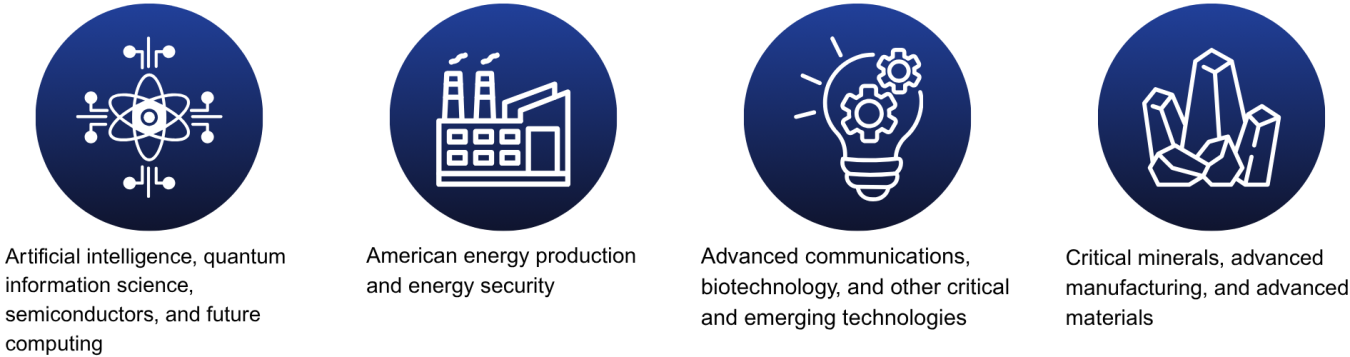
The initial SBIC-E priorities include four broad groups of technology and industrial activity:
1. American Energy Production and Energy Security
This category includes energy production, infrastructure, storage, electric power, nuclear technologies, and systems that strengthen domestic energy reliability.
Companies developing grid equipment, power systems, energy storage, fuel technologies, nuclear applications, or infrastructure supporting energy security should evaluate how their technology fits this priority.
2. Critical Minerals, Advanced Manufacturing, and Advanced Materials
The United States requires stronger domestic capability in mineral processing, materials development, manufacturing equipment, and industrial production.
Companies working in battery materials, specialty metals, robotics, industrial automation, precision production, composites, additive manufacturing, or domestic supply-chain development may align with this category.
3. Artificial Intelligence, Quantum Information Science, Semiconductors, and Future Computing
AI continues to capture a significant share of venture capital attention, but SBIC-E creates an additional public-private framework around a broader technology base.
The opportunity includes semiconductor design and manufacturing, advanced packaging, quantum systems, high-performance computing, AI infrastructure, machine learning applications, and supporting hardware.
Being in one of these fields does not guarantee investment. The company must still demonstrate a defensible technology, a capable management team, commercial demand, and a credible path to return.
4. Advanced Communications, Biotechnology, and Other Critical Technologies
The initiative also identifies advanced communications, biotechnology, and other critical and emerging technologies. This provides room for the priority areas to evolve as national economic and security requirements change.
The DOE announcement specifically identifies companies connected to DOE’s innovation ecosystem, including SBIR/STTR awardees, ARPA-E performers, Technology Commercialization Fund recipients, Lab-Embedded Entrepreneurship Program participants, and companies commercializing National Laboratory technologies.
What SBIC-E Means for Startups and Mid-Sized Companies
SBIC-E creates an opportunity, but opportunity must be converted into an investable business case.
Companies need more than a technology description. They need to show:
- The commercial problem being solved;
- The customer who will pay;
- The market size;
- The stage of product development;
- The intellectual-property position;
- Existing contracts, pilots, or purchase commitments;
- Manufacturing and operational requirements;
- The amount of capital required;
- The milestone the capital will achieve;
- The expected path to enterprise value and investor return.

A company may be technically impressive and still be unprepared for institutional investment. Funds evaluating critical technology businesses will examine development risk, regulatory requirements, manufacturing capacity, customer concentration, government dependencies, ownership structure, financial controls, and management depth.
This is why raising capital for business requires preparation before outreach begins.
A strong SBIC-E-oriented capital package should connect the technology to federal priorities without presenting the company as dependent on government support. The company must stand on its own commercially. Federal alignment is an advantage. It is not a substitute for customers, execution, or financial discipline.
Build a Capital Stack, Not a Single Funding Request

Venture capital for startups remains important. It is not the only answer.
A critical technology company may require several forms of capital over time:
- Founder and angel investment;
- Venture capital;
- Strategic corporate investment;
- SBIC-E-aligned private capital;
- SBIR/STTR funding;
- ARPA-E or other federal programs;
- State economic-development resources;
- Equipment financing;
- Purchase-order financing;
- Government contracts;
- Customer-funded pilots;
- Joint ventures and licensing;
- Revenue from commercial customers.
Each source serves a different purpose.
Non-dilutive funding may support research and development. Government contracts may provide revenue and customer validation. Strategic investors may provide manufacturing, distribution, or technical access. Equity capital may fund hiring, market expansion, and commercialization. Debt may support equipment or working capital when revenue is sufficiently predictable.
The objective is to determine which form of capital should be used at each stage, at what cost, and against which measurable milestone.
A company that combines these resources effectively can reduce unnecessary dilution, improve negotiating leverage, and present a stronger case to private investors.
How The Infinity Group Can Support the Process
The Infinity Group is a Business Development Architect. We help startups and mid-sized companies identify, structure, and secure investment capital from beginning to end.
Companies need a capital strategy. We can develop one.
Companies need investor-ready materials. We can organize the business plan, financial narrative, use-of-funds strategy, milestone schedule, management presentation, and data room.
Companies need access to government programs and public-private financing vehicles. We understand federal agencies, state resources, government contracting environments, and the requirements that influence commercial investment.
Companies need relationships with investors, strategic partners, customers, agencies, and other decision-makers. We can support that business development process.
Companies need to determine whether they are ready for venture capital, strategic equity, SBIC-related investment, government funding, contracts, debt, or a combined capital stack. We have that expertise.
Our business growth services and broader consulting services are designed to support strategic business growth, capital development, market positioning, government opportunity development, and execution.
The recent September 3, 2026 analysis from Foley Hoag confirms the practical importance of the initiative: SBIC-E may create new opportunities for both fund managers and companies operating in energy and critical technology sectors, but the details of participation will continue to develop.
That means preparation should begin now.
The Capital Opportunity Is Real. Readiness Is Required.
SBIC-E gives critical technology companies another channel for private capital. It also increases the importance of disciplined positioning.
You should be able to answer:
- Why is this technology strategically important?
- What commercial problem does it solve?
- Who will purchase it?
- What proof exists today?
- What capital is required?
- What milestone will that capital produce?
- Which investors are most likely to understand the opportunity?
- How will the company scale production, sales, compliance, and management?
- What return can the investor reasonably expect?
Is a reasonable investment in strategy, preparation, contacts, and execution worth the opportunity to secure substantially greater investment capital, revenue, contracts, or enterprise value?
The answer is in the plan.
We can help you review your SBIC-E positioning, evaluate your capital requirements, identify appropriate public and private resources, and establish the next steps. Contact us at connect@infinity-us.com or through The Infinity Group contact page.
YES. YES. YES.
CRITICAL TECHNOLOGY NEEDS CAPITAL.
CAPITAL NEEDS STRATEGY.
STRATEGY + EXECUTION = FUNDING AND GROWTH.
Comments: Disabled.
