
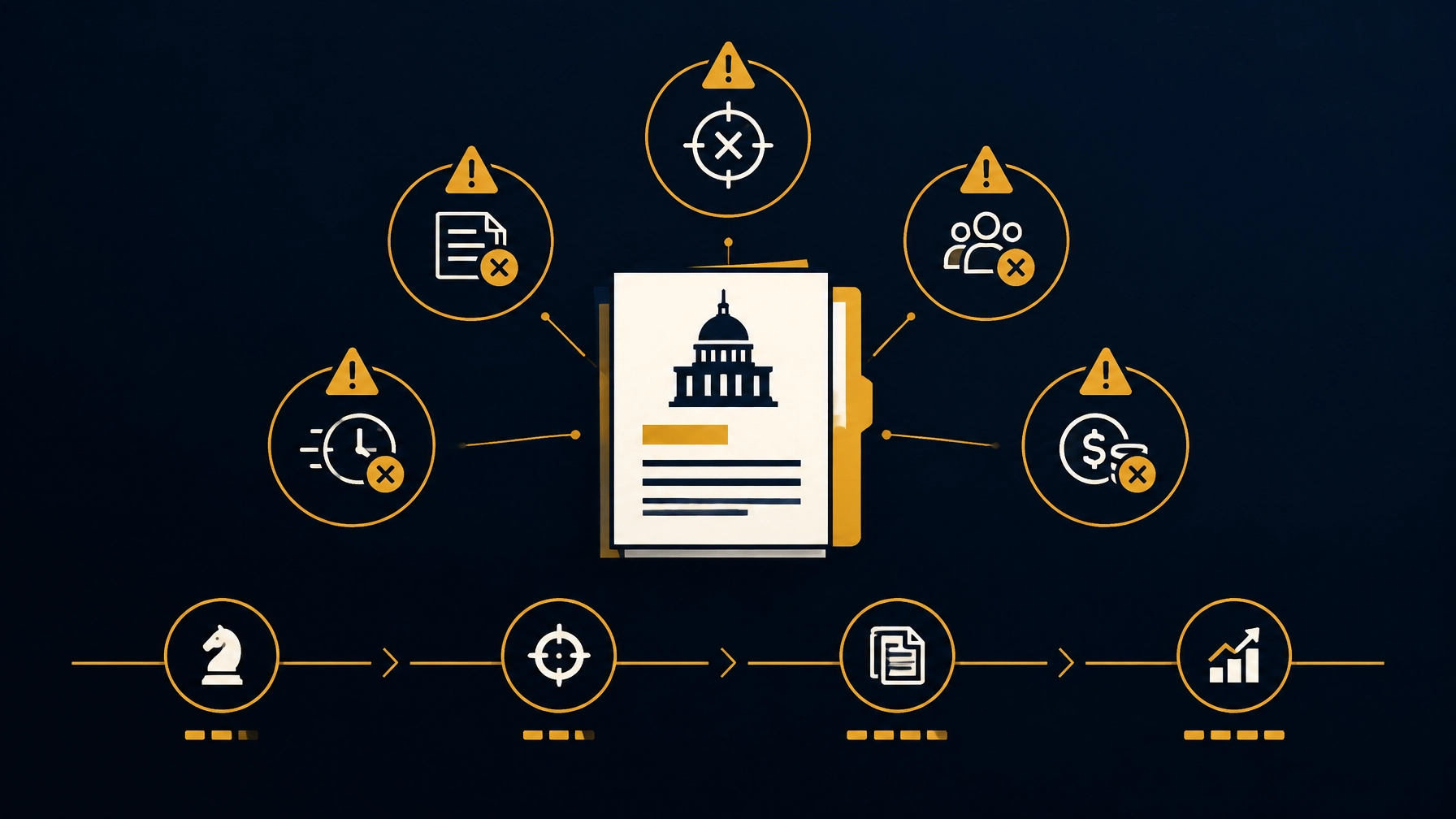
Hero artwork: Government business is won through disciplined strategy, qualification, compliance, pricing, and capture, not registration alone.
In military history, a campaign was not won because an army arrived at the battlefield. Victory depended on preparation, intelligence, logistics, command discipline, and the ability to sustain performance after the first engagement.
Government business follows the same rule.
Federal agencies do not purchase based only on a company’s registration, website, or enthusiasm. They evaluate responsibility, capability, past performance, compliance, price, delivery, and mission fit. The companies that approach government business as a complete development strategy are positioned to compete with greater discipline and protect their long-term growth.
The companies that treat it as a series of forms and last-minute proposals create unnecessary risk.
Below are five common mistakes CEOs, founders, and business development leaders should correct before pursuing federal opportunities.
1. Treating SAM.gov registration as a strategy
Registration in the System for Award Management is necessary for many federal contracting activities. It is not a government-business strategy.
SAM.gov provides an important foundation: entity registration, the Unique Entity ID, representations and certifications, contracting information, and access to federal opportunity and award data. However, an active registration does not establish market position, create agency demand, demonstrate past performance, or identify which opportunities are commercially viable.
A company may be fully registered and still have:
- The wrong primary NAICS code;
- An unclear capability narrative;
- Outdated points of contact;
- No target-agency plan;
- No contract-vehicle strategy;
- No relevant past-performance positioning;
- No compliance-readiness documentation;
- No capture calendar.
FAR Part 19 places importance on NAICS codes, size standards, small-business representations, socioeconomic eligibility, and fair market pricing. These are not passive profile fields. They affect which competitions a company may pursue and how it represents itself at the time of offer.
Corrective action: turn registration into a managed market position
Review your SAM.gov profile at least quarterly and after any major change in ownership, leadership, capabilities, location, banking information, or business direction. Confirm that your NAICS codes, capabilities, certifications, representations, and points of contact are accurate.
Then connect the profile to a written federal go-to-market plan:
- Select target agencies and mission areas.
- Identify the problems your company can solve.
- Map relevant NAICS codes and contract vehicles.
- Document past performance and proof points.
- Define prime, subcontract, and teaming objectives.
- Establish a pipeline review process.
Registration opens the door. Strategy determines whether you know where to go.
2. Bidding on keywords instead of qualifying opportunities
A keyword match is not a bid decision.
Companies often search SAM.gov for a product or service term, find a solicitation containing that term, and immediately begin preparing a proposal. This approach confuses visibility with suitability. A solicitation can contain the right keyword and still be wrong for your company because of capability gaps, incumbent strength, staffing requirements, geographic restrictions, contract type, compliance obligations, or unacceptable margin.
The correct question is not, “Can we technically submit?”
The correct question is, “Can we perform this requirement better than the likely competition, at a price that supports delivery and growth?”
A serious bid/no-bid review should examine:
- Capability fit: Can your team perform the statement of work now?
- Past performance: Can you show relevant, credible results?
- Customer fit: Do you understand the agency’s mission and operating environment?
- Competitive position: Who is the incumbent, and what advantages do competitors hold?
- Contract vehicle: Are you eligible and properly positioned to compete?
- Resource capacity: Can you staff the effort without damaging current operations?
- Compliance burden: Can you meet the applicable requirements?
- Profitability: Can you perform at the proposed price and remain financially sound?
- Capture timing: Did you engage early enough to understand the requirement?
Corrective action: use a documented bid/no-bid gate
Create a written scoring process before assigning proposal resources. Require leadership approval for opportunities that do not meet minimum thresholds for capability, past performance, strategic fit, compliance readiness, and profitability.
Do not use a keyword as the deciding factor. Use evidence.

Figure 1: A qualified opportunity must pass five gates before proposal investment begins.
The SBA’s federal contracting resources can help companies understand certifications, size standards, set-asides, subcontracting, and federal contracting assistance. Those resources are most valuable when they support a defined market strategy rather than a general search for anything available.
3. Ignoring compliance and cybersecurity until after award
Compliance is not an administrative issue to solve after winning. It is part of the cost and performance model that must be understood before bidding.
Government requirements may include solicitation instructions, representations and certifications, labor standards, recordkeeping, data protection, reporting, subcontracting limitations, cybersecurity controls, incident reporting, supply-chain restrictions, and contract-specific clauses.
For small-business set-asides and certain socioeconomic programs, FAR Part 19.505 also addresses limitations on subcontracting and the nonmanufacturer rule. A company that builds a proposal around subcontracting arrangements without checking those requirements may create a performance problem before work begins.
Cybersecurity creates a similar risk. Requirements may apply to Federal Contract Information, Controlled Unclassified Information, information systems, cloud environments, incident response, and subcontractor flow-downs. Even when a particular certification or assessment is not required for a specific opportunity, the underlying security obligations may remain relevant.
Unexpected compliance expenses can include:
- Security assessments and remediation;
- Controlled environments for sensitive information;
- Additional personnel and training;
- Specialized software and monitoring;
- Contract administration;
- Reporting and audit preparation;
- Subcontractor due diligence;
- Legal or technical support.
Corrective action: build a compliance map before proposal development
For every serious opportunity, prepare a compliance matrix that identifies:
- Each solicitation instruction;
- Each mandatory deliverable;
- Each required representation;
- Each cybersecurity and data-handling obligation;
- Each flow-down requirement;
- Each internal owner;
- The cost, schedule, and evidence required for compliance.
Review FAR 52.204-21 when basic safeguarding requirements may apply, and review all agency-specific and contract-specific clauses. Do not assume that a general cybersecurity policy satisfies a contract requirement.
Compliance should be priced, staffed, documented, and tested before award.
4. Underpricing to win and then failing to perform
Winning at an unsustainable price is not a success.
Companies underprice because they want a first contract, a reference customer, or a place in the federal market. The danger is that the contract becomes a financial strain immediately after award. Staffing is reduced, senior personnel are stretched across too many tasks, quality controls are weakened, and the company begins requesting changes that should have been anticipated during proposal development.
The consequences reach beyond one contract:
- Schedule delays;
- Missed deliverables;
- Unplanned overtime;
- Margin loss;
- Contract disputes;
- Weak customer confidence;
- Negative past-performance information;
- Reduced competitiveness on future opportunities.
FAR 19.202-6 defines fair market price in terms of reasonable costs under normal competitive conditions, not simply the lowest possible cost. That principle is important for every company building a defensible federal pricing model.
Corrective action: perform a price-to-perform review
Before submitting a proposal, confirm that the price covers:
- Fully burdened labor;
- Required qualifications and wage rates;
- Direct and indirect costs;
- Security and compliance obligations;
- Travel, equipment, software, and materials;
- Subcontractor costs;
- Management and quality assurance;
- Schedule risk and contingency;
- A reasonable operating margin.
Then test the model against multiple scenarios: staffing turnover, schedule compression, inflation, subcontractor increases, cybersecurity remediation, and delayed government decisions.
The objective is not to submit the lowest number. The objective is to submit a credible price that supports reliable performance.
5. Neglecting relationships, capture planning, and recompete positioning
Many companies begin government business development when the solicitation drops. By then, the requirement may already be shaped, the incumbent may have a strong position, the acquisition strategy may be established, and the proposal timeline may be too short for meaningful relationship development.
Government relationship strategy does not mean seeking improper influence or special access. It means conducting legitimate, professional market research and learning how an agency defines its mission requirements.
Useful activities include:
- Reviewing prior awards and agency spending;
- Attending industry days;
- Responding to requests for information;
- Engaging through appropriate small-business and industry channels;
- Understanding agency mission priorities;
- Building lawful relationships with primes and qualified teaming partners;
- Tracking incumbent performance and contract timelines;
- Preparing for recompetes well before expiration.
The SBA’s contracting programs and resources and SAM.gov award-search tools provide useful starting points. Federal News Network’s September 2026 coverage of feedback on SBA’s proposed size-standard changes also demonstrates why companies must monitor policy developments that can affect eligibility, set-aside positioning, and long-term pipeline planning. Federal procurement conditions change. Capture plans must change with them.

Figure 2: Capture begins before the solicitation and continues through performance and recompete.
Corrective action: build a capture and recompete calendar
For each target opportunity, record:
- Current contract and incumbent;
- Expected recompete date;
- Agency mission need;
- Procurement history;
- Key capability gaps;
- Potential teaming requirements;
- Industry engagement milestones;
- Proposal preparation deadlines;
- Performance and recompete objectives.
Your first contract should not be treated as an isolated transaction. It should become a platform for reliable delivery, stronger past performance, customer understanding, and future growth.
The Infinity Group Business Development Architect approach
At The Infinity Group, we approach government business as a complete development assignment: strategy, execution, funding, and growth.
We support startups and mid-sized companies with:
- Government market strategy;
- Agency and opportunity qualification;
- Capture planning;
- Proposal development;
- Government contracting consulting;
- Compliance and readiness planning;
- Teaming and subcontracting strategy;
- Capital and resource development;
- Growth planning from beginning to end.
Our role is not to encourage companies to bid on everything. Our role is to help you identify where your capabilities, relationships, resources, pricing, and long-term objectives align.
A federal opportunity should answer five questions:
- Are we eligible?
- Can we perform?
- Can we prove our value?
- Can we price the work responsibly?
- Can this opportunity support our broader growth plan?
If the answer is not clear, the bid requires more work before submission.

Figure 3: The highest-impact risks are the ones companies postpone until the proposal is already due.
Build the strategy before the solicitation
Government business is a market, not a lottery. SAM.gov registration matters. Certifications matter. Proposals matter. Compliance matters. Pricing matters. Relationships and timing matter.
Together, they form a system.
The question is straightforward: would you rather invest in disciplined preparation before the opportunity appears, or absorb the cost after a rushed bid creates an avoidable problem?
We can help you review your government-business position, develop a capture plan, strengthen proposal readiness, and connect strategy to execution, funding, and growth.
Contact The Infinity Group at connect@infinity-us.com to discuss your government relationship strategy and next steps.
Plan with discipline. Execute with purpose. Build for growth.
Authoritative sources
- Federal Acquisition Regulation Part 19: Small Business Programs, current page showing FAC 2026-01, effective March 13, 2026.
- SBA Federal Contracting Resources, current federal contracting assistance, certification, set-aside, and small-business resource information.
- SAM.gov, official U.S. government system for entity registration, contracting research, entity information, and federal award data.
- SAM.gov Announcement: Contract Awards Data and Searching Now in SAM.gov, February 25, 2026.
- Federal News Network: Feedback on SBA’s Size Standard Proposal Running Mostly Negative, September 2026.
- Federal News Network: DoD Moves to Replace Government-Unique Accounting Standards With GAAP, September 2026.
- FAR 52.204-21: Basic Safeguarding of Covered Contractor Information Systems.
General-information disclaimer
This article is provided for general informational and educational purposes. It is not legal, accounting, cybersecurity, procurement, or other professional advice, and it does not guarantee eligibility, contract awards, funding, or business results. Government requirements vary by agency, solicitation, contract type, and applicable law. Companies should review the governing solicitation and contract documents and obtain qualified professional advice for their specific circumstances.
Comments and replies: disabled.
