
By John Marsh, The Infinity Group | Comments disabled
The morning after an election, the first calls in Washington are not about speeches. They are about access, committee assignments, and who now controls the hearing calendar. After the November 3 midterms, the gavels are changing hands. For companies selling to the federal government, the old relationship map is already out of date.
Here is the hard truth: with President Trump still holding the veto, major Democratic legislation faces a steep barrier. Oversight, however, does not need the president’s signature. In this divided government, hearings, document demands, subpoenas, and pressure on agency decisions are likely to become the majority’s most immediate tools.
That changes what “government relationships” means. It is no longer enough to know the agency buyer or program office. You need to understand the committees that fund, authorize, and investigate your work, and be ready to explain how your contracts, claims, and decisions look in a public record.
The arithmetic of the sweep: power, with a limit
As of November 18, Democrats held at least 257 House seats and a 56-seat Senate majority, after flipping nine Republican-held Senate seats. Their national House popular-vote lead reached 14 points, the largest for either party since 1974, according to The Washington Post. The 120th Congress convenes January 3, 2027.
Those are formidable numbers. They are not veto-proof numbers. Democrats would need roughly 290 House votes and 67 Senate votes to override a veto. President Trump remains in office, with veto power, through January 2029. Democrats cannot simply enact their full agenda over his objection.

Chart: Democratic seats held against the two-thirds threshold needed to override a veto. The majority is 33 House seats and 11 Senate seats short. Seat counts as of November 18, 2026; override thresholds are approximate. Sources: AP News; The Washington Post.
| Chamber | Democratic seats | Approx. override threshold | Seats short |
|---|---|---|---|
| House | 257 | 290 | 33 |
| Senate | 56 | 67 | 11 |
The Senate flips included Texas, South Carolina, Kansas, Mississippi, and Alaska, where the final Senate call came. The result gives Democrats control of both chambers, but not the votes to override a determined president. That arithmetic points toward investigations and public pressure rather than a fast run of landmark statutes.
The new gatekeepers
Committee chairs control more than a room and a gavel. They shape hearings, direct investigative attention, and can seek records and testimony. The chairs below are tentatively, subject to change, the expected occupants of those seats. They are projections based on post-election analysis, not final assignments.
- Senate Banking, Housing and Urban Affairs: Elizabeth Warren (D-MA), tentatively, subject to change. Expect scrutiny of banks, housing, consumer finance, and corporate conduct.
- Senate Finance: Ron Wyden (D-OR), tentatively, subject to change. Wyden’s one-word response to the election was “Subpoenas.” Tax, trade, healthcare, and corporate practices are all within the committee’s reach.
- Senate Health, Education, Labor and Pensions: Bernie Sanders (I-VT), tentatively, subject to change. Drug pricing, healthcare costs, labor, and workplace issues are likely areas of attention.
- House Ways and Means: Richard Neal (D-MA), tentatively, subject to change. Tax policy, health-related tax credits, and trade will be central to the tax-writing panel’s work.
- House Transportation and Infrastructure: Rick Larsen (D-WA), tentatively, subject to change. A federal-aid highway reauthorization is an early priority. Transportation contractors should also watch aviation and infrastructure oversight.
- House Oversight and Accountability: Robert Garcia (D-CA), tentatively, subject to change. Garcia has named corporate corruption and government contracting as leading targets.
- Senate Permanent Subcommittee on Investigations: Richard Blumenthal (D-CT), tentatively, subject to change. Expect investigations where business conduct and public-interest questions intersect.
- Speaker: Hakeem Jeffries (D-NY), tentatively, subject to change, is the likely next Speaker. His priorities will help set the House agenda.
This is not a list of guaranteed investigations. It is a map of jurisdiction and likely attention. Quartz and ICLG’s post-election analysis likewise points to oversight as an immediate source of pressure for companies, especially those tied to federal contracts.

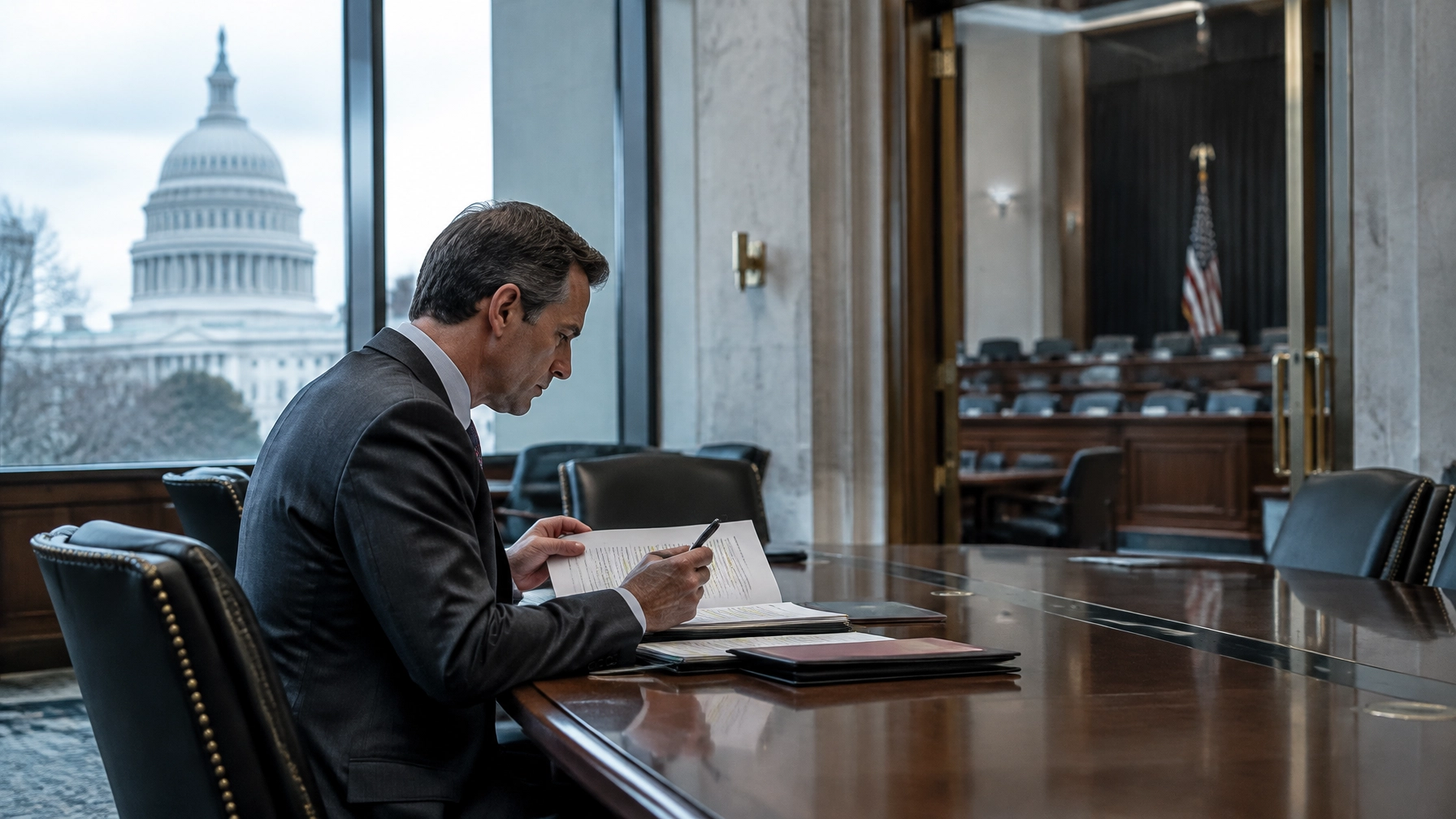
Photo: A leadership team reviewing its federal priorities. The point is practical: agency relationships matter, but committee jurisdiction belongs on the same map.
Why contractors should pay attention
A contract award can draw a company into a public discussion about how federal money was spent, how the requirement was shaped, and whether delivery matched the promise. A committee inquiry can bring requests for documents, testimony, and explanations about decisions that may have seemed routine when made.
Do not assume that courtroom rules translate neatly to a committee room. Congressional investigations operate differently from litigation, and privilege disputes require careful, specialized legal advice. Records or testimony provided during an inquiry can also become relevant to later enforcement or litigation. The right response is not panic. It is preparation.
A recent example shows how quickly oversight can focus on a particular vendor relationship. After the November 13 nationwide ground stop, Senate Commerce Committee Democrats urged the FAA to pause Juniper router installations and requested more information about the failure. Of 3,648 planned routers, 400 had been installed and 69 were operational; roughly 12,462 flights were canceled that day. The senators’ November 17 letter illustrates the pathway from a service disruption to questions about testing, contractor management, redundancy, and public funding.
For contractors, the lesson is direct: performance, documentation, and communications can become inseparable when an issue attracts congressional attention.
What may move in 2027
Democrats describe their legislative agenda in pocketbook terms: healthcare, housing, energy, and food costs, pursued through legislation and aggressive oversight. Jeffries has made restoring expanded Affordable Care Act premium tax credits a priority. The Congressional Budget Office previously estimated that extending the expanded credits would cost $350 billion over a decade. A proposal can define the debate even when the veto makes enactment unlikely.
The same is true of tax proposals. The corporate tax rate is 21 percent, and Democrats have proposals to raise it. Senator Chris Van Hollen has proposed a 12 percent surtax on taxpayers earning more than $1 million. Some Democrats have also proposed disallowing data center bonus depreciation, taxing bits, or applying an excise tax to data center electricity use. Our prediction: these proposals will be important signals and negotiation positions, but many will be messaging rather than law unless they attract bipartisan support.
Households and employers should also track the difference between current benefits and proposed expansions. The 2026 Child Tax Credit is $2,200 per child; the 2021 expansion was $3,000. The maximum childless-worker Earned Income Tax Credit is $664 in 2026, compared with $1,502 under the 2021 expansion. Tax Foundation estimates that restoring the expanded CTC could cost more than $500 billion, while restoring the expanded childless EITC could cost $60 billion to $120 billion.

Chart: The gap Democrats want to close. Base and maximum credit amounts under current law compared with the 2021 expansion. Source: Tax Foundation, “What a Democratic Congress Means for Tax Policy in 2027.”
| Credit | 2021 expansion | 2026 amount |
|---|---|---|
| Child Tax Credit, per child | $3,000 | $2,200 |
| Childless-worker EITC, maximum | $1,502 | $664 |
The debt limit could become leverage in negotiations, but it will not erase the veto math. Nor will the spending environment make new programs easy to finance: federal debt exceeds $32 trillion and has surpassed 100 percent of GDP; the most recent fiscal-year deficit was roughly $2 trillion. The 10-year Treasury yield has hovered around 5 percent, while Social Security trustees project trust-fund depletion in 2032.
The first immediate test is closer. The FY2027 continuing resolution, P.L. 119-103, expires December 11, 2026. The lame-duck session must choose among an omnibus, smaller “minibus” bills, or another continuing resolution into early 2027. Contractors should plan for uncertainty around timing and funding, not assume a new majority can rewrite every program on day one.
Where money and risk may shift
- Healthcare and health IT: Expect continued focus on affordability, premium tax credits, drug prices, insurers, and healthcare delivery. Businesses with federal health programs should connect their cost and performance evidence to the public need their work serves.
- Energy and permitting: Energy costs make this a pocketbook issue as well as an infrastructure issue. Projects should be ready to explain timelines, community impacts, reliability, and the federal approvals they need.
- Data centers and AI: The tax proposals are a warning that power use, investment incentives, and local impacts may draw scrutiny. A Bank of America November survey of 169 fund managers overseeing $461 billion found a record net 38 percent said companies were overinvesting in AI; 52 percent expected an AI hyperscaler to announce a capital-spending cut within six months. Those are investor expectations, not confirmed cuts. Source: Bloomberg.
- Transportation and infrastructure: A highway reauthorization under Larsen, tentatively, subject to change, creates an opening for firms that can demonstrate readiness, delivery capacity, and alignment with public needs. FAA events also show how quickly safety and systems integration can become oversight issues.
- Defense: Do not mistake a change in committee control for an automatic end to defense work. Position around mission requirements, credible performance, and funding vehicles that can attract support across the aisle.
Small-business rules also deserve immediate attention. SBA’s proposed size-standard changes could alter eligibility and competition in federal contracting. The agency estimated that 37,002 contractors would newly qualify as small across roughly 105,655 FY2025 contracts worth about $71 billion; SBA’s Office of Advocacy estimated only 4,000 to 6,000. The comment deadline is November 20, 2026. The estimates differ substantially, which is exactly why affected companies should review the proposal and their own contract exposure. See the Federal Register notice.

Photo: Committee influence often starts in the staff process. Build your stakeholder map around jurisdiction, not just agency contacts.
Three things to do now
-
Rebuild your stakeholder map around committee jurisdiction. By Monday, assign one executive or government-relations lead to map every relevant House and Senate committee, expected chair, ranking member, subcommittee, and agency connection for your top three federal opportunities. Identify where each opportunity touches appropriations, authorization, oversight, and regulation.
-
Audit the documentary record before anyone asks. Ask legal, contracts, compliance, and program teams to identify the records supporting your top federal awards: bid assumptions, communications, performance reports, change orders, testing, subcontractor oversight, and issue escalation. Flag gaps and inconsistent explanations. Have specialized counsel guide privilege, retention, and response decisions.
-
Re-underwrite your pipeline against the appropriations calendar and veto math. For each active pursuit, list its funding source, next decision date, agency owner, relevant committee, and whether it depends on a new law or a must-pass funding vehicle. Treat a proposed messaging bill as a signal, not booked revenue. Give finance and business development a revised risk rating before the December 11 funding deadline.
Forecast: the next eighteen months
My forecast is that the first year will be defined less by sweeping legislation than by hearings, funding negotiations, investigations, and attempts to shape the 2028 policy debate. Expect some bipartisan movement on practical issues, but do not build a company plan around a major bill surviving the veto process. The firms best positioned will be those that can demonstrate public value, document performance, and explain their government relationships clearly.
The Infinity Group has more than three decades of experience navigating federal opportunities and congressional engagement. We help organizations connect strategy, stakeholders, funding, and execution. To discuss your federal priorities and next steps, write to us at connect@infinity-us.com.
Sources: AP News; The Washington Post; Quartz/ICLG; Tax Foundation; Bloomberg; Federal Register/SBA; Senate Commerce Committee.
This article is general information, not legal or tax advice. Consult specialized legal, tax, and contracting counsel for advice on your circumstances. Committee chair assignments named here are tentatively, subject to change, based on post-election analysis as of the sources cited.
Comments: Disabled

Leave a Reply