
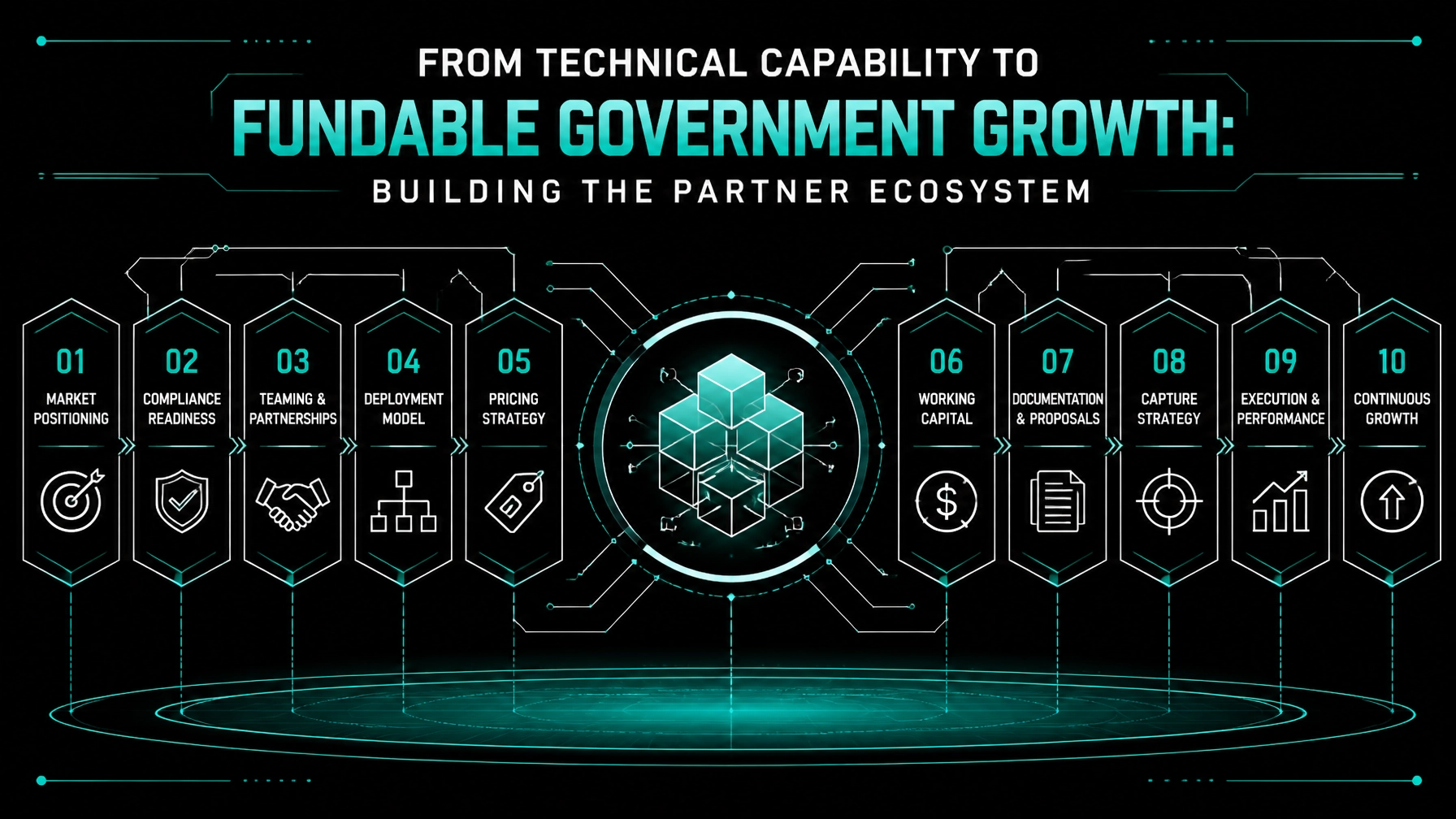
Throughout history, successful campaigns have depended on more than capable equipment. They have depended on logistics, disciplined command, reliable intelligence, trained personnel, and the ability to sustain operations after the first objective was reached. Government growth follows the same principle.
A technology or services company may possess an excellent product, strong engineers, and a clear commercial use case. That is not yet a government-ready growth platform. Government buyers, prime contractors, and investors need to see how the capability will be positioned, authorized, staffed, deployed, documented, priced, supported, and sustained.
At The Infinity Group, we build that bridge. We are Business Development Architects. We connect strategy and execution across government opportunity development, capital planning, partner formation, compliance readiness, and market pursuit.
Strategies + Execution = Funding and Growth.

Technical Capability Must Become a Mission Solution
The first step is market positioning. “We build secure networks” is a technical description. “We provide deployable, supportable communications and cybersecurity infrastructure for authorized government missions in constrained environments” is a government-facing solution.
The difference is important.
Government organizations and prime contractors evaluate capabilities in the context of mission requirements, operating environments, contract structures, risk, schedule, and sustainment. They need to understand what your company does, where it fits, which problem it solves, and how your team will perform when conditions become difficult.
This is especially important for companies pursuing OCONUS or Latin America opportunities. A solution may involve network engineering, communications infrastructure, cybersecurity, technical staffing, logistics, equipment staging, installation, testing, maintenance, and field support. The capability is not only the equipment or software. The capability is the complete operating model.
We help clients translate technical strengths into clear government applications, credible customer language, and defined routes to market. Our government expertise includes opportunity research, acquisition analysis, competitive positioning, stakeholder engagement, teaming strategy, and pursuit development.
Compliance Readiness Is Part of the Product
For overseas government work, readiness begins before deployment.
Personnel performing outside the United States may be subject to contract-specific requirements concerning civilian status, documentation, training, medical readiness, travel, security, accountability, logistics, and subcontract flowdowns. FAR 52.225-19 provides an important framework for certain covered OCONUS and diplomatic missions. The contract, statement of work, agency requirements, and applicable law control in each matter.
Defense Base Act considerations can also affect proposal pricing, personnel deployment, insurance documentation, incident procedures, and subcontract administration. DBA coverage should not be treated as an afterthought or assumed to be satisfied by ordinary domestic workers’ compensation.
Technology movement creates another readiness requirement. Equipment, software, technical data, and services may require review under applicable export-control, sanctions, customs, and contract rules. The shipment must connect the item, destination, end user, authorization, route, documentation, and delivery record before movement begins.
This is not legal advice. It is a business-planning principle: compliance responsibilities must be identified, assigned, budgeted, documented, and incorporated into the operating model.
A fundable company can show investors and primes that readiness is built into the business. It can identify who owns export review, customs coordination, insurance administration, personnel records, cybersecurity controls, and contract documentation. It can demonstrate that these functions do not depend on informal knowledge held by one individual.

Build the Partner Ecosystem Before the Opportunity Requires It
Complex government opportunities rarely belong to one discipline. They may require a technology provider, field-services team, logistics company, accounting support, insurance professionals, telecommunications specialists, cybersecurity personnel, local coordination, and a prime contractor with the appropriate contract pathway.
The correct question is not, “Can we do everything ourselves?”
The correct question is, “Which capabilities must we own, and which capabilities should we coordinate through qualified partners?”
The Infinity Group’s strategic partner model is built around that question. We assemble the right combination of organizations and professionals around the opportunity rather than forcing every project into one fixed delivery structure.
JPI Worldwide is a strategic technical and field-support partner in this ecosystem. JPI’s Insights library addresses OCONUS personnel, Defense Base Act planning, export and customs coordination, prime-contractor expectations, tactical cybersecurity, secure network deployment, and civilian contractor support in Latin America.
JPI may support communications, network infrastructure, cybersecurity, technical staffing, systems integration, logistics, field deployment, and sustainment requirements. Its role must be defined by the applicable requirement, contract structure, scope of work, and customer direction. We do not represent that any partnership guarantees an award, contract, revenue result, or return on investment.
The value of a partner ecosystem is practical. It expands capability without requiring every company to build every department immediately. It also gives primes a clearer view of responsibility: who designs, who supplies, who deploys, who documents, who sustains, and who reports.
Design the Deployment Model, Not Just the Proposal
A government-ready offering must explain how performance will occur from beginning to end.
For a secure network or tactical communications requirement, that model may include:
- Mission and user requirements.
- Architecture and equipment selection.
- Export and customs review.
- Procurement and staging.
- Configuration and security hardening.
- Pre-deployment testing.
- Personnel readiness and mobilization.
- Installation and commissioning.
- Monitoring, troubleshooting, and reporting.
- Sustainment, replacement, and operational handoff.
Secure connectivity is not created simply by turning on equipment. A resilient deployment may require multiple transport options, network segmentation, controlled identity and access, patch management, centralized monitoring, configuration control, backup procedures, and a defined response process when connectivity or field support is limited.
The same discipline applies to Latin America mission support. Geography, infrastructure, customs, local coordination, transportation, staffing, weather, language, and sustainment can affect the delivery model. The company that explains these factors clearly is more credible than the company that presents only a product sheet.
Price the Work for Performance and Working Capital
A technically sound company can still fail to scale if it prices only the visible deliverable.
Government work may require proposal development, travel, insurance, export review, equipment staging, subcontractor coordination, documentation, compliance administration, field support, spare inventory, and payment-cycle management. These costs must be reflected in the pricing model.
Primes expect subcontractors to provide labor categories, labor rates, estimated hours, material costs, travel assumptions, indirect-cost treatment, basis-of-estimate support, exclusions, and schedule dependencies. A company that cannot explain its price creates friction for the prime and uncertainty for investors.
Working capital is equally important. Growth may require hiring or reserving personnel before reimbursement, purchasing equipment before delivery, carrying insurance, paying logistics providers, and maintaining operations while invoices move through an approval cycle.
We help clients connect the opportunity pipeline to the financial plan. That includes identifying the capital required for capture, mobilization, inventory, staffing, compliance, and delivery. Funding should support an executable growth model: not merely a hopeful sales forecast.
Document the Evidence That Makes Growth Investable
Investors and government customers both respond to evidence.
A fundable government-growth platform should maintain an organized record of:
- Qualified opportunities and agency fit.
- Customer and stakeholder research.
- Capability statements and technical narratives.
- Partner roles and teaming assumptions.
- Compliance ownership and readiness status.
- Personnel and deployment requirements.
- Equipment lists and configuration records.
- Pricing assumptions and cost support.
- Pipeline stages and next actions.
- Delivery milestones and corrective actions.
- Cash requirements and billing status.
Documentation turns a collection of conversations into an operating system for growth. It allows leadership to measure progress, identify gaps, and make decisions before a problem becomes a missed milestone.

Measure Execution Without Promising Unsupported Returns
No responsible advisor should guarantee a government contract or unsupported financial return. The correct approach is to measure the activities and conditions that support disciplined growth.
Useful indicators include:
- Number of qualified opportunities aligned to the company’s capabilities.
- Percentage of pursuits with a defined customer, route to market, and partner model.
- Completion of required compliance and deployment-readiness reviews.
- Proposal packages delivered with complete pricing support.
- Partner responsibilities documented before submission.
- Equipment, personnel, and logistics milestones completed on schedule.
- Invoice packages accepted without avoidable correction.
- Cash requirements identified before mobilization.
- Risks escalated with a corrective path.
These measures connect strategy to execution. They show whether the company is becoming easier for a prime to use, easier for an investor to understand, and more prepared for government performance.
The Infinity Group Builds the Architecture
Companies need technical capability. We have the strategic framework to position that capability.
Companies need compliance readiness. We help organize the responsibilities, resources, and documentation required for a credible pursuit.
Companies need partners. We bring together specialized organizations around the actual opportunity.
Companies need pricing and working capital discipline. We connect the growth plan to the financial requirements of performance.
Companies need capture strategy. We identify the customer environment, stakeholders, procurement path, competitive position, and next action.
Companies need execution. We build the structure that moves from requirement to pursuit, from award readiness to deployment, and from deployment to sustainment.
This is the work of a Business Development Architect.
If your company has a technology, service, or field capability that can support government, defense, civilian, diplomatic, infrastructure, cybersecurity, logistics, or Latin America mission requirements, contact The Infinity Group at connect@infinity-us.com. We will discuss your objective, your current position, your partner needs, your capital requirements, and the practical next steps.
Strategies + Execution = Funding and Growth.
Build the capability. Organize the ecosystem. Execute the opportunity.
Attributed Sources and Partner Reading
This article synthesizes themes from the following JPI Worldwide Insights articles:
- JPI Worldwide Insights
- FAR 52.225-19: What “Contractor Personnel Are Civilians” Means for OCONUS Missions
- Defense Base Act Insurance, Explained
- OFAC, ITAR, and Customs: Moving Technology Into an Austere Theater
- What Primes Really Expect From a Subcontractor
- 7 Mistakes Government Contractors Make With Cybersecurity at the Tactical Edge
- 5 Steps to Deploy Secure Network Infrastructure in an OCONUS War Zone
- Civilian Contractors in Latin America: The Infrastructure Behind U.S. Mission Support
Additional resources include The Infinity Group’s Business Growth services, technical operations, government contracting guidance, and contact page.
Administrative notice: This article is for general informational purposes. It is not legal, accounting, insurance, export-control, cybersecurity, or government-contracting advice. Contract-specific requirements, current law, agency direction, and qualified professional review control.
Comments and replies: Disabled.
