
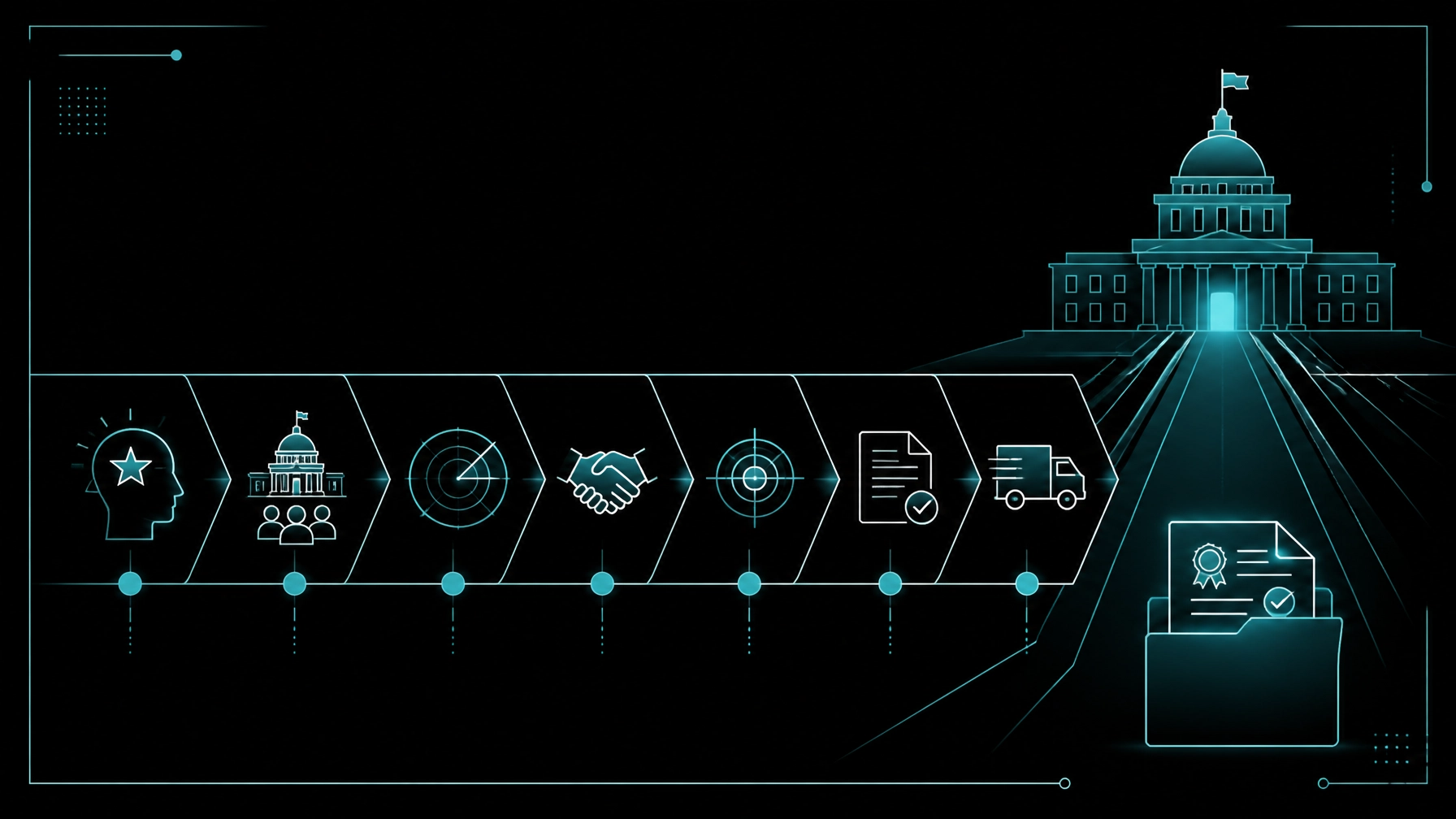
Great campaigns are not won on the battlefield by showing up at the gate. They are won through intelligence, positioning, logistics, disciplined execution, and the ability to perform under pressure.
Federal contracting works the same way.
A registration in the System for Award Management (SAM.gov) is necessary for many federal contracting activities, but it is not a business-development strategy. Registration makes your company visible. It does not automatically make you relevant to an agency, competitive against an incumbent, prepared for a proposal, or capable of delivering the work after award.
Companies need more than a profile. They need a qualified pipeline, a capture plan, a proposal system, and operational readiness.
We have that expertise.
The Infinity Group serves as a Business Development Architect for companies pursuing federal, state, and commercial growth. We bring private-sector business experience together with a practical understanding of government agencies, acquisition processes, and Congressional and public-sector environments: without promising special access, guaranteed awards, or shortcuts around the rules.
The objective is direct: build a government-contracting pipeline that can actually perform.
1. Position Your Capability Around the Buyer’s Mission
Your capability statement should not read like a general company brochure. It should explain why your organization is relevant to a specific agency, office, mission, or requirement.
A strong capability position answers four questions:
- What do you provide?
- Which government problems do you solve?
- What evidence shows that you can perform?
- Why should an agency or prime contractor consider you now?
Your core competencies should use clear, buyer-facing language. Tie your services to appropriate NAICS codes and SBA size standards, but do not stop at classifications. Agencies are not purchasing a NAICS code. They are purchasing outcomes, capacity, risk reduction, technical performance, and dependable delivery.
Your capability statement should include:
- A concise company overview
- Three to six specific core competencies
- Relevant past performance
- Quantified results where available
- Differentiators supported by evidence
- UEI, CAGE code, primary NAICS codes, size status, certifications, and contract vehicles
- A clear contact and teaming invitation
The same story should appear across your website, SAM.gov profile, SBA profile, capability statement, and proposal materials. Inconsistent information creates unnecessary questions. Consistent information establishes control.
Review The Infinity Group’s Government practice and What We Do pages for examples of how business-development capabilities can be organized around strategic needs rather than a disconnected list of services.
2. Align With Agencies Before You Chase Opportunities
Government contracting is not one market. It is a collection of agencies, offices, programs, budgets, missions, buying methods, and acquisition calendars.
Companies need to identify where their capabilities fit. We will help you narrow the field.
Begin by selecting a manageable target list:
- Choose agencies whose missions connect directly to your capabilities.
- Identify the specific offices, components, or program areas that purchase those capabilities.
- Review agency procurement forecasts and historical awards.
- Study budget priorities, strategic plans, public notices, and recurring requirements.
- Map your offering to the agency’s stated objectives.
FAR Subpart 19.2 establishes a federal policy of providing maximum practicable opportunities to small businesses and certain small-business categories, including veteran-owned, service-disabled veteran-owned, HUBZone, small disadvantaged, and women-owned businesses. The rule also directs agencies to consider market research, small-business participation, acquisition structure, and the effects of consolidation or bundling.
That context matters. A company should understand not only what an agency buys, but also how an acquisition may be structured and where small-business participation can be practical.
Alignment is not political access. It is disciplined preparation: understanding the mission, the buying environment, the requirement, and the evidence needed to support your position.

3. Conduct Market Research Before You Invest Capture Resources
A published opportunity is not automatically a good opportunity.
Market research should help you determine whether an opportunity is real, funded, aligned, accessible, and winnable. Use SAM.gov Contract Opportunities and other official agency resources to review active solicitations, sources-sought notices, requests for information, award histories, and related procurement activity.
For each target opportunity, document:
- Agency and contracting office
- Mission and requirement
- NAICS code and size standard
- Contract type and estimated value
- Funding status and period of performance
- Incumbent and contract history
- Current vehicle or planned vehicle
- Set-aside or socioeconomic structure
- Key dates and acquisition milestones
- Relevant past performance requirements
- Security, clearance, location, labor, and technical requirements
The purpose is not to collect hundreds of notices. The purpose is to build a focused pipeline that your company can manage.
A practical pipeline should separate opportunities into stages:
- Watch: early market signal or forecast
- Shape: pre-solicitation activity where research and positioning are possible
- Qualify: enough information exists for a formal decision
- Capture: customer, solution, team, and pricing strategy are being developed
- Propose: the solicitation is active and the proposal effort is authorized
- Perform: the company is delivering and building past performance
This structure prevents the common mistake of treating every notice as an urgent proposal.
4. Analyze the Incumbent and the Competitive Field
Federal buyers often face meaningful transition risk. The incumbent knows the environment, has established processes, and may have personnel already performing the work.
You should know what you are competing against.
For each serious opportunity, analyze:
- The incumbent’s contract history and scope
- Relevant past performance
- Customer relationships and operating presence
- Staffing model and labor categories
- Technical strengths and service gaps
- Contract vehicles and socioeconomic status
- Likely pricing posture
- Potential teaming relationships
- Areas where your company can reduce risk or improve results
Do not build a strategy around unsupported criticism. Build it around credible differentiation.
Your win themes may involve faster implementation, stronger reporting, specialized expertise, regional capacity, better customer communication, a more efficient staffing model, or a qualified small-business team that supports the agency’s participation objectives.
The question is not, “How are we better in general?”
The question is, “What can we prove that matters to this customer, under this requirement, at this time?”
5. Build Teams Before the Proposal Deadline
Teaming is not an emergency activity. It is a capability decision that should begin before a solicitation is released.
A prospective partner may fill a gap in:
- Technical expertise
- Past performance
- Geographic coverage
- Labor capacity
- Security clearances
- Contract vehicles
- Socioeconomic eligibility
- Financial capacity
- Specialized equipment or facilities
The best teams are opportunity-specific. Define the roles, workshare, management responsibilities, pricing assumptions, proposal obligations, data ownership, and performance expectations early. Make sure each partner can provide relevant past-performance details, resumes, technical content, and pricing information on schedule.
The SBA certification programs can also provide important avenues for eligible businesses, including 8(a), HUBZone, WOSB, and other veteran-related programs. Certification can support set-aside eligibility, subcontracting opportunities, mentoring, and joint ventures. It does not guarantee an award.
Treat certification as one part of a broader strategy. The strongest position combines eligibility with mission fit, relevant performance, a credible team, and the ability to execute.
6. Use Bid/No-Bid Discipline
A proposal consumes management time, technical labor, pricing effort, legal review, and cash. A company that bids on everything will eventually weaken its strongest pursuits.
Before authorizing a proposal, score the opportunity against practical criteria:
- Do we meet the scope?
- Do we understand the customer?
- Is the requirement funded or reasonably supported?
- Can we meet the experience and past-performance requirements?
- Do we have a credible competitive position?
- Is our team complete?
- Can we staff the work?
- Can we price it responsibly?
- Can we finance the startup and delivery period?
- Can we comply with every material instruction?
If several answers are negative, the correct decision may be no-bid, defer, or pursue as a subcontractor.
A no-bid decision is not a failure. It is resource control. It protects your management team and keeps your organization focused on opportunities where you can compete with discipline.

7. Turn the Solicitation Into a Compliance-Controlled Proposal
A proposal must be persuasive, but it must first be compliant.
Create a compliance matrix that tracks every instruction, evaluation factor, attachment, page limit, form, certification, and submission requirement. Assign an owner and identify where each requirement will be addressed.
Then test the proposal for internal consistency:
- Does the technical approach match the staffing plan?
- Do resumes support the labor categories?
- Does the schedule match the work plan?
- Does the pricing match the staffing and assumptions?
- Do all attachments use the correct entity name and information?
- Do your size status, certifications, NAICS codes, and representations align across systems?
- Are all required forms signed and submitted correctly?
A strong proposal is easy for an evaluator to navigate. It responds directly to the solicitation, uses the agency’s terminology accurately, demonstrates understanding of risk, and connects each solution element to a measurable result.
We can help establish the capture, compliance, content, and review structure required to move from interest to a complete submission.
8. Prepare to Perform Before You Pursue the Award
Winning a contract creates obligations. Your company must be ready before the award arrives.
Performance readiness includes:
- Cash flow: reserves, financing, or a line of credit for payroll, recruiting, equipment, insurance, and startup costs before collections begin.
- Staffing: identified personnel, recruiting channels, backup resources, realistic compensation, and labor rates that support both performance and margin.
- Systems: timekeeping, invoicing, accounting, document control, security practices, and contract reporting.
- Quality control: measurable service standards, reviews, corrective-action processes, and customer reporting.
- Management: a named program manager with authority, accountability, and a clear escalation process.
- Subcontractor control: written responsibilities, reporting requirements, flow-down awareness, and performance monitoring.
Past performance should feed the next opportunity. Document outcomes, customer feedback, performance metrics, contract modifications, and lessons learned. Each completed project should strengthen your capability statement and improve your next bid.

Build the Pipeline Before You Need It
Government contracting rewards preparation. Registration is the entry point. Positioning, agency alignment, market intelligence, competitive analysis, teaming, capture, proposal compliance, financial control, and delivery capability create the business.
The Infinity Group can support your development from A to Z: refining your government-market position, evaluating opportunities, building partner strategies, developing capture plans, organizing proposal readiness, identifying capital requirements, and preparing your company for performance.
No responsible advisor can promise a contract award. We can provide a disciplined process, experienced strategic support, and a clear plan for the next stage.
If your company is registered but not yet building a qualified pipeline, contact us at connect@infinity-us.com. We will discuss your capabilities, target agencies, current opportunities, and practical next steps.
Comments are disabled. Replies are disabled.
REGISTERED IS NOT READY.
POSITION. CAPTURE. PERFORM.
Strategies + Execution = Funding and Growth.
Sources
- Federal Acquisition Regulation, Subpart 19.2 : Policies
- U.S. Small Business Administration : Certifications
- SAM.gov : Official Website
- SAM.gov : Contract Opportunities
- SBA : Size Standards
- The Infinity Group : Government
- The Infinity Group : Business Growth
- The Infinity Group : Services
- The Infinity Group : Contact
