
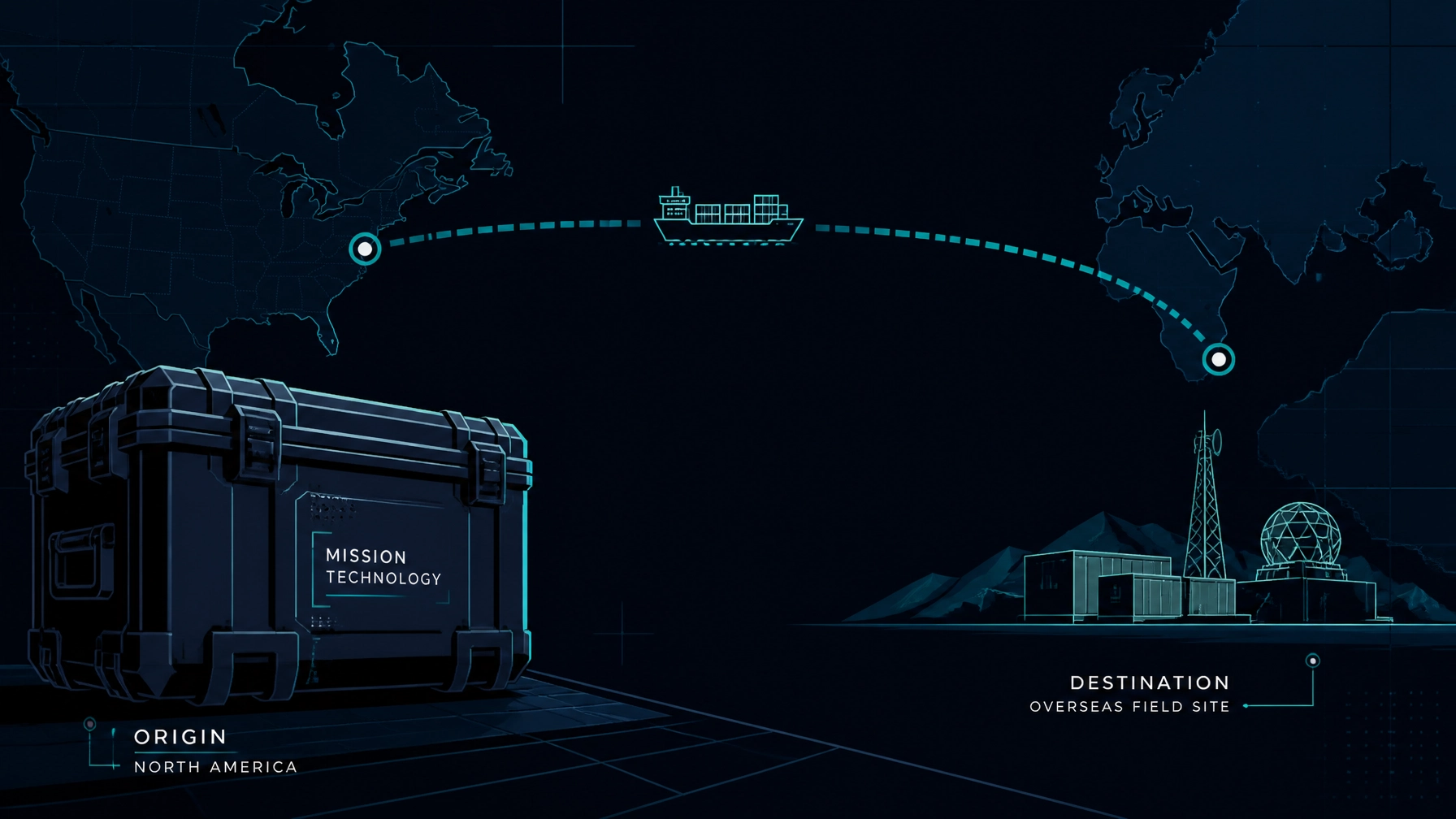
In military campaigns, infrastructure and supply lines often determine success before the first operation begins. The same principle applies to modern international technology deployments. Communications equipment, network infrastructure, cybersecurity tools, software, technical data, and field services must move through a controlled chain of decisions before they can support a mission.
A shipment may be technically ready and still fail to move because the item is misclassified, a party is not properly screened, a customs document is incomplete, a carrier lacks required information, or a design change was made after the original authorization review.
The correct objective is not simply to ship equipment overseas. The objective is to connect the item, the parties, the destination, the authorization, the carrier, and the delivery record into one accountable process.
This article provides general business-development and execution guidance for companies moving mission technology internationally. It is not legal advice, an export-control determination, or an authorization to export, reexport, transfer, or provide technical services. Requirements vary by item, destination, end user, transaction structure, contract, and applicable law. Qualified export counsel and compliance professionals should review each transaction.

Begin with an item-and-party map
The first step is to define exactly what is moving and who is involved.
A description such as “communications equipment” may be inadequate for export, customs, or contract review. The project team should develop an item register that identifies, as applicable:
- Hardware, components, tools, batteries, and replacement parts.
- Software, firmware, encryption functionality, and technical data.
- Manufacturer, model, serial number, and country of origin.
- Intended function and operational environment.
- Whether the item is sold, leased, loaned, repaired, returned, or temporarily exported.
- Whether technical assistance or installation support will be provided overseas.
- The final destination and any transit locations.
The party map should identify the seller, exporter, purchaser, consignee, end user, freight forwarder, customs broker, financial institution, local partner, installation team, and any other intermediary.
This mapping exercise creates the foundation for every later decision. It also prevents a common failure: treating the direct customer as the only relevant party in the transaction.
Screen parties, destinations, and payment paths
OFAC sanctions controls may apply because of a destination, a listed party, ownership interests, a financial institution, a carrier, a vessel, or the nature of the transaction. Screening should therefore extend beyond the manufacturer and direct buyer.
A practical review may include:
- Customer and consignee screening.
- Beneficial ownership review where appropriate.
- Local suppliers and agents.
- Freight forwarders and customs brokers.
- Payment intermediaries and banks.
- Transit countries and routing points.
- End-use and end-user information.
- Requests for unusual routing, substitutions, or unexplained intermediaries.
A screening result should be documented, dated, attributable, and connected to the transaction file. Potential matches and other red flags should be escalated rather than resolved informally by sales or logistics personnel.
The team should also establish a stop-and-escalate process. Field personnel and shipping staff must know who can pause a movement when the destination, party, item, route, or intended use changes.
The OFAC Framework for Compliance Commitments identifies management commitment, risk assessment, internal controls, testing and auditing, and training as important elements of a sanctions compliance program.
Determine export-control and customs classification
Export classification and customs classification are related, but they are not the same determination.
Depending on the facts, a company may need to evaluate whether an item is subject to the International Traffic in Arms Regulations, the Export Administration Regulations, OFAC sanctions, or other U.S. and foreign requirements. An ITAR review may involve a defense article, technical data, or defense service. An EAR review may require an Export Control Classification Number and analysis of licensing requirements.
Customs classification requires separate analysis, including the applicable Harmonized System or tariff classification, valuation, country of origin, and admissibility rules.
The project team should maintain written support for:
- The technical description of the item.
- The relevant USML category or ECCN, where applicable.
- The customs and tariff classification.
- The reasoning behind the classification.
- Any license, exemption, exception, or other authorization considered.
- Conditions attached to the authorization.
- The person or qualified professional responsible for the determination.
A temporary export is not automatically exempt from authorization requirements. Likewise, government involvement does not automatically create permission to export controlled technology. The actual item, parties, destination, purpose, and transaction structure must be reviewed.
The ITAR regulatory text and applicable DFARS export-controlled items clause should be reviewed with qualified counsel or an export-compliance professional.
Build a complete customs and shipping document package
International delivery depends on consistency. The commercial invoice, packing list, export filing, transport document, license references, and physical contents should tell the same story.
Depending on the transaction, the document package may include:
- Commercial or pro forma invoice.
- Packing list with weights, quantities, and package numbers.
- Air waybill, bill of lading, or other transport document.
- Export license or authorization evidence.
- AES filing information and Internal Transaction Number, when required.
- Country-of-origin information.
- Import permits or local customs documentation.
- Certificates of conformity or product certifications.
- Insurance and Incoterms information.
- Contact information for the shipper, consignee, broker, and carrier.
Descriptions should be specific enough to support classification and clearance without unnecessarily disclosing sensitive operational information. Values should be accurate. Temporary movements, repair returns, samples, and government-furnished equipment may require special treatment and should not be described as ordinary commercial sales.
For U.S. exports, Electronic Export Information may be required through the Automated Export System. The exporter or authorized filing agent should confirm whether filing is required, submit the information within the applicable timeframe, and provide the carrier with the ITN or correct exemption citation.
The Trade.gov AES guidance and U.S. Customs and Border Protection importer guidance provide useful starting points.

Coordinate the carrier, broker, and importer of record
A capable carrier does not replace an organized exporter. A customs broker does not replace accurate technical information. Each partner needs a defined role.
Before tendering the shipment, confirm:
- Who is the exporter of record.
- Who is the importer of record.
- Who prepares and submits export filings.
- Who provides the commercial invoice and packing list.
- Who communicates license conditions to the carrier.
- Who manages customs questions.
- Who pays duties, taxes, storage, and demurrage.
- Which Incoterms apply.
- Which party owns delivery confirmation.
- Who can approve a routing change or shipment hold.
Carrier instructions should reflect the approved transaction. A freight forwarder should not be substituted for the actual final consignee. A change in route, consignee, carrier, or destination should trigger a documented review before movement continues.
The Trade.gov Incoterms guidance can help teams understand the allocation of transportation, insurance, delivery, and customs responsibilities. Contract-specific terms still control.
Use change control before the equipment moves
Mission technology changes frequently. A firmware update, replacement component, encryption feature, revised bill of materials, new local partner, or alternative shipping route may affect classification, authorization, customs treatment, security, or delivery timing.
A controlled change process should require the project team to reassess:
- Hardware and software configuration.
- Technical data and support services.
- USML, ECCN, and customs classifications.
- End user, end use, and destination.
- License or exemption conditions.
- Carrier, route, and transit points.
- Personnel who will access the equipment or data.
- Contract and customer requirements.
No shipment should be treated as approved merely because an earlier version of the equipment was reviewed. The approved configuration and physical shipment must match.
Retain records that explain the decision
A complete record should allow an independent reviewer to understand what moved, why it moved, who approved it, and how the delivery was completed.
Maintain, as applicable:
- Item and configuration records.
- Classification analysis.
- Screening results.
- Licenses, exemptions, and approvals.
- Commercial invoices and packing lists.
- AES filings and ITNs.
- Carrier and broker correspondence.
- Route and delivery details.
- Change-control records.
- Installation or acceptance documentation.
- Final delivery confirmation.
Records should be stored in a controlled, retrievable system. Sensitive information should be handled through approved channels. Do not place classified information, Controlled Unclassified Information, export-controlled technical data, passwords, or credentials in public forms or ordinary email.
Assign partner roles before the proposal or purchase order
Export and delivery risk is easier to manage when responsibilities are assigned before the project begins.
Compliance and legal professionals review sanctions, export-control, customs, and contract requirements.
Engineering and technical teams provide accurate item descriptions, bills of material, software versions, performance details, and change notices.
Supply-chain and logistics teams coordinate carriers, forwarders, brokers, packaging, routing, filing deadlines, and delivery records.
Prime contractors and program managers define the statement of work, allocate responsibilities, manage customer communication, and control changes.
Local partners and field-support providers support site access, installation, staging, technical assistance, and sustainment within their authorized scope.
JPI Worldwide can serve as a technical infrastructure, logistics, integration, and field-support resource for communications, networks, cybersecurity tools, technical staffing, deployment, and sustainment. Its role should be defined by the applicable contract and work scope. JPI Worldwide does not replace qualified export counsel, customs professionals, or the responsible compliance function.
The Infinity Group helps clients connect strategy, execution, funding, partners, and growth planning around complex opportunities. Through our government consulting, technical operations, business growth, and strategic partner functions, we help organizations move from an initial capability to a structured, credible pursuit and delivery plan.
A business-development view of international delivery
International technology movement should be addressed during opportunity development, not after the contract is signed.
Your proposal, pricing model, schedule, staffing plan, and risk register should account for:
- Classification and professional review.
- Export filings and authorization timelines.
- Customs brokerage and import requirements.
- Packaging, insurance, and carrier constraints.
- Local installation and support.
- Spare parts and replacement cycles.
- Configuration control.
- Documentation and records.
- Funding requirements and working capital.
- Partner responsibilities and escalation paths.
A company that can demonstrate this discipline is easier for a prime contractor, government customer, investor, or strategic partner to evaluate. It shows that the business understands the difference between selling equipment and delivering an operational capability.
The Infinity Group is a Business Development Architect. We can help you assess the opportunity, develop the partner structure, plan the execution path, identify funding needs, and organize the growth strategy from beginning to end. We do not issue export authorizations or provide legal advice. We help bring the right strategy, resources, and qualified professionals together.
Conclusion
Moving mission technology overseas requires more than a shipping label and a freight account. It requires disciplined coordination among technical teams, compliance professionals, logistics providers, carriers, customs brokers, prime contractors, field personnel, and customers.
Map the item. Screen the parties. Classify the technology. Confirm authorization. Prepare consistent documents. Coordinate the carrier. Control changes. Preserve the record.
That is how delivery risk becomes a managed business process.
To discuss a technology deployment, government-facing growth strategy, partner structure, funding requirement, or international execution plan, contact The Infinity Group at connect@infinity-us.com or visit our contact page.
This article is general information only. It is not legal advice and does not authorize any export, import, reexport, retransfer, or technical service. Consult qualified export counsel, customs professionals, and compliance advisors before proceeding.
Comments and replies are disabled.
Sources and further reading
- JPI Worldwide: OFAC, ITAR, and Customs: What It Takes to Move Technology Into an Austere Theater
- OFAC: A Framework for OFAC Compliance Commitments
- Electronic Code of Federal Regulations: ITAR
- U.S. Customs and Border Protection: Importing into the United States
- Trade.gov: Filing Export Shipments Through AES
- Trade.gov: Know Your Incoterms
- Acquisition.gov: DFARS 252.225-7048, Export-Controlled Items
- The Infinity Group: Government Consulting
- The Infinity Group: Technical Operations
- The Infinity Group: Strategic Partners
