
Infinity Group Insights : Article 4 of 7
Great commanders do not inspect their defenses once a year and assume the mission is secure. They establish a daily operating rhythm: assess the perimeter, update the plan, monitor activity, train personnel, rehearse response, and correct weaknesses before the next engagement.
Your compliance program requires the same discipline.
An annual audit may provide a useful point-in-time review. It does not, by itself, create secure operations, reliable evidence, prepared employees, or documented corrective action. Continuous compliance is the operating discipline that keeps your business prepared throughout the year: before an audit, government contract review, investor diligence process, customer questionnaire, or major growth event.
The Infinity Group Insights series examines how companies can build stronger strategies, execution plans, and capital readiness. Article 4 focuses on the compliance systems that support sound growth.
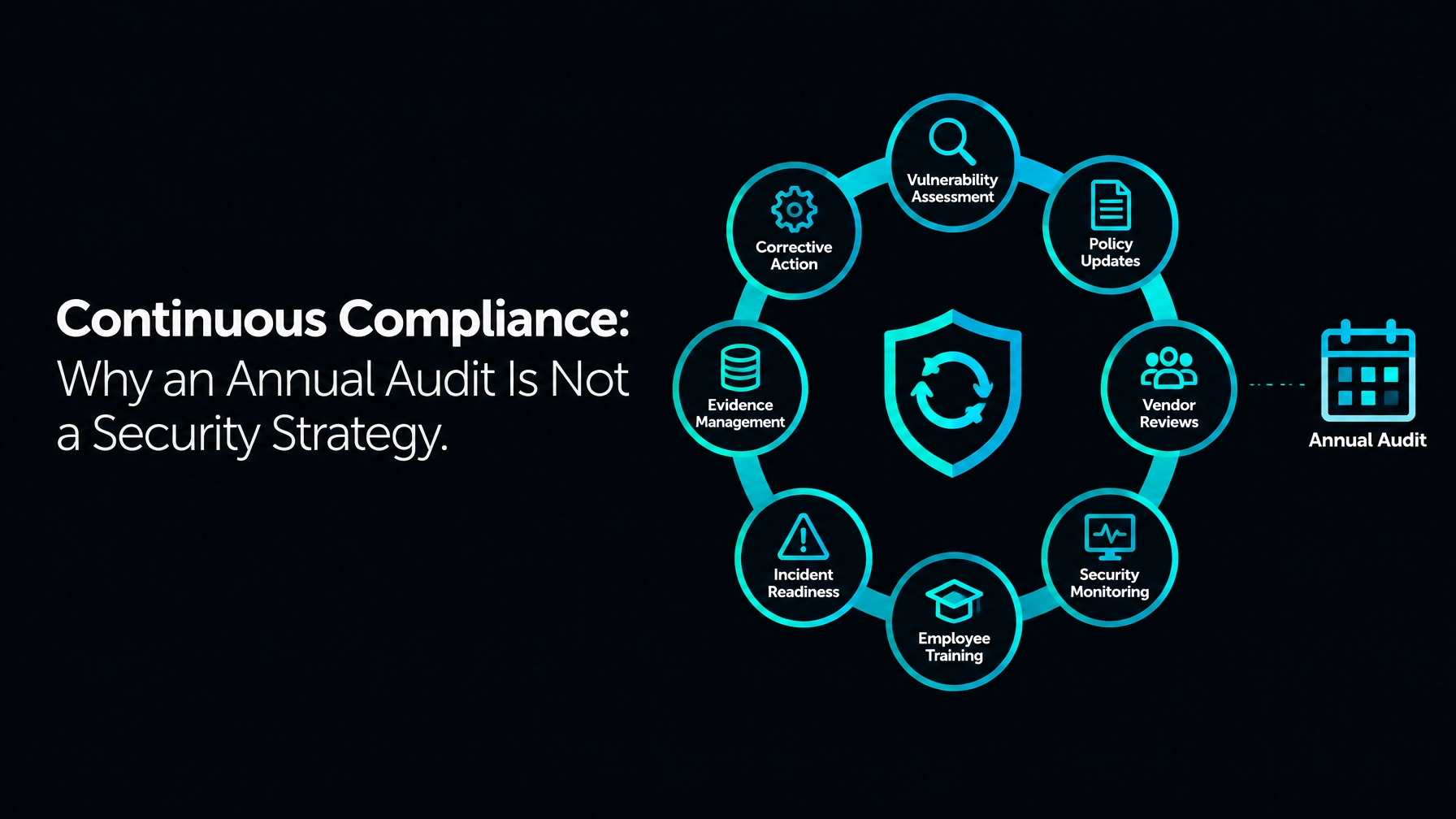
Annual Audits Show a Moment. Continuous Compliance Shows the Business.
An annual audit is a scheduled event. Continuous compliance is a management system.
The difference is important. A point-in-time review may identify whether selected controls and documents are available on the review date. A continuous program helps leadership understand whether those controls operate consistently as systems, vendors, policies, people, and risks change.
Companies need current visibility into their vulnerabilities; we have the strategic coordination to organize assessments, qualified technical support, reporting, and corrective action.
Companies need policies that reflect actual operations; we can coordinate policy updates with changes to systems, contracts, personnel, suppliers, and business priorities.
Companies need evidence that is produced during normal work; we can help establish ownership, schedules, repositories, and reporting processes so evidence is managed throughout the year instead of reconstructed under pressure.
The annual audit remains one input. It should not be the entire strategy.

Continuous Compliance Is a Recurring Operating Discipline
Continuous compliance does not mean that every control must be checked every minute. It means that the organization establishes a documented cadence, assigns responsibility, measures performance, and responds when conditions change.
A practical program includes the following operating areas:
Vulnerability Assessments
Vulnerability assessments identify weaknesses in applications, infrastructure, endpoints, cloud services, and other technology environments. The value comes from the complete process: not merely from producing a scan report.
Your organization should track:
- Number of open vulnerabilities by severity;
- Age of critical and high-priority findings;
- Percentage remediated within internal target periods;
- Repeated findings and root causes;
- Systems not covered by assessment activity; and
- Exceptions that require documented business approval.
The objective is not to claim that every vulnerability can be eliminated. The objective is to identify exposure, prioritize action, document decisions, and verify that corrective work is completed.
Policy Updates
Policies must match how your business actually operates. A policy written two years ago may not reflect remote work, new vendors, artificial intelligence tools, cloud migrations, acquisitions, or government contract requirements.
Track:
- Policies reviewed during the quarter;
- Policies changed because of business or technology developments;
- Employee acknowledgement rates;
- Exceptions and approved deviations;
- Policy owners and review dates; and
- Gaps between policy language and operating practice.
Companies need policies that can be followed and demonstrated; we can coordinate policy owners, subject-matter specialists, leadership review, and evidence collection.
Vendor Reviews
Your security and compliance posture is affected by the providers that process data, host systems, support operations, or access business information.
A vendor review process should measure:
- Critical vendors with current risk records;
- Vendors with expired assessments or agreements;
- Services with access to sensitive information;
- Contractual security requirements;
- Vendor incidents and response performance;
- Business continuity and recovery information; and
- Outstanding vendor corrective actions.
Review vendors according to risk. A payroll provider, managed technology provider, cloud platform, and low-risk office supplier should not automatically receive the same level of review.
Security Monitoring
Monitoring provides operational visibility between formal assessments. Leadership should understand whether logging, alerting, endpoint protection, identity controls, and escalation processes are functioning as expected.
Monthly reporting may include:
- Alerts received and investigated;
- Incidents classified and closed;
- Monitoring coverage across critical systems;
- Failed or unusual authentication activity;
- Privileged access activity;
- Unresolved alert backlogs; and
- Mean time to acknowledge and resolve priority events.
The goal is not to produce impressive numbers. The goal is to identify where the organization sees activity, where it does not, and whether the response process is working.
Employees and Incident Readiness Are Core Controls
Technology does not operate independently. Employees create, access, transmit, approve, and protect information every day.
Training should be scheduled for new hires, role changes, policy updates, and recurring awareness. Measure:
- Completion rates by department;
- Overdue training;
- Completion time for new employees;
- Training related to privileged or sensitive roles;
- Repeated user mistakes; and
- Lessons incorporated into future training.
Incident readiness also requires practice. A response plan stored in a folder is not the same as a response capability tested by decision-makers.
Quarterly or semi-annual exercises can examine:
- Who declares an incident;
- Who contacts leadership;
- Who preserves evidence;
- Who communicates with customers or partners;
- Who coordinates technology recovery;
- How vendors participate; and
- How decisions are documented.
This is an operating exercise, not a prediction of a specific event. It establishes roles, exposes confusion, and creates corrective actions before an actual disruption.

Evidence Management Turns Activity Into Demonstrable Control
Evidence should be created as part of business operations. Access approvals should live in a traceable workflow. Training records should be retained. Vulnerability reports should connect to remediation tickets. Vendor reviews should show decisions and follow-up. Incident exercises should produce meeting records, findings, and assigned actions.
A useful evidence structure identifies:
- The control or requirement;
- The responsible owner;
- The evidence required;
- The source system or repository;
- The review frequency;
- The retention period;
- The reviewer; and
- The corrective action process.
Companies need evidence that is organized, current, and connected to responsible people; we can coordinate reporting structures, documentation workflows, management reviews, and qualified specialist support.
Evidence management also protects leadership from an unreliable “hero system,” where one employee knows where everything is stored and manually prepares every response. That approach creates concentration risk and becomes increasingly difficult as the business grows.
Documented Corrective Action Is the Measure of Maturity
Every program will identify weaknesses. Mature organizations do not hide that fact. They record the issue, assign an owner, set a target date, evaluate the risk, and document the result.
Each corrective action should include:
- The identified condition;
- The affected system, process, vendor, or department;
- The risk or business impact;
- The assigned owner;
- The planned action;
- The target completion date;
- Any approved exception;
- Evidence of completion; and
- Management disposition of remaining risk.
Measure the number of open actions, overdue actions, aging by priority, recurring findings, and actions closed with verified evidence. These measures show whether the organization is improving or simply recording the same problems repeatedly.

How to Measure Monthly and Quarterly
A practical cadence keeps the program active without making every activity an emergency.
Monthly
Review:
- Security alerts and incidents;
- Vulnerability remediation progress;
- Critical system coverage;
- Privileged and high-risk access;
- New and retired vendors;
- Policy acknowledgements;
- Training completion;
- Open corrective actions; and
- Evidence collection exceptions.
The monthly review should produce a concise management report. It should identify what changed, what remains open, who owns the work, and which decisions require executive attention.
Quarterly
Conduct a deeper review of:
- Vulnerability assessments and remediation trends;
- Access rights for critical systems;
- High-risk vendor reassessments;
- Selected policy updates;
- Incident response or business continuity exercises;
- Evidence completeness;
- Risk register changes;
- Scope changes caused by new products, contracts, or acquisitions; and
- Budget requirements for the next quarter.
Quarterly reviews should result in documented decisions: not just presentations. Leadership should approve priorities, assign resources, accept or reject exceptions, and confirm the next operating cycle.
Annually
An annual review can consolidate the year’s evidence, refresh the enterprise risk assessment, review the full policy set, evaluate the vendor population, and prepare the organization for external scrutiny where applicable.
The annual event becomes more valuable when it confirms an operating program rather than discovering the program for the first time.
How to Budget and Prioritize Remediation
Compliance budgeting should separate three categories:
- Critical: Work addressing material exposure, essential systems, high-impact vulnerabilities, incident readiness, or contract-driven priorities.
- Required: Work necessary to maintain defined policies, evidence, training, vendor reviews, monitoring, and recurring assessments.
- Improvement: Work that strengthens resilience, efficiency, automation, reporting, or long-term maturity.
Prioritize remediation by considering business impact, exposure, likelihood, contractual importance, customer expectations, operational dependency, and available resources. Do not fund every request equally. Do not postpone every difficult issue indefinitely.
A documented priority model helps executives explain why one issue is addressed immediately, another is scheduled, and a third is accepted temporarily with ownership and review. It also helps investors and government-facing stakeholders see that spending decisions are connected to business risk.
The NIST Cybersecurity Framework and CISA Cybersecurity Performance Goals offer useful reference points for organizing cybersecurity activity. They do not replace organization-specific requirements, qualified technical evaluation, contract review, or professional advice.
This article provides general business information. It is not legal, audit, certification, or cybersecurity advice, and it does not guarantee a particular compliance outcome.
The Infinity Group Coordinates the Full Strategy
Companies need to prepare for audits, government contracts, investment diligence, customer requirements, and growth without losing operational focus. We have the experience to coordinate the business strategy around those demands.
We can help organize:
- Executive objectives and risk priorities;
- Compliance roadmaps;
- Vulnerability and remediation planning;
- Policy and evidence workflows;
- Vendor review programs;
- Monitoring and reporting structures;
- Employee training schedules;
- Incident readiness exercises;
- Budget and resource planning;
- Government-facing requirements;
- Investor diligence preparation; and
- Qualified technical, legal, audit, or certification specialists where those services are required.
We do not promise that a program will eliminate risk or guarantee an audit, contract, investment, or certification result. We provide structure, coordination, reporting, and strategic execution so you can make informed decisions and keep the work moving.
The practical question is direct: What is the cost of maintaining a disciplined compliance operation compared with the cost of discovering major gaps immediately before an audit, contract opportunity, financing process, or customer review?
We can help you evaluate that investment, establish priorities, and build a plan from beginning to end.
Contact The Infinity Group to discuss your strategic needs and next steps: connect@infinity-us.com
ANNUAL REVIEWS CONFIRM THE STRATEGY.
CONTINUOUS COMPLIANCE OPERATES THE STRATEGY.
ASSESS. EXECUTE. DOCUMENT. CORRECT. GROW.
Sources
- National Institute of Standards and Technology : Cybersecurity Framework
- Cybersecurity and Infrastructure Security Agency : Cross-Sector Cybersecurity Performance Goals
- TrustCloud : Continuous Compliance and Annual Audit Readiness
- Vanta : Continuous Compliance
- Drata : Continuous Compliance
- Secureframe : Governance, Risk, and Compliance Resources
- The Infinity Group : Technical Operations
- The Infinity Group : Consulting Services
- The Infinity Group : Contact
Comments and replies are disabled for this article.
