Category: Uncategorized

  • The Business Development Strategy Every Mid-Sized Company Needs Before Raising Capital

    The Business Development Strategy Every Mid-Sized Company Needs Before Raising Capital


    Alexander the Great did not move an army across continents by improvising one decision at a time. He relied on preparation, intelligence, logistics, disciplined execution, and a clear objective. Raising capital for business requires the same standard of planning.

    Mid-sized companies do not need a funding conversation first. They need a business development strategy that proves where the company stands, where it can grow, how it will execute, and what capital is required to support that plan.

    This is why corporate strategy consulting should precede a capital raise. Investors, lenders, strategic partners, and government stakeholders want to see more than ambition. They want to see a company with a practical growth plan, management discipline, reliable financial information, and a defined use for capital.

    At The Infinity Group, we are Business Development Architects. We help decision-makers organize the full development picture: from A to Z: using private-sector experience and a deep understanding of Federal and State government agencies, Congressional stakeholders, capital sources, and strategic partnerships.

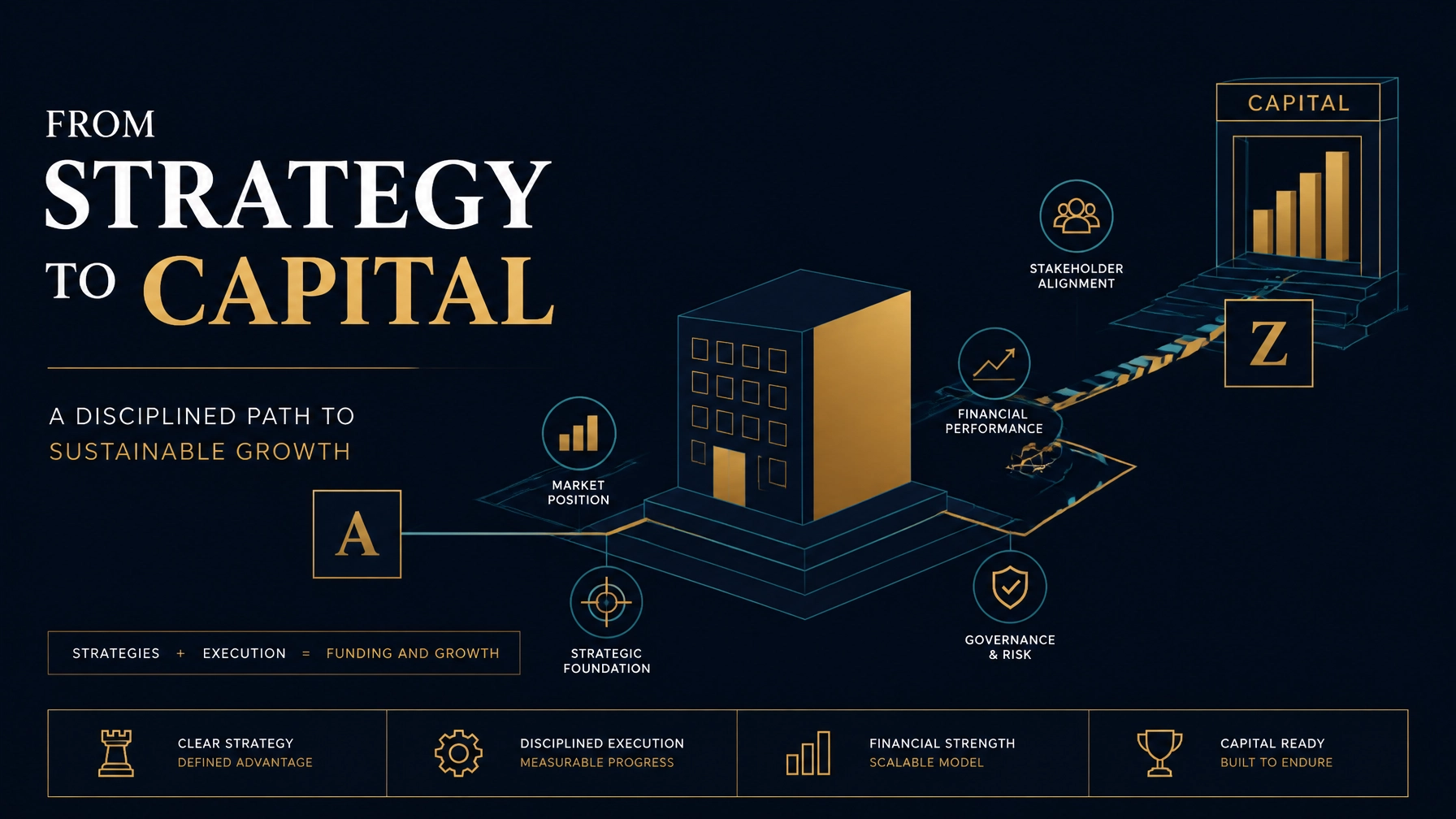
    The A-to-Z Pre-Capital Framework

    A-to-Z business development framework diagram showing ten connected stages from assessment through risk management

    Caption: A disciplined capital strategy connects assessment, positioning, proof, funding, partnerships, resources, and execution.

    A capital raise should be the result of a coherent strategy, not a substitute for one. Use the following framework to prepare your company.

    1. Assess the Business Honestly

    Begin with a structured assessment of the company’s current position. Review revenue, gross margin, customer concentration, retention, operating costs, cash position, delivery capacity, technology, contracts, leadership bandwidth, and internal controls.

    You should be able to answer:

    • What is working today?
    • Which activities produce reliable revenue?
    • Where are margins being lost?
    • Which processes will fail under increased volume?
    • What management roles or capabilities must be strengthened?
    • What risks could limit strategic business growth?

    Complete a SWOT analysis, but do not stop at general statements. Support each conclusion with operating evidence. A strong assessment identifies three to five major opportunities, three to five material risks, and the specific actions required to address each one.

    Pre-capital checklist:

    • Historical financial statements organized
    • Revenue and margin trends documented
    • Customer and contract concentration reviewed
    • Operational constraints identified
    • Leadership and staffing gaps listed
    • Legal, compliance, and governance records assembled

    2. Define Your Market Position

    Capital providers back companies that understand the market they intend to win. Your company needs a clear ideal customer profile, a defined market position, and a practical explanation of why customers select your organization over alternatives.

    Document your priority sectors, customer size, buyer roles, purchase triggers, competitive alternatives, pricing conditions, and market gaps. Then state your value proposition in one sentence.

    A useful positioning statement answers four questions:

    1. Who do you serve?
    2. What business problem do you solve?
    3. What measurable value do you provide?
    4. Why are you better positioned than competing options?

    Do not present ten disconnected growth ideas. Select two or three growth paths for the next 12 to 24 months: deeper penetration of current markets, adjacent industries, geographic expansion, new channels, product development, strategic alliances, or government-market entry.

    Our business growth services are designed to help companies connect market opportunity to an executable development plan.

    3. Prove Revenue and Operating Capability

    A forecast is not proof. Investors need evidence that the company can acquire customers, deliver products or services, protect margins, and repeat the process.

    Your proof may include:

    • Recurring or repeat revenue
    • Qualified sales pipeline
    • Customer retention data
    • Signed contracts or purchase orders
    • Case studies and references
    • Channel or partner agreements
    • Delivery and fulfillment metrics
    • Documented sales and operating procedures
    • Certifications, intellectual property, or specialized capabilities

    Mid-sized companies often have valuable operating history but present it poorly. Organize the evidence so a decision-maker can see the connection between your capabilities and your growth plan.

    Revenue quality matters. Explain which revenue is contracted, recurring, repeatable, project-based, concentrated, seasonal, or dependent on one individual. Clear information increases confidence; unsupported claims weaken it.

    4. Build the Management Plan

    Capital does not execute itself. Management must convert resources into decisions, hires, contracts, customer relationships, and operating results.

    Your management plan should identify:

    • Executive responsibilities
    • Department ownership
    • Hiring requirements
    • Reporting relationships
    • Decision rights
    • Advisory or board needs
    • Key-person dependencies
    • Performance measures
    • Succession and continuity considerations

    Investors want to know whether the organization can manage growth without losing control. That requires documented processes, financial oversight, customer accountability, and a leadership structure that matches the company’s next stage.

    Companies need the right people in the right roles. We have the experience to help evaluate organizational requirements, strengthen strategic positioning, and align management responsibilities with business development objectives.

    5. Connect the Strategy to a Financial Model

    A financial model should explain how the business works: not simply display optimistic numbers.

    Your model should include:

    • Three to five years of projections
    • Monthly or quarterly cash flow
    • Revenue by customer, product, service, or segment
    • Gross margin assumptions
    • Operating expense requirements
    • Hiring and compensation assumptions
    • Customer acquisition costs
    • Sales-cycle assumptions
    • Retention and churn
    • Working-capital requirements
    • Base, downside, and upside scenarios

    Investor-grade financial model infographic showing revenue, margins, runway, scenarios, and use of proceeds

    Caption: A useful financial model connects strategic choices to capital requirements, operating milestones, and measurable reporting.

    Every major assumption must have a business reason. If revenue grows because you are entering a new market, explain the customer target, sales channel, staffing needs, timing, and expected cost. If margins improve, show which process, price, supplier, or product change produces that improvement.

    Your model should also show how capital will be used. Separate funds for hiring, equipment, product development, marketing, expansion, working capital, technology, acquisitions, or government-market preparation. Then connect each allocation to a milestone.

    6. Define the Capital Requirement

    “ We need capital to grow ” is not a capital strategy.

    State how much funding is required, when it is required, what form may be appropriate, and what the company expects to accomplish with the funds. Consider equity, debt, convertible instruments, strategic investment, asset-based financing, government-backed lending, grants, tax credits, and other resources where applicable.

    The correct amount is determined by the plan. It is not determined by a round number selected before the strategy is complete.

    Ask yourself:

    • What does the company need to accomplish before additional capital is necessary?
    • What milestones will the proposed funding support?
    • How long will the capital extend operating capacity?
    • What reporting obligations will follow?
    • Which funding structure fits the company’s risk and cash-flow profile?

    The SBA funding programs provide official information on programs such as 7(a), 504, and microloans. Eligibility, terms, and lender requirements vary. These resources should be evaluated as part of a broader funding plan: not treated as automatic sources of capital.

    7. Target the Right Investors and Partners

    Investor targeting is a business development activity. Do not distribute the same materials to every capital source.

    Build a target list based on:

    • Industry experience
    • Investment size
    • Geography
    • Preferred ownership position
    • Debt or equity preference
    • Growth stage
    • Strategic value
    • Portfolio fit
    • Government or commercial relationships
    • Operating expertise

    A strategic investor may provide customers, distribution, technology, manufacturing, or market access. A lender may focus on repayment capacity and collateral. An equity investor may focus on growth, governance, and potential value creation.

    Your materials must reflect the decision-maker’s priorities. Prepare a concise presentation, an executive summary, a use-of-proceeds schedule, a financial model, and a secure data room containing financial, legal, operational, customer, contract, and governance documentation.

    8. Develop Partnerships and Government Resources

    Partnerships can improve growth economics and strengthen the capital story. Evaluate distributors, suppliers, technology providers, prime contractors, channel partners, research institutions, and complementary service providers.

    For companies pursuing government-facing opportunities, the strategy must also account for agencies, programs, acquisition pathways, stakeholders, budgets, procurement requirements, and Congressional considerations.

    The Infinity Group’s government expertise includes opportunity research, procurement strategy, program analysis, competitive positioning, teaming strategy, proposal planning, and capability alignment. We understand that successful government business development requires more than identifying an opportunity. It requires positioning, relationships, resources, and execution.

    Non-dilutive resources may include grants, tax credits, export programs, training support, research programs, or government-backed financing. Grants.gov is the official federal source for organizational grant opportunities. Eligibility and application requirements must be verified for each program.

    9. Establish Milestones and Risk Management

    A capital plan becomes credible when it includes measurable milestones and a process for managing risk.

    Use milestones such as:

    • Revenue targets
    • Gross-margin targets
    • Customer or contract acquisition
    • Product or service launch
    • Hiring completion
    • Geographic or sector expansion
    • Partnership activation
    • Government opportunity stage
    • Operating-cost control
    • Cash and liquidity thresholds

    For each milestone, assign an owner, deadline, budget, and reporting measure. Then document the risks that could prevent completion.

    Your risk register should cover:

    • Customer concentration
    • Pricing pressure
    • Supply-chain disruption
    • Hiring and retention
    • Regulatory exposure
    • Cybersecurity
    • Contract dependence
    • Cash-flow timing
    • Execution capacity
    • Key-person reliance

    Risk management is not a negative presentation. It demonstrates that management understands the operating environment and has prepared responses.

    A Practical 90-Day Pre-Raise Plan

    Three-stage 90-day pre-raise timeline showing assessment, financial preparation, investor readiness, government resources, and execution governance

    Caption: The first 90 days should convert business information into an organized strategy, financial plan, and capital-readiness package.

    Days 1–30: Assessment

    Complete the internal business review, market map, customer analysis, SWOT, risk register, and operating-capacity review.

    Days 31–60: Strategy and Financial Model

    Finalize your positioning, priority growth paths, management plan, financial scenarios, capital requirement, use of proceeds, and KPI structure.

    Days 61–90: Readiness and Outreach

    Prepare the investor presentation and data room. Prioritize investors and strategic partners. Evaluate government and non-dilutive resources. Begin qualified conversations only after the materials and strategy are aligned.

    Why The Infinity Group

    Mid-sized companies need more than a presentation deck. They need strategic development that connects market position, operating proof, management, capital, partnerships, government resources, and execution.

    The Infinity Group serves companies across industry sectors as Business Development Architects. We combine private-sector expertise with relationships and knowledge involving Federal and State agencies, Congress, government programs, capital development, and strategic growth.

    We can help you assess your position, develop your business development strategy, strengthen investor readiness, organize your capital requirements, identify relevant partnerships, evaluate government-facing opportunities, and establish a practical execution plan.

    The question is straightforward: if disciplined strategy can improve the quality of your capital conversation, clarify your use of funds, and protect your company from avoidable mistakes, what is that preparation worth compared with the cost of raising capital without it?

    We will discuss your objectives, review your present position, and help determine the appropriate next steps at reasonable costs. Begin with our services, review the industries we support, or contact The Infinity Group to discuss your plan.

    STRATEGY FIRST. EXECUTION ALWAYS.

    CAPITAL WITH PURPOSE. GROWTH WITH DISCIPLINE.

    The official full horizontal Infinity Group corporate logo with the tagline Strategies + Execution = Funding and Growth

  • Government Contracting Consulting for Startups: Turning Federal Opportunities into Strategic Growth

    Government Contracting Consulting for Startups: Turning Federal Opportunities into Strategic Growth


    Figure 1. Government contracting becomes a strategic growth pathway when capability, readiness, market focus, and execution are built in the correct sequence.

    From the campaigns of history to the operations of a modern enterprise, major objectives are achieved through planning before action. A company does not enter a complex market by advancing in every direction. It establishes its position, studies the field, assembles the right resources, and executes with discipline.

    Federal contracting requires the same approach.

    For startups and mid-sized businesses, government work can create a meaningful pathway to revenue diversification, stronger market credibility, research and development, and long-term strategic business growth. It can also require significant preparation, administrative discipline, cybersecurity controls, financial capacity, and patience.

    This is why government contracting consulting must begin with strategy: not simply with a registration form or a search for open solicitations.

    At The Infinity Group, we are Business Development Architects. We combine private-sector expertise with a deep understanding of Federal and State government agencies and Congress. We support companies from A to Z: capability positioning, registrations, agency alignment, partnerships, capture planning, proposals, compliance, financing strategy, and execution.

    Government Contracting Starts with Capability Positioning

    Companies need a clear answer to one fundamental question: Why should a government buyer select your business for this requirement?

    We have the expertise to help you define that answer.

    Your company may have a strong technology, specialized service, manufacturing capacity, cybersecurity solution, health innovation, engineering capability, logistics platform, or other commercial strength. However, federal buyers evaluate those capabilities through specific mission requirements, procurement categories, contract terms, past performance expectations, and evaluation criteria.

    Your positioning must therefore connect four elements:

    • The problem your company solves;
    • The federal mission or agency need it supports;
    • The measurable value your solution provides; and
    • The evidence that your company can perform reliably.

    This process includes reviewing your core capabilities, relevant experience, NAICS classifications, staffing, facilities, technology, financial controls, quality systems, and ability to meet contract requirements. It also includes developing a focused capability statement and supporting materials that communicate your value without unnecessary claims.

    Government contracting is not the place for a broad, generic description of everything your company might do. A disciplined position is more valuable. Your message must be specific enough for a program office, contracting officer, prime contractor, or partner to understand where you fit.

    Readiness and Registrations Must Support the Strategy

    Companies need the proper registrations and representations before pursuing federal work. We have that support available.

    The SAM.gov entity registration process explains that a company seeking to bid directly on federal contracts generally needs an active registration. Registration includes assignment of a Unique Entity ID, and the business must provide substantial information about its legal identity, ownership, representations, certifications, and capabilities.

    SAM.gov registration is foundational, but registration alone does not create a contracting strategy. It does not guarantee an award, establish past performance, or make a company competitive. It is one operational requirement within a larger readiness plan.

    Startups and mid-sized businesses should also evaluate:

    • Applicable NAICS codes and SBA size standards;
    • UEI and CAGE information, as applicable;
    • Representations and certifications;
    • Accounting and timekeeping systems;
    • Insurance, bonding, and working-capital requirements;
    • Cybersecurity and data-protection obligations;
    • Quality-control and subcontract-management procedures;
    • Staffing and surge capacity; and
    • Eligibility for relevant small-business programs.

    The SBA contracting assistance programs include resources such as the Mentor-Protégé Program and joint ventures. Eligibility, documentation, affiliation rules, work-share requirements, and reporting obligations must be reviewed carefully before a company relies on any particular structure.

    Readiness also includes financial realism. A contract may produce revenue, but performance can require payroll, equipment, hiring, insurance, travel, compliance systems, and delayed receivables before the company receives payment. A sound business development strategy accounts for that working-capital cycle from the beginning.

    Agency Alignment Creates a More Focused Pipeline

    Companies need a market focus. We have the research and planning discipline to help establish one.

    A startup should not chase every federal opportunity that appears to match a keyword. That approach consumes time and produces disconnected proposals. A stronger plan identifies a limited number of agencies, programs, missions, and buying patterns that align with the company’s actual capabilities.

    Agency alignment should consider:

    • Where the company’s solution supports a defined mission;
    • Which agencies have purchased similar products or services;
    • Whether the requirement is recurring, emerging, or one-time;
    • What contract vehicles and NAICS codes are commonly used;
    • Whether opportunities are competed, set aside, or subcontracted;
    • Which incumbents and prime contractors currently perform the work; and
    • Whether the company can realistically meet the scale and compliance requirements.

    Focused agency alignment diagram showing a startup capability connected to selected government mission areas

    Figure 2. A focused pipeline prioritizes a small number of agency and mission alignments instead of pursuing every available opportunity.

    This is where strategic business growth becomes more than a sales objective. The right government opportunity should strengthen the company’s core business, improve its operating maturity, build relevant past performance, and support future commercial or public-sector expansion.

    The Infinity Group can help companies examine federal, state, and broader public-sector pathways together. We also understand the importance of accurate, lawful communication with agencies and public officials. Our role is to support preparation, positioning, analysis, and execution: not to promise special access or improper influence.

    Teaming Can Provide a Practical First Entry

    Companies need a practical entry point when they lack federal past performance or the capacity to serve as a prime contractor. We have the contacts and strategic development experience to help evaluate teaming and subcontracting options.

    A startup may enter the market by:

    • Subcontracting to an established prime;
    • Joining a properly structured team;
    • Pursuing a mentor-protégé relationship;
    • Participating in a compliant joint venture;
    • Providing a specialized product or technical capability; or
    • Supporting a larger contract with a defined work package.

    The objective is not to become a nominal partner. The objective is to establish a relationship in which responsibilities, pricing, work share, intellectual property, data rights, performance expectations, and compliance duties are clearly understood.

    The SBA Mentor-Protégé Program provides a formal framework for eligible businesses, but companies must identify a prospective mentor and satisfy program requirements. A partnership should create real developmental gains, operational capability, and measurable experience.

    For many startups, the first meaningful milestone may be a well-defined subcontract rather than an immediate prime award. That is not a lesser strategy. It may be the disciplined route toward past performance, stronger systems, better cash-flow planning, and future prime opportunities.

    Capture Planning Begins Before the RFP

    Companies need a capture process that starts before a solicitation is released. We have that expertise.

    Capture planning involves more than monitoring SAM.gov contract opportunities. It includes identifying likely requirements, understanding the customer’s mission, researching incumbent performance, assessing competitors, clarifying the company’s position, identifying partners, and determining whether the opportunity fits the organization’s capacity.

    A practical capture plan should define:

    1. The opportunity and anticipated procurement path;
    2. The agency, program office, and mission need;
    3. The incumbent or known competitive landscape;
    4. The customer’s likely evaluation priorities;
    5. The company’s differentiators and weaknesses;
    6. Potential teaming partners and subcontractors;
    7. Staffing, pricing, and delivery assumptions;
    8. Required certifications, systems, and security controls; and
    9. A clear bid/no-bid decision.

    A bid/no-bid decision is essential. Pursuing every opportunity can damage a growing company by diverting senior staff, consuming proposal resources, and creating financial risk. A disciplined business development strategy selects opportunities where the company has a credible path to performance and a reasonable basis for competition.

    RFP Response Discipline and Compliance

    Companies need proposals that answer the solicitation exactly as written. We have the process to support that discipline.

    Government proposals are evaluated against stated instructions and criteria. A technically impressive response can fail when it overlooks page limits, formatting requirements, submission procedures, mandatory representations, evaluation factors, pricing instructions, or required attachments.

    Our government contracting consulting support can include:

    • Solicitation analysis;
    • Compliance matrices;
    • Proposal calendars and responsibility assignments;
    • Technical and management narratives;
    • Staffing and transition plans;
    • Past-performance presentation;
    • Pricing and cost narrative coordination;
    • Risk identification;
    • Review cycles and quality control; and
    • Final submission readiness.

    Government proposal execution infographic showing documents, compliance controls, a shield, a clock, and a bid/no-bid gate

    Figure 3. Proposal discipline connects solicitation compliance, pricing, staffing, risk review, and final bid decisions.

    Compliance continues after submission and after award. Depending on the contract, a company may need reliable accounting, timekeeping, subcontract administration, cybersecurity controls, reporting procedures, quality assurance, change management, and record retention.

    Requirements may involve the Federal Acquisition Regulation, agency supplements, contract-specific clauses, data protection standards, or other applicable rules. Companies should obtain qualified legal, accounting, cybersecurity, and compliance advice where appropriate. The Infinity Group helps organize the overall strategy and execution so these requirements are recognized early: not discovered after a problem occurs.

    Realistic Timelines Protect Strategic Growth

    Companies need realistic expectations. We provide them directly.

    A basic readiness review and registration effort may take several weeks to a few months, depending on the company’s records, ownership structure, responsiveness, and complexity. SAM.gov states that registration can take up to 10 business days to become active after submission, but the full preparation process may take longer.

    Agency research, positioning, partner development, and pipeline construction require additional time. Larger competitive federal opportunities commonly involve capture cycles measured in multiple quarters. Some pursuits may extend 9–24 months or more from early planning through solicitation, evaluation, award, and possible protest activity. Smaller purchases, task orders, and subcontracting opportunities may move faster, but they still require readiness and compliance.

    Realistic government contracting timeline infographic showing readiness, registration, agency focus, capture, proposal, and performance milestones

    Figure 4. A multi-quarter timeline helps startups match contracting ambitions with staffing, cash flow, compliance, and operating capacity.

    The first milestones may be:

    • Completing a readiness assessment;
    • Establishing an accurate capability position;
    • Activating SAM.gov registration;
    • Selecting priority agencies;
    • Building a qualified opportunity pipeline;
    • Initiating compliant partner discussions;
    • Completing a first proposal review; or
    • Winning a subcontract that supports future prime work.

    These milestones are valuable because they create the structure required for sustainable growth. A government contract should be pursued as part of the company’s broader operating plan: not as a substitute for one.

    The Infinity Group Supports Your Full Development Path

    Startups and mid-sized businesses need more than a list of solicitations. They need a complete plan connecting capability, capital, market focus, partners, compliance, and execution.

    We are startup business consultants and Business Development Architects. We can support your needs from A to Z:

    • Business development strategy;
    • Federal and State market analysis;
    • Government contracting readiness;
    • Agency and program alignment;
    • Teaming and partnership development;
    • Capture planning;
    • Proposal and RFP support;
    • Compliance coordination;
    • Capital and investment strategy; and
    • Long-term strategic business growth.

    If government contracting is part of your growth plan, begin with a serious evaluation. What will the company need to invest in readiness, people, systems, compliance, and working capital? What is the potential value of a properly aligned contract, a stronger pipeline, a new partner, or a repeatable public-sector capability?

    The answer should be based on facts, not wishful thinking.

    Contact The Infinity Group to discuss your objectives, review the requirements, and establish the next steps at reasonable costs.

    We Plan. We Position. We Execute.

    Strategies + Execution = Funding and Growth.

    Official full horizontal Infinity Group corporate logo with the tagline Strategies + Execution = Funding and Growth

  • Beyond Venture Capital: How Startups Can Build a Strategic Capital Stack in 2026

    Beyond Venture Capital: How Startups Can Build a Strategic Capital Stack in 2026

    Figure 1. A resilient capital strategy combines multiple sources instead of depending on a single venture capital round.

    Alexander the Great did not build an empire by sending one unit into every battle. He organized resources, secured supply lines, understood the terrain, and deployed the right force at the right time. Startup financing requires the same discipline.

    In 2026, venture capital remains an important source of investment capital for startups. It is not, however, the entire capital strategy. Venture capital can accelerate product development, hiring, market expansion, and strategic execution, but it also creates dilution, governance requirements, and pressure to pursue a particular growth model.

    The strongest founders are building a strategic capital stack: a coordinated combination of customer revenue, angel and equity investment, strategic partners, grants, federal and state programs, government contracts, debt where appropriate, and milestone-based financing.

    At The Infinity Group, we are Business Development Architects. We help you evaluate the complete capital picture, prepare the business for serious funding conversations, identify appropriate capital sources, and execute a practical strategy from A to Z.

    Venture Capital Is One Instrument: Not the Whole Strategy

    Companies need capital to develop products, hire talent, acquire customers, manage operations, and reach commercial milestones. We have the expertise to determine which type of capital fits each need.

    Venture capital is generally most useful when a company is pursuing significant, uncertain growth: entering a new market, building a major product line, expanding nationally, or developing a technology with a long path to commercial adoption. It can provide substantial resources and valuable relationships.

    But venture capital is also dilutive. Founders exchange ownership for capital, and investors may receive board rights, approval rights, information rights, liquidation preferences, or other contractual protections. Those terms can be appropriate when aligned with the company’s objectives. They should not be accepted simply because venture capital is familiar.

    A strategic capital stack asks a more practical question:

    What is the right source of capital for this specific objective, at this specific stage, with the least unnecessary cost and dilution?

    That question changes how you approach raising capital for business. Instead of raising one large round to cover an undefined period of runway, you build a funding plan around proof, performance, and measurable business progress.

    The Core Components of a Strategic Capital Stack

    Layered infographic of a startup capital stack with customer revenue, grants, government contracts, angels, strategic partners, debt, and venture capital

    Figure 2. Each layer serves a different financial and strategic purpose.

    1. Customer Revenue: The First Form of Validation

    Customer revenue is usually the most valuable capital available because it does not require permanent equity dilution. Revenue validates demand, demonstrates commercial relevance, and gives the company greater control over its future.

    Companies need customers who will pay for a product, service, pilot, implementation, subscription, or development effort. We have helped businesses think through customer-funded development, paid pilots, advance purchase commitments, annual contracts, and co-development structures.

    For an early-stage company, even modest revenue can improve the funding conversation. It demonstrates that the company is solving a real problem for a defined market. For a growth-stage company, predictable revenue can support debt, revenue-based financing, or a more favorable equity discussion.

    Customer revenue does not replace outside capital in every situation. It does establish a foundation for stronger capital planning.

    2. Angel and Equity Investment: Capital With Access

    Angel investors and strategic equity investors can provide more than a check. They may offer industry contacts, operating experience, customer introductions, technical knowledge, or access to later-stage investors.

    This makes angel capital particularly useful for startups that are validating a market, developing an initial product, or building an early commercial team. The right angel investor can help the company reach a milestone that makes later financing more practical.

    Companies need a clear investment proposition before approaching angels. We have that expertise. We help define the market opportunity, explain the business model, organize the financial case, prepare the investor narrative, and clarify how the requested capital will be used.

    Equity should be raised with purpose. The objective is not simply to sell ownership. The objective is to secure the resources and relationships required to create greater enterprise value.

    3. Strategic Partners: Capital Plus Commercial Leverage

    A strategic partner may be a major customer, distributor, manufacturer, technology provider, corporate investor, or channel partner. Strategic partners can contribute equity, working capital, technical resources, distribution, facilities, personnel, or market access.

    Companies need partners who strengthen the business rather than merely add a recognizable name to a presentation. We help evaluate whether a proposed partner brings measurable value: revenue access, procurement knowledge, operational capacity, technology, credibility, or customer reach.

    Possible structures include:

    • Strategic equity investment
    • Paid pilot or proof-of-concept agreement
    • Advance purchase or minimum-volume commitment
    • Joint development agreement
    • Channel or distribution partnership
    • Licensing arrangement
    • Preferred supplier relationship
    • Corporate venture investment

    Strategic capital is most effective when the commercial relationship and the investment relationship support the same milestone.

    4. Grants and Federal or State Programs: Non-Dilutive Support

    Federal and state programs can support research, product development, commercialization, manufacturing, exporting, workforce development, and regional economic growth. Eligibility, timing, cost-sharing requirements, and reporting obligations vary by program.

    For technology companies, the SBIR/STTR programs provide an established federal pathway for eligible small businesses pursuing research and development with commercialization potential. The program describes Phase I proof-of-concept awards, Phase II technology development, and Phase III commercialization pathways.

    State programs may provide additional opportunities through economic-development agencies, export programs, innovation initiatives, manufacturing support, and sector-specific incentives. The SBA State Trade Expansion Program is one example of a program administered through state and territory organizations for eligible export-related activity.

    Companies need to distinguish between a true grant opportunity and general business assistance. The SBA states clearly that it does not provide grants for simply starting or expanding a business. We help companies assess fit, identify credible programs, organize the required materials, and avoid wasting time on programs that do not match their business.

    Grants are not free money without obligations. They require a qualified project, a defensible budget, compliance discipline, and strong execution.

    5. Government Contracts: Revenue and Market Credibility

    Government contracts can become a significant part of a company’s capital and growth strategy. A contract is not the same as a grant: the company must deliver a product or service in accordance with defined requirements, terms, schedules, and performance standards.

    Companies need to understand the agency, mission, acquisition pathway, customer requirements, competitive environment, and procurement process. We bring more than three decades of experience involving federal agencies, government procurement, Congressional stakeholders, program development, and business-to-government strategy.

    The federal SAM.gov Contract Opportunities system allows businesses to search procurement notices, including presolicitation notices, solicitations, award notices, and sole-source notices. Searching the database is only the beginning. A credible government strategy also requires positioning, relationship development, capability alignment, teaming, proposal planning, and disciplined pursuit.

    Government business development can support strategic business growth when the opportunity matches the company’s capabilities and delivery capacity. No contract is automatic, and no advisor can guarantee an award. The work is to develop a credible, informed, and properly executed pursuit.

    6. Debt and Revenue-Based Financing: Useful When the Numbers Support It

    Debt can preserve ownership, but it creates repayment obligations. That makes it appropriate only when the company has sufficient revenue visibility, assets, purchase orders, receivables, or a clear path to repayment.

    Potential instruments include:

    • Bank or Small Business Administration-backed loans
    • Equipment financing
    • Purchase-order financing
    • Accounts-receivable facilities
    • Revenue-based financing
    • Growth loans
    • Venture debt

    Debt may be appropriate for inventory, equipment, receivables, or a repeatable customer-acquisition channel. It is generally less appropriate for an unproven product, indefinite operating losses, or highly uncertain revenue.

    We help decision-makers compare repayment pressure, covenants, warrants, personal guarantees, interest expense, and the effect on future financing. The right question is not whether debt is available. The right question is whether the business can responsibly carry it.

    Build the Stack Around Milestones

    Left-to-right milestone financing process showing Validate, Prove Demand, Scale, and Expand with corresponding capital sources

    Figure 3. Capital should be tied to measurable business milestones rather than an undefined runway target.

    A strategic capital stack becomes effective when every financing source is connected to a defined result.

    A pre-revenue startup may use founder capital, grants, paid pilots, and carefully selected angels to validate the problem and build an initial product.

    A seed-stage company may combine customer revenue, angel investment, state or federal programs, strategic partnerships, and limited working-capital financing to prove product-market fit.

    A company with repeatable revenue may use a targeted equity round for major expansion, debt for equipment or working capital, and revenue-based financing for predictable acquisition initiatives.

    A growth-stage company may combine venture capital, strategic equity, government contracts, structured debt, and continued customer revenue to expand into new markets.

    The financing plan should identify:

    1. The milestone the capital will achieve
    2. The amount required to reach that milestone
    3. The appropriate capital source
    4. The economic cost and dilution
    5. The reporting and compliance requirements
    6. The next milestone that improves the company’s position

    This structure gives investors and lenders a clearer understanding of how their capital will be deployed. It also gives management a disciplined operating plan.

    What Investor Readiness Really Requires

    Four-quadrant capital selection framework comparing dilution and repayment pressure across major startup financing sources

    Figure 4. Capital sources should be evaluated by ownership cost, repayment pressure, strategic value, and timing.

    Investor readiness is not just a polished pitch deck. Companies need a complete business case: a defined market, credible customer strategy, competitive positioning, financial model, use-of-funds plan, capitalization table, intellectual-property position, operating plan, and milestone schedule.

    We provide startup business consultants who can help organize those elements into a coherent funding strategy. We identify gaps, strengthen the presentation, clarify the investment case, and help management prepare for conversations with investors, strategic partners, government stakeholders, lenders, and other capital providers.

    A strong capital stack also requires execution after the funding conversation begins. That includes outreach, follow-up, diligence support, proposal refinement, partner coordination, and decision-making through each stage.

    The Infinity Group Builds the Strategy From A to Z

    Companies need more than a list of funding sources. They need a plan that connects capital to business development, market access, government opportunity, operating priorities, and anticipated return.

    At The Infinity Group, we can support:

    • Business development strategy
    • Capital-source identification
    • Investor readiness
    • Financial and milestone planning
    • Angel and equity positioning
    • Strategic partner development
    • Federal and state program research
    • Government opportunity development
    • Contract proposal strategy
    • Government-facing positioning
    • Stakeholder and relationship planning
    • Execution support from beginning to end

    Our consulting services combine funding development, startup advisory, federal agency guidance, business-to-government support, and contract proposal strategy. Our government practice reflects experience across defense and civilian agencies, Congressional stakeholders, and complex procurement environments. We also provide business growth support for organizations building a broader strategic plan.

    The issue is not whether venture capital is good or bad. The issue is whether it is the right instrument for the next milestone.

    If your company is raising capital for business, ask yourself: What percentage of ownership should you exchange? What repayment obligation can your revenue support? Which grants or government programs fit your work? Which customer or strategic partner could accelerate commercial development? What milestone will make the next financing more attractive?

    The answer should be deliberate. It should be documented. It should be executed with discipline.

    Build the stack. Strengthen the strategy. Advance the business.

    Discuss your capital strategy with The Infinity Group.

    Comments: Disabled
    Replies: Disabled

    Official full horizontal Infinity Group corporate logo with the tagline “Strategies + Execution = Funding and Growth”

  • How to Raise Venture Capital in 2026 When AI Is Capturing 86% of Deal Flow

    How to Raise Venture Capital in 2026 When AI Is Capturing 86% of Deal Flow

    Almost 2,000 years ago, Hannibal demonstrated that strategy could defeat superior numbers, superior resources, and a larger industrial base. He did not win by meeting Rome on Rome’s terms. He won by selecting the ground, understanding the opposition, and executing a plan.

    That is the lesson for founders raising capital in 2026.

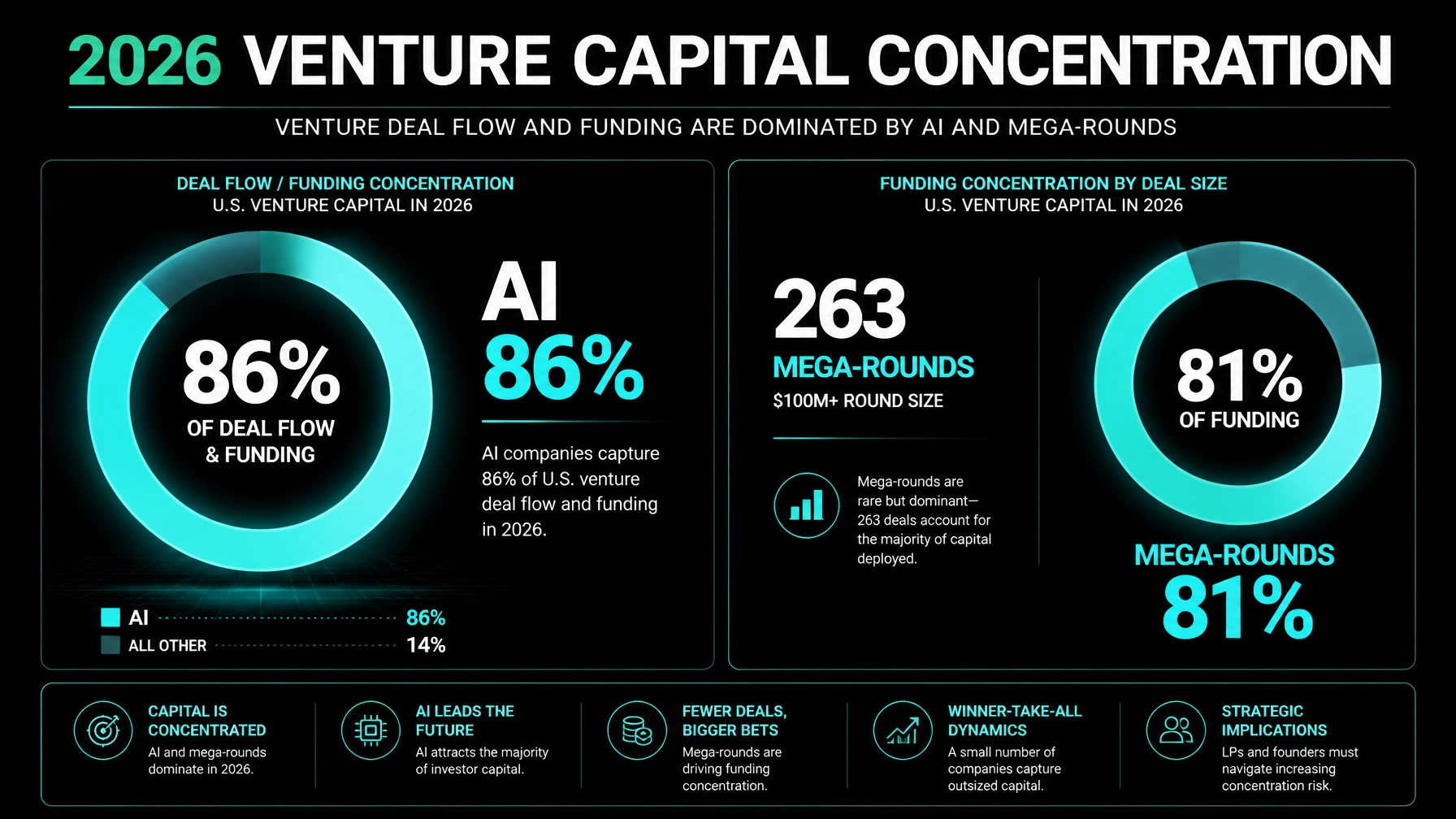
    The venture market is producing record headline numbers, but access to that capital is highly concentrated. Global venture funding reached approximately $510 billion in the first half of 2026. AI companies captured approximately 86% of deployed U.S. venture dollars, while 263 mega-rounds represented approximately 81% of total funding in the period reported by market analysts.

    The result is a two-level market: a small number of AI companies receiving extraordinary rounds, and a much larger group of startups and mid-sized companies competing for attention, disciplined checks, strategic investors, government resources, contracts, and revenue-based growth.

    You can still raise capital. But you must raise it with a complete strategy.

    The 2026 Market Is Concentrated : Not Closed

    The first mistake is assuming that a record funding year means capital is broadly available. It does not.

    Capital is moving toward a limited number of companies with:

    • Artificial intelligence infrastructure;
    • Proprietary data;
    • Large enterprise contracts;
    • Rapid revenue growth;
    • Strong retention;
    • Defensible technology;
    • Experienced management teams;
    • Large addressable markets;
    • Clear paths to substantial financial return.

    AI has captured the largest share of attention because investors expect major changes across nearly every industry. But investors are not funding every company that adds an AI feature. They are funding companies that can prove why their technology matters, why customers will pay, and why competitors cannot easily duplicate the result.

    If you are not an AI company, you must not pretend to be one. You must show why your business solves an enduring problem, produces measurable value, and can generate attractive returns with disciplined use of capital.

    If you are an AI company, you must show more than a demonstration. You must show proprietary data, customer adoption, gross margin, retention, distribution, security, compliance, and a credible operating model.

    The market is not rewarding general statements. It is rewarding evidence.

    Step One: Define the Capital You Actually Need

    Companies often begin fundraising by asking, “Who will invest in us?”

    The better question is: What type of capital will move the company to its next measurable milestone?

    A venture round may be appropriate. It may also be only one part of the answer.

    Your capital plan can include:

    • Venture capital;
    • Angel investors;
    • Strategic corporate investors;
    • Family offices;
    • Private equity;
    • Equipment financing;
    • Bank financing;
    • Federal grants;
    • State and local economic development programs;
    • Research and development funding;
    • Government contracts;
    • Commercial revenue;
    • Joint ventures;
    • Licensing;
    • Acquisitions or strategic partnerships.

    Venture capital is generally designed for companies with high growth potential and a path toward a major liquidity event. Federal and State funding may support research, product development, workforce expansion, infrastructure, or commercialization. Government contracts can create revenue, customer validation, and operating scale without requiring the same level of equity dilution.

    This is why a founder should not approach fundraising as a single transaction. You need a capital architecture.

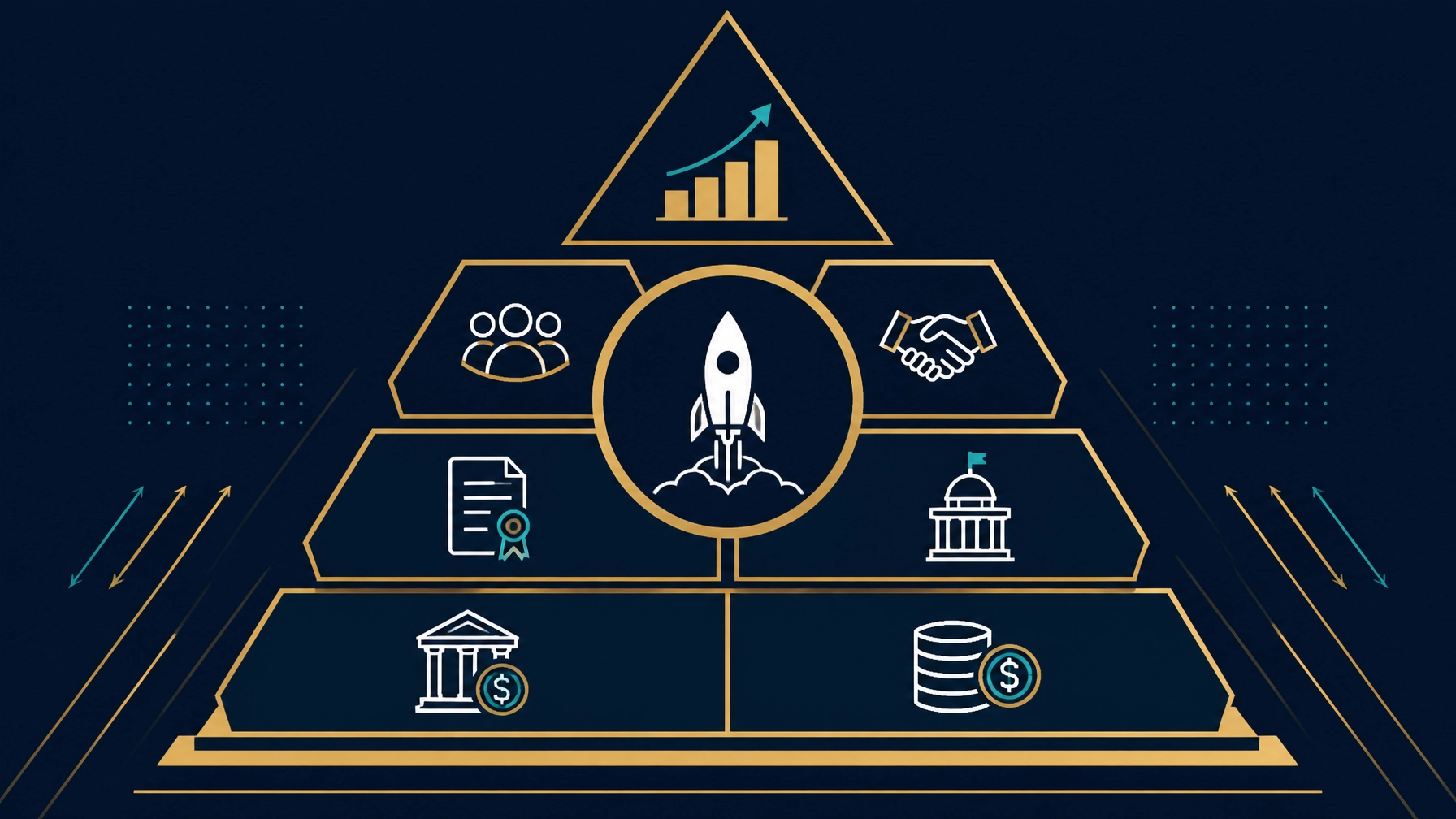
    Professional capital architecture infographic showing venture capital, strategic investors, government funding, contracts, grants, revenue, and partnerships working together in a complete capital plan

    Step Two: Build an Investor-Ready Business Case

    In a concentrated market, your materials must answer the investor’s questions before the investor asks them.

    Your business plan, presentation, financial model, and data room should clearly establish:

    1. The problem: Who has the problem and what does it cost them?
    2. The solution: What do you provide and why is it better?
    3. The market: How large is the opportunity?
    4. The customer: Who pays, how much, and how often?
    5. The traction: What revenue, contracts, users, retention, or partnerships exist?
    6. The economics: What are your gross margins, customer acquisition costs, payback period, and lifetime value?
    7. The competition: Why will you win?
    8. The management: Why does your team have the expertise to execute?
    9. The capital request: How much are you raising?
    10. The use of funds: What will the money accomplish?
    11. The milestone plan: What will be true 12 to 18 months after the investment?
    12. The return: How can the investment become substantially more valuable?

    An investor does not want to fund uncertainty without a plan for reducing it.

    If you are raising a seed round, explain the milestones that lead to your next round. If you are raising a Series A, demonstrate repeatable sales, customer retention, and a growing commercial engine. If you are a mid-sized company seeking expansion capital, show contracts, operating history, margins, acquisition opportunities, and the exact use of new capital.

    A clean data room should include your cap table, financial statements, tax records, customer contracts, intellectual property records, employment agreements, organizational documents, forecasts, and material litigation or regulatory information.

    Preparation communicates management quality.

    Step Three: Stop Chasing Only the Largest Venture Funds

    The largest fund is not automatically the right fund.

    In 2026, many brand-name investors are concentrating their attention on frontier AI, infrastructure, and very large later-stage rounds. That does not mean they are the best source of capital for your company.

    Develop a target list based on:

    • Investment stage;
    • Check size;
    • Industry focus;
    • Geography;
    • Partner relationships;
    • Portfolio conflicts;
    • Follow-on capacity;
    • Recent investments;
    • Strategic value;
    • Government or corporate relationships;
    • Experience with your type of commercialization.

    Target 50 to 100 potential investors. Separate them into priority groups. Identify 10 to 15 investors who are highly aligned with your business and seek introductions through customers, advisors, board members, attorneys, accountants, industry executives, existing investors, and strategic partners.

    A warm introduction is useful, but a strong investment case is decisive.

    Run the process in a compressed schedule. Hold meetings within the same one- to two-week period when possible. Follow up within 24 hours. Send requested information promptly. Provide progress updates every two to three weeks. Maintain a written record of each conversation, concern, request, and next action.

    Fundraising is a campaign. It requires command, timing, discipline, and follow-through.

    Step Four: Use Government Funding and Contracting as a Capital Strategy

    Founders frequently overlook Federal and State resources because they believe venture capital is the only serious form of growth capital.

    That is a costly mistake.

    Federal contracting remains a substantial market for qualified small businesses. The SBA reported that in FY2025, small businesses received approximately $179 billion in prime federal contract awards, representing nearly 28% of eligible prime contracting dollars. Including prime contracts and subcontracts, the total was approximately $273 billion.

    Some market reports use figures near $195 billion and cite set-aside access above 48%, depending on whether they are measuring prime awards, subcontracts, solicitations, categories, or a specific agency program. These figures should be defined carefully before they appear in an investor presentation. The opportunity is real, but so are the requirements.

    Federal and State contracting can support a broader capital plan through:

    • Paid pilot programs;
    • Research and development contracts;
    • Commercialization opportunities;
    • Agency partnerships;
    • Small business set-asides;
    • State procurement;
    • Technology demonstrations;
    • Manufacturing and infrastructure programs;
    • Subcontracting relationships;
    • International government and business opportunities.

    Compliance costs are rising. Registration, certifications, cybersecurity, accounting systems, proposal controls, contract terms, labor requirements, and reporting obligations must be managed correctly.

    This is where strategy matters. A government opportunity is not valuable merely because it exists. Your company must be qualified, positioned, compliant, capable of performing, and connected to the right acquisition path.

    Step Five: Present a Specific, Defensible Investment Thesis

    Your pitch must answer one central question:

    Why should this investor place capital with your company instead of the hundreds of AI opportunities already in the pipeline?

    Your answer should be specific.

    You may be:

    • A non-AI company with dependable recurring revenue;
    • A vertical software company with deep customer relationships;
    • A defense or aerospace company aligned with Federal priorities;
    • A healthcare company solving a measurable operational problem;
    • A manufacturing company with contracts and expansion capacity;
    • An infrastructure company supporting data, energy, logistics, or communications;
    • An AI company with proprietary data and a clear commercial wedge;
    • A mid-sized company ready for acquisition or geographic expansion.

    Do not lead with a general vision. Lead with the commercial facts.

    Show the customer. Show the contract. Show the margin. Show the repeatability. Show the market. Show the barrier to entry. Show the use of funds. Show the return.

    Polished five-step infographic showing how to win capital in a concentrated 2026 market: define capital need, build investor case, target the right funds, use government strategy, and present a defensible investment thesis

    The Infinity Group Approach: Business Development Architecture From A to Z

    The Infinity Group was formed in 1994 and has provided business development support for more than 30 years. Our primary focus is the Washington Metropolitan Area, with relationships involving industry, Federal agencies, and Congress. Our partners include industry executives and retired military officers from the Army, Air Force, Navy, and Marines.

    Our associates complete coverage across Federal agencies, U.S. Congress, State and local governments, international governments, and international businesses.

    That breadth matters when you are raising capital in a concentrated market.

    We can help develop the business plan, identify investment capital, organize the management strategy, establish the marketing plan, identify customers, develop government opportunities, support technical requirements, evaluate acquisitions, coordinate international business development, and prepare the company for larger financing, an IPO, or a sale.

    We can support private-sector capital and government-sector resources. We can help determine which path should come first, which paths can operate together, and which milestones will create the strongest financial position.

    Our specialties include business plans, investment capital, marketing, strategies, government relationships, international business development, mergers and acquisitions, technical support, and IPO preparation. Our government expertise covers major Federal departments, defense organizations, NASA, transportation, justice, commerce, health, homeland security, and Congress.

    Companies need a plan. We have that expertise.

    Companies need capital. We can identify private, Federal, State, local, and strategic sources.

    Companies need customers and revenues. We will support the strategy to identify and win new business.

    Companies need technical and operational support. We can provide it directly or through our partners.

    Companies need execution from beginning to end. We are Business Development Architects.

    Raise Capital With a Complete Plan

    The question is not whether your company can compete with the largest AI financings.

    The question is whether you have built a strategy that allows the right investor, agency, customer, or strategic partner to recognize your value.

    Is a $50,000 investment in strategy, preparation, relationships, and execution worth revenues of $500,000, $1 million, $2 million, and more?

    The answer depends on the plan and the execution.

    We have the experience, contacts, and capability to help fulfill your business needs at reasonable costs. Contact The Infinity Group to discuss your company, your capital requirements, your target market, and the next steps.

    YES. YES. YES.

    CAPITAL NEEDS A STRATEGY.
    STRATEGY NEEDS EXECUTION.
    BUSINESS IS OUR BUSINESS.