
In military strategy, commanders do not deploy every resource at once. They match personnel, equipment, timing, and supply lines to the objective. Mid-sized businesses require the same discipline when planning growth.
Capital is not simply money added to a bank account. It is a strategic resource that must match your milestones, cash flow, repayment capacity, ownership objectives, risk tolerance, and execution plan. The right capital can help you expand capacity, enter a new market, pursue an acquisition, fulfill a major customer order, or compete for government business. The wrong capital can restrict operations, create unnecessary dilution, or place repayment pressure on a company before the underlying growth is ready.
The Infinity Group helps businesses evaluate these decisions from A to Z. We are Business Development Architects supporting business plans, investor readiness, capital-source identification, Federal and State opportunities, partnerships, and strategic execution.
The Current Market Rewards Specificity: Not Noise
The August 2026 Crunchbase roundup of large announced U.S. funding rounds illustrates both the scale of available capital and the importance of perspective. The roundup included Castelion’s $800 million equity financing alongside $250 million in debt, Etched’s $700 million round, Higgsfield’s $400 million financing, Groq’s $350 million raise, Muon Space’s $250 million round, and other substantial transactions.
These announcements show that investors continue to fund defense, advanced manufacturing, infrastructure, satellites, mobility, healthcare, and technology. They also show how capital can be layered: Castelion’s financing included both equity and debt rather than relying on a single source.
However, large announced deals are not representative of all companies. They are selected examples from the upper end of the market. Your business should not use a $250 million or $800 million transaction as a direct valuation, funding, or growth benchmark. The useful lesson is structural: investors and lenders are matching capital to market opportunity, operating capability, strategic importance, and credible execution.
Your capital strategy must be built around your company: not around the largest headline.
Read the August 2026 Crunchbase funding roundup.
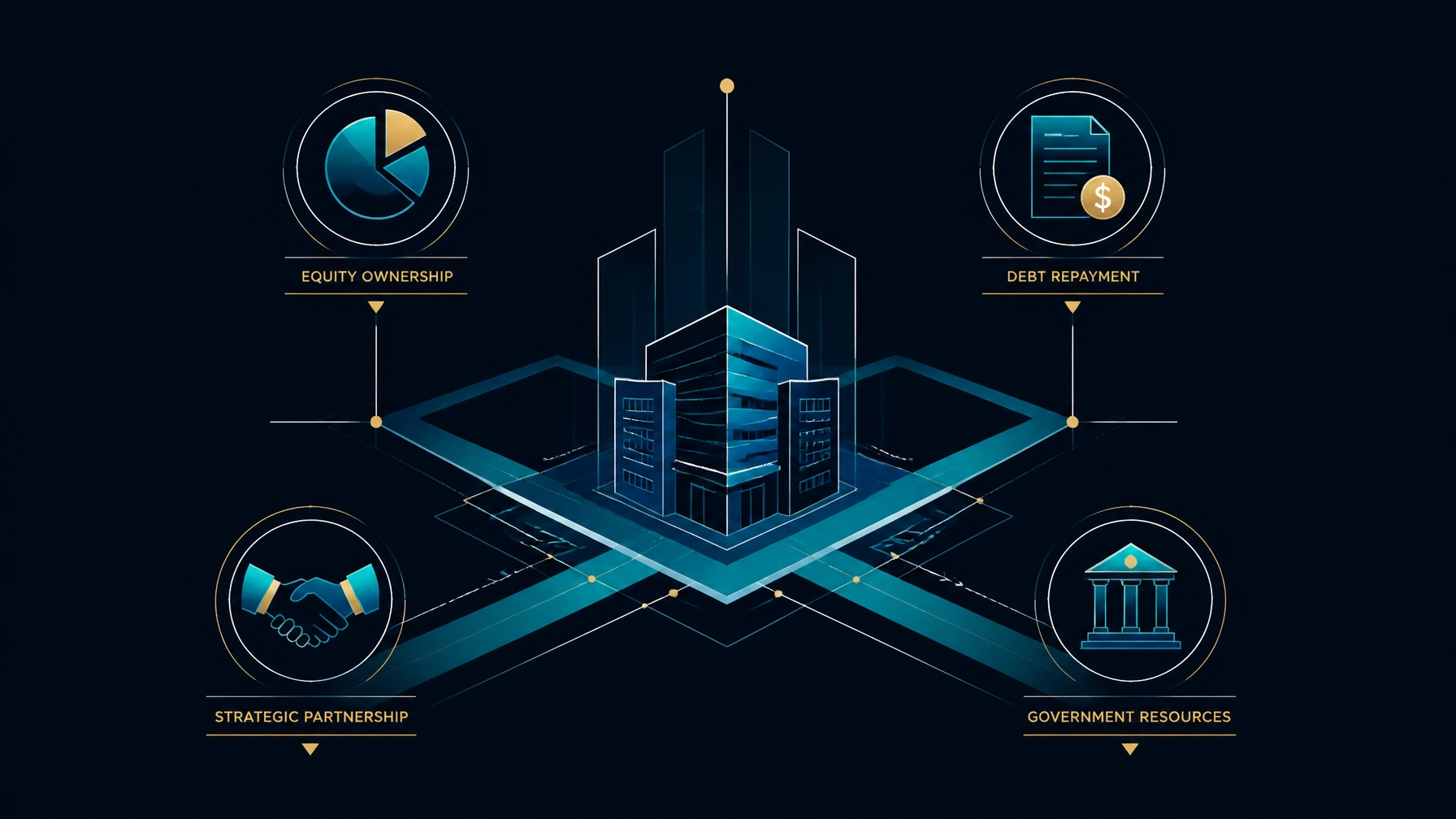
1. Equity Investment and Venture Capital
Equity investment provides capital in exchange for ownership. It does not require scheduled principal repayment, which can preserve cash for hiring, product development, sales, facilities, acquisitions, and market expansion.
Equity may be appropriate when:
- Your growth plan is larger than your current debt capacity;
- Cash flow is still developing or highly variable;
- The business requires substantial investment before revenue increases;
- An investor can contribute customers, relationships, expertise, or follow-on capital;
- You are pursuing a major market opportunity with a credible path to scale.
Venture capital is a specialized form of equity. It is generally most appropriate for businesses capable of rapid, large-scale growth in a market that can support venture returns. A stable services company, regional manufacturer, or mature distribution business may need growth equity or private equity rather than traditional venture capital.
The tradeoff is dilution. You are exchanging a portion of future ownership and control for capital and, ideally, strategic value. Terms matter as much as valuation. Governance rights, preferred shares, liquidation preferences, information rights, protective provisions, and future financing rights should be reviewed as part of the complete transaction.
We help companies prepare business plans, investor presentations, financial narratives, use-of-funds schedules, and milestone plans that allow potential investors to evaluate the opportunity with greater clarity.

2. Debt and Repayment Capacity
Debt allows a business to raise capital without giving up ownership. The obligation is repayment, with interest, under agreed terms.
Debt is commonly used for:
- Working capital;
- Equipment and facilities;
- Inventory;
- Expansion;
- Acquisitions;
- Refinancing;
- Purchase-order or contract fulfillment.
Traditional bank loans, asset-based lending, private credit, senior secured loans, and unitranche facilities can all serve mid-sized companies. SBA-backed financing may also provide useful options for eligible businesses. The SBA identifies 7(a) loans as its primary long-term financing program, while 504 loans provide long-term, fixed-rate financing for qualifying growth and fixed-asset needs.
Debt should be matched to predictable cash flow. A company with recurring revenue, reliable margins, quality receivables, and appropriate collateral may support more leverage than a company dependent on a few uncertain contracts.
Before borrowing, management should calculate:
- Monthly debt service;
- Minimum cash reserves;
- Existing obligations;
- Customer concentration;
- Best-case, expected, and downside revenue;
- Working-capital requirements;
- Covenant and collateral implications;
- The effect of delayed customer payments.
A loan can support growth. It cannot correct an unclear business model, weak collections, or an underdeveloped sales pipeline.
3. Revenue-Based Financing and Customer-Funded Growth
Revenue-based financing provides capital in exchange for a percentage of future revenue until an agreed repayment amount is reached. It generally does not require traditional equity dilution, and payments may rise or fall with revenue.
This structure can be useful for companies with:
- Recurring or highly visible revenue;
- Strong gross margins;
- A demonstrated customer base;
- A clear use for near-term growth capital;
- Limited interest in selling ownership.
The cost and repayment mechanics must be reviewed carefully. A percentage of revenue can reduce cash available for operations during a growth period. The company should compare the effective cost with alternatives, including a bank facility, strategic investment, or customer-funded expansion.
Customer-funded growth is another important source of capital. It may include deposits, prepaid contracts, milestone billing, annual commitments, purchase orders, licensing advances, subscriptions, or shared development arrangements. These structures can reduce the amount of outside capital required.
Companies need to ask customers for more than a purchase. They can structure commercial relationships that support production, staffing, implementation, and delivery: while ensuring the contract terms, service obligations, refunds, and working-capital requirements are fully understood.
4. Strategic Investors and Partnerships
A strategic investor may provide capital while also creating access to customers, distribution, manufacturing, technology, supply chains, talent, or government markets.
The right strategic partner can help you:
- Enter a new geography;
- Expand distribution;
- Meet a major customer requirement;
- Strengthen production capacity;
- Add technical or operational capability;
- Pursue a Federal or State opportunity;
- Support an acquisition or joint venture;
- Improve credibility with other capital sources.
Partnerships can also be structured without an immediate equity investment. Joint ventures, licensing arrangements, contract manufacturing, teaming agreements, channel partnerships, co-development agreements, and supplier financing may all support growth.
The key is alignment. A strategic partner should have a defined role, measurable responsibilities, appropriate access to information, and a shared understanding of commercial objectives. A partnership based only on introductions is not a growth strategy. It must connect relationships to capability and execution.

5. Government Resources and Government Contracts
Government resources should be evaluated as part of a broader capital plan: not treated as guaranteed funding.
The SBA states that more than 300 Small Business Investment Companies, or SBICs, are licensed to invest in small businesses through debt, equity, or a combination of both. SBICs may be relevant for mature, profitable companies that meet applicable size, ownership, industry, and U.S. operating requirements.
Government-backed lending, SBIC investment, export assistance, research programs, State economic-development programs, and targeted grants may provide additional support. Eligibility varies substantially. The SBA also makes clear that it does not generally provide grants for starting or expanding an ordinary small business. Certain programs support scientific research, exporting, manufacturing assistance, and community organizations.
Government contracts are not capital in themselves, but they can strengthen a company’s revenue base and support future financing when the business is positioned to perform. Contract pursuits require capability alignment, registration, compliance, pricing discipline, working capital, proposal preparation, and delivery capacity.
The Infinity Group brings more than three decades of experience involving Federal agencies, Congressional stakeholders, government procurement, program development, and commercial organizations pursuing government-facing growth. Through our government expertise, we help clients evaluate agencies, requirements, stakeholders, competitive conditions, teaming options, and practical paths to market.
We also support business growth strategy and consulting engagements that connect capital planning with market development.
6. Match Capital to the Milestone
Capital should arrive because the business is ready for a defined next step.

A practical framework looks like this:
| Business milestone | Potential capital sources |
|---|---|
| Stabilize operations and working capital | Bank debt, SBA-backed loan, customer deposits |
| Add equipment or facilities | 504 financing, equipment debt, asset-based lending |
| Fulfill a large order | Purchase-order financing, receivables financing, customer-funded growth |
| Expand sales and capacity | Growth equity, strategic investor, revenue-based financing |
| Pursue a government contract | Working-capital facility, teaming partner, contract financing |
| Complete an acquisition | Senior debt, private credit, mezzanine capital, equity |
| Enter a new market | Strategic partnership, joint venture, growth equity, State resources |
This framework is not a substitute for diligence. It is a starting point for disciplined analysis.
You should also determine how much capital is required, when it is required, what result it must produce, and what happens if the milestone is delayed. Funding too early can create unnecessary dilution or repayment costs. Funding too late can cause missed contracts, strained vendors, delayed hiring, and lost market position.
Build the Capital Plan Before You Need the Capital
Mid-sized companies need more than a list of lenders and investors. They need a capital plan connected to business development, financial performance, customers, contracts, partnerships, and execution.
We can support your business plan, investor readiness, capital-source identification, debt and equity analysis, government opportunity development, Federal and State research, strategic partnerships, and long-term growth planning. We will help organize the work from beginning to end, at reasonable costs and with clear next steps.
There are no guarantees of funding, return on investment, contract awards, or business outcomes. The objective is stronger preparation, better positioning, and a more informed capital decision.
Is the cost of a disciplined capital strategy reasonable when it can help you preserve ownership, protect cash flow, reach better capital sources, and pursue substantially larger commercial opportunities?
The answer depends on the quality of the plan and the execution that follows.
Contact The Infinity Group or email connect@infinity-us.com to discuss your capital requirements, growth objectives, government opportunities, or strategic partnership plans.
CAPITAL WITH A PLAN.
STRATEGY WITH EXECUTION.
BUSINESS DEVELOPMENT ARCHITECTS : FROM A TO Z.
Sources
- Crunchbase News: Biggest Funding Rounds in the U.S. : August 2026
- U.S. Small Business Administration: Loans
- U.S. Small Business Administration: Investment Capital and SBICs
- U.S. Small Business Administration: Grants
- U.S. Small Business Administration: Federal Contracting Guide
- The Infinity Group: Government Expertise
- The Infinity Group: Business Growth
- The Infinity Group: Consulting Services
