
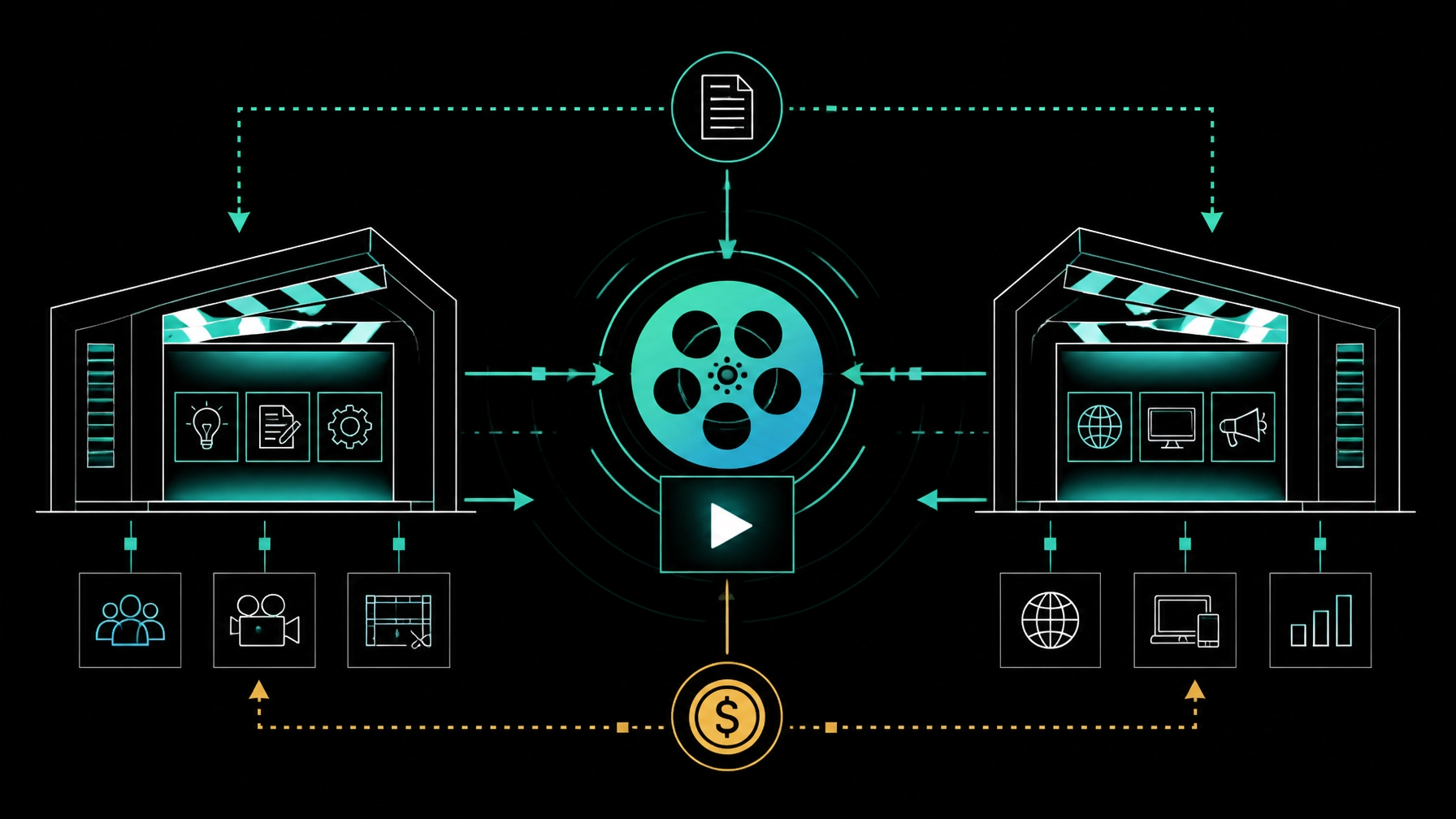
In military strategy, an objective is not secured by force alone. It is secured by planning, logistics, command structure, timing, and disciplined allocation of resources. The same principle now governs the modern media business.
A strong series, film, podcast, or digital property requires more than creative talent. It requires rights strategy, financing commitments, production capacity, distribution access, marketing support, delivery discipline, and a clear path to revenue. The emerging co-production economy is built around bringing those capabilities together.
A recent agreement reported by Deadline illustrates this shift. Netflix and AMC Studios have agreed to jointly develop and produce original series, with Bannerman: from Shane Black and Craig Silverstein: as the first project identified under the arrangement.
The specific deal is not a universal template. It is, however, a useful case study in how established media companies can share risk, preserve strategic value, and expand distribution without requiring one party to control every element.
The Netflix–AMC Structure: A Shared Project With Deliberate Windows
According to Deadline, AMC Studios will serve as lead studio on Bannerman. The series will premiere on AMC in the United States and Canada, then become available on Netflix in those territories 90 days after the season finale airs.
In Australia, New Zealand, and Spain, Netflix and AMC will jointly debut each episode. Netflix will carry the series exclusively in other international territories.
That is not simply a production arrangement. It is a coordinated allocation of:
- Development responsibility
- Production leadership
- First-window value
- Streaming distribution
- International exposure
- Audience acquisition
- Platform identity
- Revenue opportunity
- Long-term franchise potential
AMC maintains a meaningful first-window role in its core North American market. Netflix receives a defined second window in the United States and Canada, joint exposure in selected territories, and exclusive international distribution elsewhere.
This structure allows each partner to contribute what it already does well. AMC brings studio infrastructure, development history, creative relationships, and a recognizable premium-drama brand. Netflix brings global reach, streaming scale, audience data, and international availability.

Co-Production Is Not the Same as Licensing
The distinction between co-production and licensing is central.
In a licensing arrangement, one company generally acquires rights to distribute content that another company has already produced or controls. The license may be exclusive, nonexclusive, co-exclusive, limited by territory, or limited by time.
The licensee pays for access. The rights holder receives consideration and retains some degree of ownership or control, depending on the agreement.
In a co-production arrangement, the parties participate earlier and more deeply. They may jointly develop the project, commit production resources, share approvals, coordinate financing, divide territory rights, and agree in advance on distribution windows.
The risk is shared earlier. So is the opportunity.
The Netflix–AMC relationship already includes major licensing activity. Deadline reported that Netflix and AMC entered a five-year, approximately $500 million co-exclusive licensing agreement covering The Walking Dead universe. That arrangement is materially different from the Bannerman co-production.
One deal primarily monetizes an existing library and established intellectual property. The other creates a new production relationship around a developing project.
Both structures can be valuable. They solve different business problems.
How Co-Production Allocates Risk
A well-structured co-production can divide risk across several categories.
Development risk
Development risk exists before cameras begin to roll. The project may face script delays, creative changes, packaging challenges, talent availability issues, or uncertainty about audience positioning.
Partners can reduce this risk by agreeing on:
- Who controls development
- Who funds development expenses
- Which approvals are required
- How many drafts or development stages are expected
- What happens if the project is not greenlit
- Whether development materials can be reused elsewhere
For producers and media startups, development capital should never be treated as an informal promise. It must be connected to milestones, deliverables, approvals, and a realistic schedule.
Production risk
Production risk includes budget overruns, delays, labor complications, location problems, insurance claims, post-production changes, and failure to deliver the agreed program.
A project evaluation should identify:
- The approved production budget
- Each party’s cash or in-kind contribution
- Completion-bond or contingency expectations
- Cost-overrun responsibility
- Production-management authority
- Delivery specifications
- Insurance and risk-management requirements
- Post-production control
The question is direct: if the budget increases by 10 percent, who pays, who approves the increase, and what rights change if the funds are not available?
Distribution risk
Distribution risk is the risk that the completed project does not reach the intended audience or does not receive adequate promotional support.
A co-production can allocate distribution responsibility by territory and platform. It can also establish minimum marketing commitments, launch timing, delivery dates, and consultation rights.
Distribution terms should address:
- First window
- Second window
- Subscription streaming
- Transactional streaming
- Broadcast or cable
- International licensing
- Airline, educational, or institutional use
- Physical media, where relevant
- Promotional clips and social-media rights
- Marketing approvals and obligations
The Bannerman structure demonstrates how windowing can preserve value for more than one platform. AMC receives the initial North American launch. Netflix receives a later streaming window. Other territories follow a different arrangement.
Windowing is not an afterthought. It is part of the project’s financial architecture.

A Practical Evaluation Framework for Producers and Investors
Before committing capital or accepting a co-production proposal, evaluate the project across nine areas.
1. Rights control
Confirm who owns or controls the underlying rights. This includes books, articles, characters, recordings, trademarks, likenesses, music, archival material, formats, and derivative works.
You should know what rights are controlled, for how long, in which territories, and subject to what restrictions.
2. Financing commitments
Separate firm commitments from expressions of interest. Identify cash contributions, tax-credit assumptions, presales, minimum guarantees, grants, loans, equity, in-kind services, and deferred compensation.
A financing plan should show the full capitalization of the project: not only the amount needed to begin production.
3. Delivery obligations
Define what must be delivered, when it must be delivered, and to what technical standard. A project can lose value when delivery materials are incomplete, late, or rejected by a platform.
Delivery obligations should include masters, captions, subtitles, music documentation, artwork, metadata, legal documentation, and promotional materials.
4. Territory
Map the world by territory. Do not assume that “global” means one uniform right.
Territory planning should identify:
- Countries included
- Countries excluded
- Local partners
- Language requirements
- Censorship or classification issues
- Existing rights conflicts
- Local marketing responsibility
5. Windowing
Build a written release sequence. A project may have different windows for theatrical, broadcast, premium streaming, ad-supported streaming, transactional platforms, international television, and library exploitation.
The timing between windows affects both audience growth and revenue value.
6. Recoupment
Establish how money flows back before profits are divided. The model should identify approved expenses, distribution fees, overhead, interest, sales commissions, reserves, and the order in which parties recoup their contributions.
Investors should ask to see a recoupment waterfall and sample performance scenarios. A project can generate substantial revenue while still producing limited distributable profit if the waterfall is poorly understood.
7. Governance
Determine who has authority over budget, casting, creative changes, vendors, release timing, marketing, licensing, and disputes.
Shared ownership without defined governance creates delay. Defined governance creates execution.
8. Contingency planning
Every serious media project requires a plan for failure points: a lead actor becomes unavailable, a location closes, financing is delayed, production is paused, a platform changes strategy, or a delivery date moves.
Contingency planning should cover replacement talent, alternate locations, reserve financing, schedule changes, revised distribution, and project wind-down.
9. Exit and continuation rights
A successful first season or first installment may create a franchise. The agreement should anticipate renewals, sequels, spinoffs, remakes, podcasts, books, merchandise, live events, and other derivative opportunities.
If the project succeeds, who has the right to continue it? If the partners disagree, what process applies?
The Broader Lesson for Media Startups
The co-production economy creates opportunities for companies that can present more than a creative idea.
Producers need a business plan. Studios need a capital and distribution strategy. Media startups need a credible rights position, operating budget, production roadmap, and defined audience. Investors need a transparent path from capital deployment to recoupment and return.
That is where preparation matters.
At The Infinity Group, we support producers, screenwriters, directors, production companies, broadcasters, and podcasters with project positioning, business planning, funding-source development, investor readiness, strategic relationships, and execution support.
Our entertainment and media practice is built around the business side of creative work. We help connect strategy, relationships, resources, and execution. We can also coordinate with appropriate financial, legal, technical, government, and industry professionals when specialized capabilities are required.
Our partner, Spokane Productions, brings full-service creative and production capabilities across film, video, live streaming, audio recording, mixing, mastering, podcasting, music, radio and television narration, ADR, and photography. That relationship supports a practical view of the production pipeline: from concept and packaging through execution and delivery.
We do not present the Netflix–AMC agreement as a form to copy. We use it as a reminder that the strongest media ventures are structured before the first major commitment is made.
Build the Structure Before You Chase the Opportunity
Companies need creative quality. We have that perspective.
Companies need capital strategy. We have that expertise.
Companies need production resources, distribution relationships, rights analysis, investor materials, business development, and disciplined execution. We can help assemble the plan from beginning to end: from A to Z.
The question for any producer or investor is practical: if a stronger rights position, better financing structure, improved distribution plan, and clearer recoupment model materially increase the project’s opportunity, what is the cost of failing to build that structure early?
The answer is usually larger than the cost of preparation.
If you are developing a film, television series, podcast network, digital media venture, or other entertainment project, contact The Infinity Group at connect@infinity-us.com. We will discuss your project, timeline, capital requirements, strategic needs, and next steps at reasonable costs.
CREATIVE PROJECTS NEED BUSINESS DISCIPLINE.
BUSINESS DISCIPLINE CREATES FUNDING AND GROWTH.
PLAN IT. STRUCTURE IT. DELIVER IT.
Sources
- Deadline: Netflix and AMC Studios Enter Co-Production Agreement for Bannerman
- Deadline: Bannerman Spy Books in Works for Television at AMC Networks
- Deadline: The Walking Dead Franchise Rights Renewed by Netflix in Five-Year Co-Exclusive Deal With AMC Global Media
- The Infinity Group: Entertainment & Media
- The Infinity Group: About
- The Infinity Group: Business Growth

Comments are disabled. Replies are disabled.